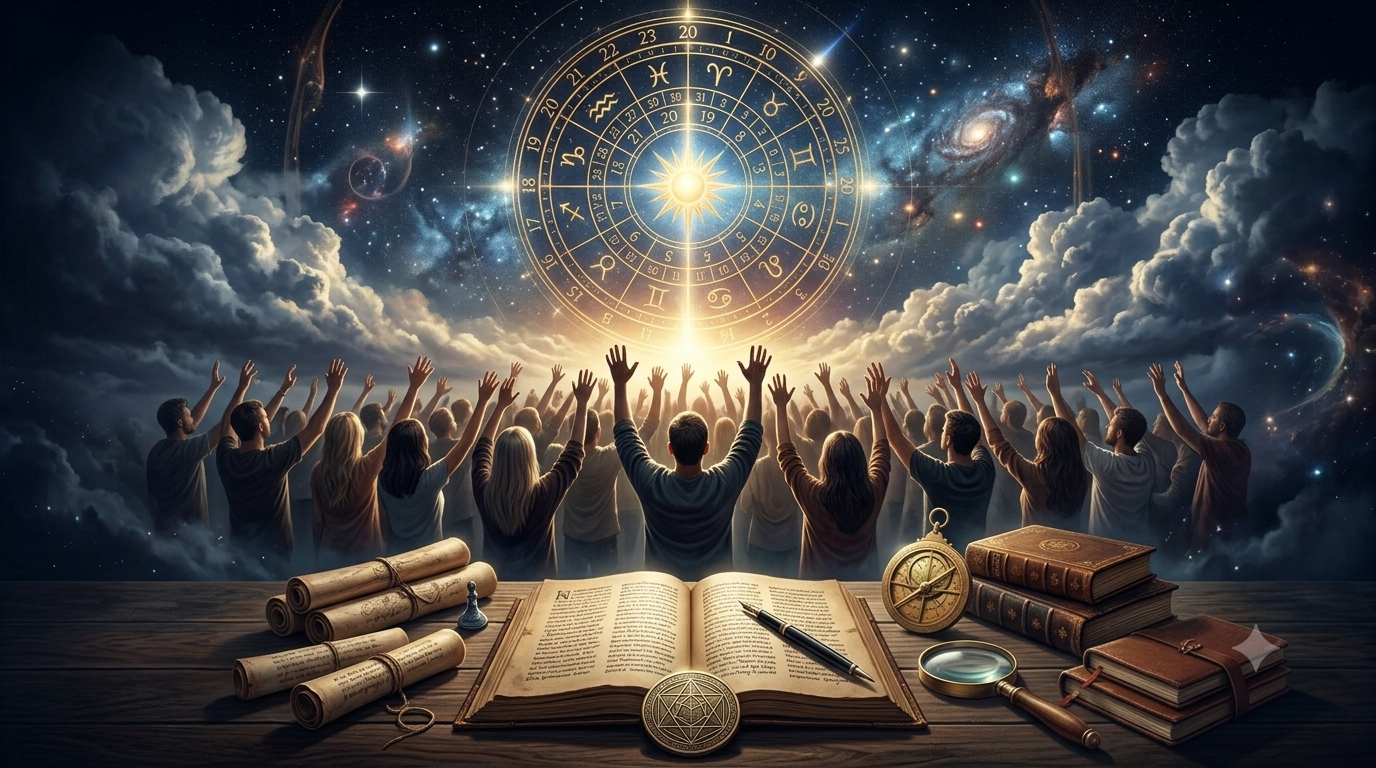
The ancient world possessed an understanding of the power of numbers with a depth and precision that much of modern mathematics has moved away from. Pythagoras (c. 570–495 BCE) taught that number was the fundamental principle underlying all things — To the Pythagoreans, numerical relationships were not simply a way of describing reality; they were the very structures that formed reality itself.
Aristotle discusses this idea in Metaphysics, explaining that for the Pythagoreans, the elements of number were the elements of all things, and that the entire cosmos — even the heavens themselves — was understood as a form of harmony, music, and number.
The authors of the Bible — or more precisely, the priestly traditions responsible for its compilation and structure — were aware of these principles and incorporated them into the text. They embedded numerical patterns, symbolic structures, and layers of meaning into a work that would become a mass-scale spiritual operation, amplified by the belief, devotion, and psychological energy of countless generations of practitioners — many of whom never realized they were participating in such a process.
This is why, from this perspective, the suppression of spiritual knowledge among ordinary people became so important. The same teachings that were pushed aside — meditation, energy practices, the creation and influence of thought-forms, numerology, sacred geometry, and the deeper mechanics of consciousness — were preserved and utilized by those who understood them.
When a population loses access to spiritual knowledge, only those who maintain that knowledge retain the ability to consciously work with it. This becomes the “death of knowledge” on a civilizational scale: not the complete disappearance of wisdom, but its concentration into the hands of those who understand how to use it.
“Prophecies” that appear to come true, from this viewpoint, are not necessarily evidence of divine prediction. They can also be understood as the result of directed collective psychic energy operating on a scale beyond ordinary awareness.
When billions of people believe something will happen, fear it, pray about it, visualize it, and emotionally invest in it repeatedly over centuries, that collective focus creates a powerful force. The concept of the egregore — a collective thought-form sustained by shared belief, attention, and emotional energy — describes this mechanism.
An egregore grows stronger according to the number of people feeding it and the intensity of their focus. Religious egregores, sustained by billions of people over thousands of years, would therefore represent some of the most powerful collective thought-forms humanity has ever created.
In this interpretation, the prophecy becomes part of the mechanism that brings about its own fulfillment. The belief creates the conditions. The expectation shapes behavior. The energy sustains the pattern.
This is a form of magic — not necessarily in the theatrical sense, but as the ancient understanding of consciousness, intention, symbolism, and will interacting with reality. People participate in it constantly, even if they simply call it “prayer.”
The Greek Magical Papyri (PGM, roughly 2nd century BCE to 5th century CE) document the deliberate use of repetition, numbers, focused intention, sacred names, correspondences, and emotional concentration to create desired outcomes.
The same structural principles appear throughout many sacred texts: repeated divine names, numerical patterns, symbolic associations, and emotionally charged invocations. The difference is one of scale. Ancient practitioners often used these methods individually for specific aims, while organized religious systems expanded similar mechanisms across millions or billions of people.
The collective force generated by such practices is immense, and according to this worldview, it influences both human consciousness and the reality people experience.
Recognizing prophecy as a technology of consciousness rather than simply a miracle can be a liberating realization. The future is not necessarily fixed. The narratives of apocalypse, judgment, and inevitable destruction may be understood as structures sustained by collective belief — patterns that continue as long as people continue to empower them.
Every person who withdraws their belief weakens the structure. Every person who redirects their attention toward spiritual growth, self-knowledge, meditation, and a direct connection with the divine forces they honor changes the balance of energy.
Stop feeding fear. Stop surrendering your awareness. Stop giving your power away.
Cultivate your own spiritual understanding through contemplation, knowledge, inner discipline, and a direct relationship with the sacred. The more people awaken to their own consciousness, the less power any external system built on fear and unconscious belief can hold.