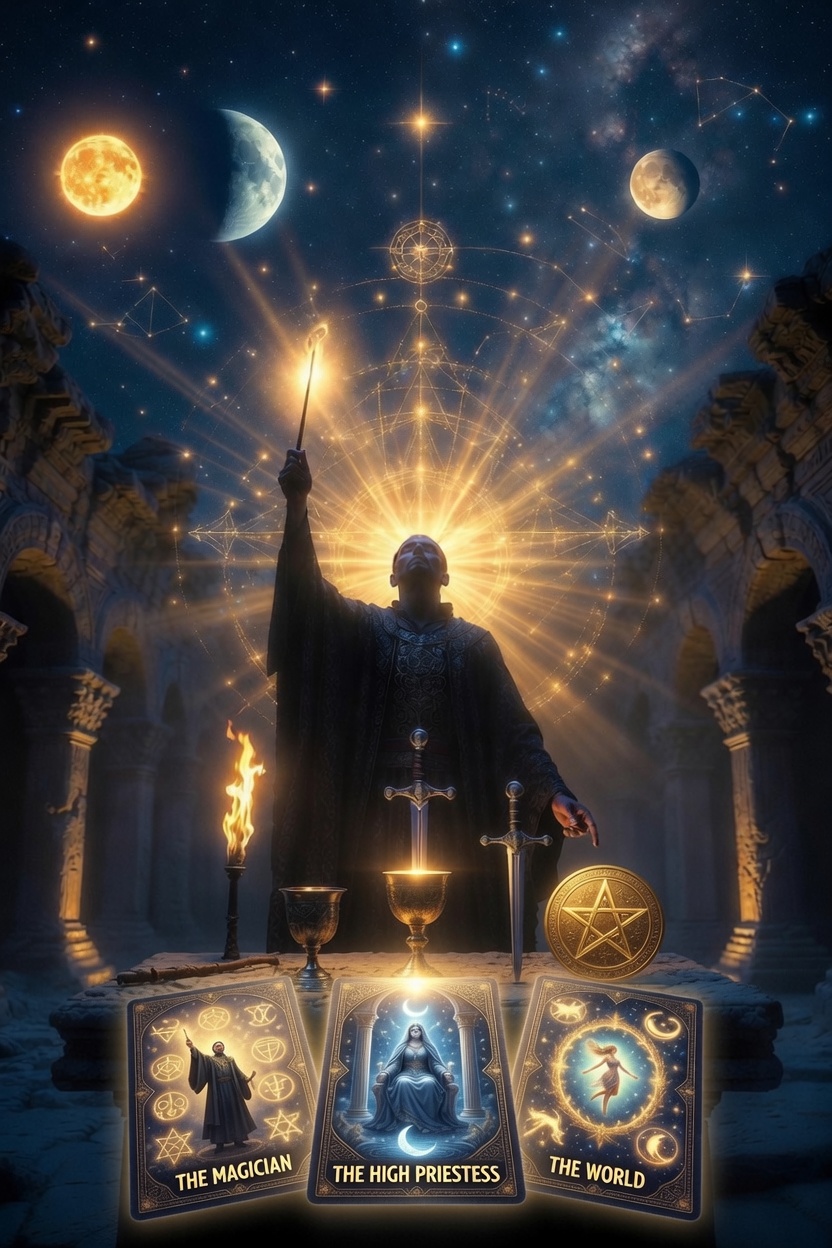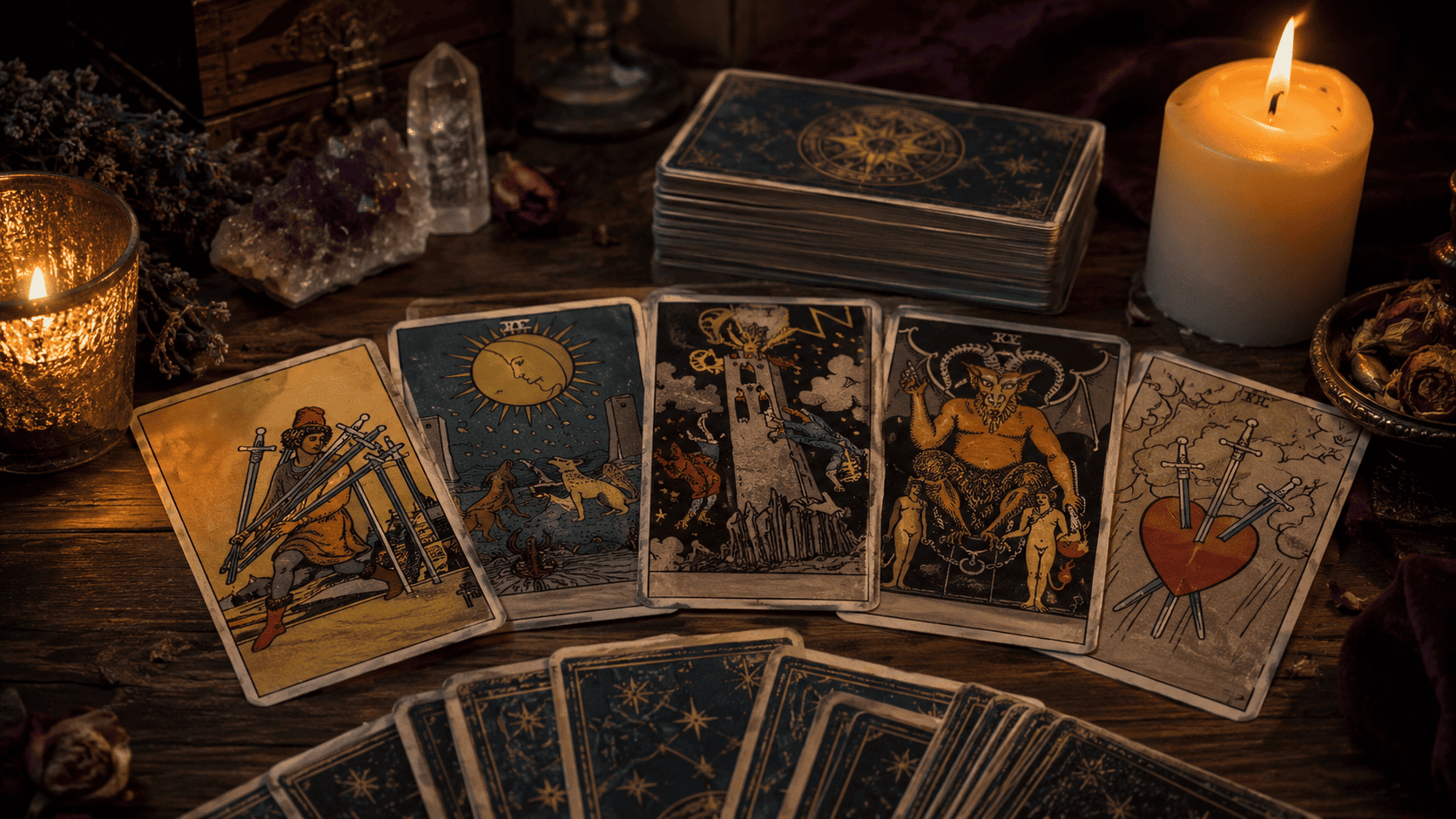
Tarot is often associated with insight, intuition, self-discovery, and answers to life’s biggest questions. A beautiful spread can reveal possibilities, hidden influences, emotional patterns, and opportunities that may not be obvious at first glance.
But tarot isn’t always comfortable.
Sometimes the cards seem to interrupt the reading with a warning.
A difficult combination can point toward secrecy, emotional instability, inconsistency, impulsive behavior, unhealthy attachment, or a situation that is becoming impossible to ignore. These are the moments when a tarot reading can feel less like a prediction and more like a mirror.
But what exactly counts as a tarot red flag?
And does seeing The Devil, The Tower, reversed Cups, or a troubling Sword combination automatically mean something terrible is going to happen?
Not necessarily.
A tarot card should rarely be interpreted in isolation. The question you asked, the position of the card, the surrounding cards, and the circumstances of the situation all influence its meaning.
A “red flag” in tarot is better understood as something worth examining more carefully.
The cards may be encouraging you to slow down, look beyond appearances, question an assumption, or pay attention to a pattern that you have been overlooking.
Here are five tarot warning signs that deserve a closer look.
What Are Tarot Red Flags?
A tarot red flag is a card, combination, or recurring theme that suggests there may be something beneath the surface of a situation that deserves attention.
In a relationship reading, for example, a red flag might involve:
- unclear communication
- secrecy or avoidance
- inconsistent behavior
- emotional unavailability
- unequal effort
- impulsive decisions
- unhealthy attachment
- repeated conflict
- unrealistic expectations
- difficulty letting go of a destructive pattern
However, there is an important distinction between a warning and a prediction.
If you pull the Seven of Swords, it doesn’t automatically prove that someone is lying to you.
If you pull The Devil, it doesn’t automatically mean that a relationship is toxic.
If you pull The Tower, it doesn’t necessarily predict disaster.
Tarot works through symbolism and context. The cards can encourage you to investigate a possibility without providing objective proof of another person’s intentions.
This is especially important when doing a tarot love reading.
Instead of asking:
“Does this card prove that they are cheating?”
A more useful question might be:
“What does this card suggest I should pay attention to in this relationship?”
That small change can transform the entire reading.
How to Recognize a Warning Sign in a Tarot Reading
Before looking at specific cards, there are several things to consider whenever a reading feels uncomfortable.
Look for Repeated Themes
One difficult card may simply represent a temporary obstacle.
Several cards expressing the same theme are more significant.
For example, imagine a reading containing:
- Seven of Swords
- The Moon
- Five of Swords
- Two of Pentacles reversed
You might notice a recurring theme of uncertainty, avoidance, conflict, and instability.
The important thing isn’t necessarily that each individual card is “bad.”
It’s that the cards are telling a similar story from different angles.
Consider the Question
The same tarot card can mean very different things depending on what you are asking.
The Devil in a career reading could describe unhealthy attachment to work, obsession with money, or feeling trapped in an unfulfilling situation.
The same card in a relationship reading might point toward attachment, dependency, temptation, or a difficult pattern between two people.
Context matters.
Pay Attention to Reversals
Reversed tarot cards can sometimes indicate blocked, internalized, delayed, excessive, or distorted expressions of a card’s energy.
They aren’t automatically negative.
A reversed card might describe something happening internally rather than externally, or an energy that is beginning to change.
Read Combinations
Tarot becomes especially interesting when cards interact.
The Seven of Swords alone might suggest avoidance.
The Seven of Swords alongside The Moon could emphasize uncertainty and things that aren’t fully visible.
The Seven of Swords alongside Justice could bring the themes of truth, accountability, and consequences into the reading.
The cards don’t exist independently.
They form a conversation.
1. Swords — Manipulation, Secrecy & Difficult Truths
The Suit of Swords is connected with the realm of the mind.
It can represent:
- thoughts
- communication
- truth
- decisions
- conflict
- perception
- logic
- mental struggles
Because Swords deal so strongly with communication and thought, they can become particularly important when you’re asking about honesty or interpersonal conflict.
Some Sword cards may function as tarot warning signs when surrounded by other difficult cards.
The Seven of Swords
The Seven of Swords is one of the most obvious cards to examine when questions of secrecy arise.
It can represent:
- avoidance
- secrecy
- withholding information
- acting indirectly
- strategic behavior
- escaping responsibility
But the card doesn’t automatically mean betrayal.
Sometimes the Seven of Swords describes someone avoiding a difficult conversation because they don’t know how to deal with it.
It can even represent your own tendency to avoid something you don’t want to confront.
The important question is:
What is being avoided?
If the card appears in a relationship tarot reading, look at the surrounding cards before reaching a conclusion.
The Five of Swords
The Five of Swords can highlight conflict, power struggles, arguments, and situations where “winning” becomes more important than maintaining harmony.
In some readings, it can describe someone who wants to be right at any cost.
In others, it may simply reveal that a conflict has become unnecessarily destructive.
If you’re repeatedly drawing the Five of Swords around a particular situation, ask yourself:
Is this conflict actually solving anything?
Swords and Communication
A major tarot red flag isn’t necessarily dishonesty.
Sometimes it’s communication that consistently leaves you confused.
When someone’s words and behavior repeatedly contradict one another, the cards may encourage you to stop focusing exclusively on what is being said and examine what is actually happening.
2. Reversed Cups — Emotional Instability & Mixed Signals
The Suit of Cups takes us into the emotional realm.
Cups are associated with:
- feelings
- relationships
- intuition
- emotional connection
- vulnerability
- affection
- emotional fulfillment
When Cups appear reversed, their energy can become blocked, distorted, internalized, or difficult to express.
This can be particularly significant in relationship tarot readings.
Two of Cups Reversed
Upright, the Two of Cups can represent connection, mutual attraction, partnership, and emotional exchange.
Reversed, it can point toward:
- emotional imbalance
- disconnection
- mismatched expectations
- relationship tension
- difficulty meeting each other halfway
The key theme is often lack of reciprocity.
One person may want something different from the other.
King of Cups Reversed
The King of Cups represents emotional maturity when upright.
Reversed, however, the card can suggest emotional instability, emotional suppression, manipulation, or difficulty managing feelings.
Again, context is essential.
The card doesn’t automatically describe a manipulative person.
It could just as easily describe someone who is overwhelmed by emotions but doesn’t know how to communicate them.
Eight of Cups Reversed
The Eight of Cups reversed can be especially interesting when you’re asking whether you should move on.
It may suggest difficulty leaving something behind, repeatedly returning to the same situation, or remaining emotionally attached to something that no longer provides fulfillment.
The question becomes:
Are you staying because the situation is genuinely healthy, or because letting go feels difficult?
3. Reversed Pentacles — Inconsistency, Broken Promises & Lack of Stability
Pentacles are connected with the tangible world.
They often relate to:
- stability
- work
- money
- reliability
- physical reality
- long-term foundations
- practical commitment
This makes Pentacles surprisingly useful for identifying a very specific kind of tarot red flag:
the gap between words and actions.
Someone can promise anything.
Pentacles ask whether those promises are actually being turned into something tangible.
Knight of Pentacles Reversed
The Knight of Pentacles is normally associated with patience, reliability, consistency, and steady progress.
Reversed, those qualities can become stagnation, laziness, inconsistency, or failure to follow through.
In a relationship reading, this might raise the question:
Is this connection actually moving forward?
Someone may talk about future plans while repeatedly doing nothing to make those plans real.
Six of Pentacles Reversed
The Six of Pentacles concerns giving and receiving.
Reversed, it can highlight:
- unequal exchange
- one-sided generosity
- taking without giving
- dependence
- power imbalances
Relationships don’t necessarily need to be perfectly equal every day.
Sometimes one person gives more because the other needs additional support.
But if the imbalance becomes a permanent pattern, it deserves attention.
Ten of Pentacles Reversed
The Ten of Pentacles is associated with long-term security and established foundations.
Reversed, it can point toward instability involving long-term plans, family expectations, financial matters, or conflicting visions of the future.
In a relationship reading, this can be a useful prompt:
Are we actually building toward the same future?
4. Reversed Wands — Impulsiveness, Hot-and-Cold Behavior & Emotional Chaos
The Suit of Wands brings a completely different energy.
Wands are associated with:
- passion
- desire
- motivation
- action
- confidence
- ambition
- enthusiasm
Wands can create tremendous momentum.
But when that energy becomes uncontrolled, it can also produce impulsiveness and instability.
Knight of Wands Reversed
The Knight of Wands reversed is one of the cards worth examining when a situation seems to move extremely quickly and then suddenly lose momentum.
It can suggest:
- impulsiveness
- inconsistency
- impatience
- rushing into situations
- lack of direction
- unreliable enthusiasm
In a love reading, this can sometimes correspond to the classic hot-and-cold dynamic.
Someone may appear intensely interested one moment and distant the next.
But rather than immediately labeling the person as unreliable, consider what the surrounding cards reveal.
Is the person genuinely confused?
Are they afraid of commitment?
Is the relationship moving too quickly?
Or is there simply not enough stability behind the initial attraction?
Page of Wands Reversed
The Page of Wands reversed can suggest enthusiasm without maturity or direction.
Someone may have exciting ideas but little intention of following through.
The card can therefore raise an important question:
Is this genuine intention, or simply temporary excitement?
Ace of Wands Reversed
The Ace of Wands reversed can indicate blocked momentum, false starts, frustration, or an opportunity that never develops into action.
Again, the message isn’t necessarily “walk away.”
Sometimes it is simply:
Slow down and see whether the energy becomes consistent.
5. The Devil + The Tower — Toxic Cycles & Sudden Breakthroughs
Few tarot combinations are as visually dramatic as The Devil and The Tower.
Both are powerful Major Arcana cards, and together they can describe a situation in which an unhealthy pattern is being brought into consciousness.
The Devil
The Devil is often associated with:
- attachment
- temptation
- obsession
- unhealthy patterns
- dependency
- fear
- feeling trapped
- compulsive behavior
The Devil can represent something that has gained too much power over you.
That doesn’t necessarily mean another person.
You can become attached to:
- an idea
- a relationship
- a habit
- a fantasy
- a fear
- a particular outcome
The card asks:
What has control over you?
The Tower
The Tower represents disruption.
It can symbolize:
- sudden change
- revelation
- collapse
- unexpected developments
- breaking down an unstable structure
- seeing something differently
Although many people fear The Tower, it isn’t inherently evil or destructive.
Sometimes something needs to change because its foundation was already unstable.
The Devil + The Tower Together
When these cards appear together, the reading can suggest that an unhealthy attachment or destructive pattern has reached a point where it can no longer remain hidden or unchanged.
It could describe:
- confronting an uncomfortable truth
- breaking an unhealthy cycle
- realizing that an attachment has become destructive
- sudden awareness
- the collapse of an unsustainable situation
- finally recognizing a pattern that has been repeating
The combination doesn’t have to mean catastrophe.
It can actually represent liberation.
The Tower can break the structure.
The Devil can reveal what was keeping you trapped inside it.
Are “Negative” Tarot Cards Always Bad?
One of the biggest mistakes beginners make when learning tarot is dividing the deck into two categories:
good cards and bad cards.
Tarot is much more nuanced than that.
Cards traditionally considered difficult can contain incredibly valuable messages.
Death
Death can represent endings, transformation, release, and transition.
It doesn’t mean literal death in an ordinary tarot interpretation.
The Tower
The Tower can represent disruption, but disruption can create the opportunity to rebuild on a stronger foundation.
The Devil
The Devil can reveal unhealthy attachment, but recognizing the attachment is the first step toward changing it.
Three of Swords
The Three of Swords can represent emotional pain or difficult truth, but acknowledging a painful truth may ultimately allow healing.
Ten of Swords
The Ten of Swords can represent the ending of a painful cycle.
And supposedly “positive” cards can also have challenging expressions.
The Lovers can involve difficult choices.
The Magician can represent skill and manifestation, but depending on context, it can also raise questions about how someone uses their abilities.
The Sun can bring illumination—which means something previously hidden may become impossible to ignore.
This is why experienced tarot readers don’t simply memorize:
“Card X = good.”
They ask:
“What is this card doing here?”
Tarot Red Flags in Love Readings
Relationship questions are some of the most common reasons people turn to tarot.
When reading about love, it can be tempting to search for one definitive card that tells you whether someone is “good” or “bad.”
A better approach is to examine several dimensions of the connection.
1. Communication
Are the cards showing openness and honesty, or avoidance and confusion?
Swords can be especially relevant here.
2. Emotional Availability
Are both people capable of expressing their feelings?
Reversed Cups may encourage you to examine emotional patterns more closely.
3. Consistency
Do someone’s actions match their words?
Pentacles can help you think about whether promises are actually becoming reality.
4. Impulsiveness
Is the relationship developing at a healthy pace, or does it repeatedly swing between intense excitement and withdrawal?
Wands can reveal this kind of energy.
5. Attachment
Is the connection based on genuine compatibility, or fear of being alone?
The Devil can be an important card when attachment becomes stronger than healthy choice.
6. Stability
Does the relationship have a foundation?
The Tower can appear when an existing structure is no longer sustainable.
The goal isn’t to use tarot to judge another person.
It’s to use the reading to ask better questions about the situation.
A 7-Card Tarot Spread for Identifying Red Flags
If you want to explore a relationship or situation more deeply, try this seven-card tarot spread.
Card 1 — What Am I Not Seeing?
What information may be outside my current awareness?
Card 2 — What Pattern Is Developing?
What recurring energy should I pay attention to?
Card 3 — What Is the Energy of the Other Person?
How are they approaching this situation?
This doesn’t give you literal access to another person’s private thoughts. Instead, interpret the card as symbolic information about the dynamic you’re observing.
Card 4 — What Should I Be Cautious About?
Where would it benefit me to slow down?
Card 5 — What Am I Overlooking?
What factor deserves greater attention?
Card 6 — What Boundary Would Help Me?
What could create greater clarity, balance, or emotional stability?
Card 7 — What Do I Need to Understand Before Moving Forward?
What larger lesson or perspective can you take from the situation?
This spread is particularly useful because it doesn’t simply ask:
“Is this person bad?”
Instead, it brings the focus back to awareness, boundaries, patterns, and your own choices.
Tarot Cards That Can Signal Relationship Warning Signs
Here is a quick reference guide:
| Tarot Card | Possible Warning Theme |
|---|---|
| Seven of Swords | Secrecy, avoidance, hidden motives |
| Five of Swords | Power struggles, destructive conflict |
| Three of Swords | Emotional pain, difficult truths |
| The Moon | Confusion, uncertainty, unclear information |
| Two of Cups Reversed | Emotional imbalance or disconnection |
| King of Cups Reversed | Emotional instability or poor emotional regulation |
| Knight of Wands Reversed | Impulsiveness, inconsistency |
| Six of Pentacles Reversed | Unequal exchange or imbalance |
| Knight of Pentacles Reversed | Lack of follow-through or stagnation |
| The Devil | Unhealthy attachment or dependency |
| The Tower | Sudden disruption or revelation |
Remember that these are possible interpretations, not fixed definitions.
A card’s meaning depends on the question, spread position, surrounding cards, and the larger story of the reading.
What Should You Do When Tarot Reveals a Red Flag?
This is where tarot becomes much more useful than simple fortune-telling.
Suppose you pull a troubling combination.
Don’t immediately panic.
Instead, ask yourself:
What am I actually observing?
Separate the symbolism from the facts.
What is happening in the real world?
Am I ignoring something because I want a particular outcome?
Sometimes our emotional investment makes it difficult to acknowledge information that contradicts what we hope will happen.
Are someone’s actions consistent with their words?
This is one of the most useful questions in any relationship reading.
Do I feel respected?
A tarot reading shouldn’t convince you to ignore how you are actually being treated.
Is the situation reciprocal?
Are both people contributing?
What boundary would create more clarity?
Sometimes the answer isn’t immediately “leave.”
Sometimes it’s simply to slow down, communicate clearly, stop over-investing, or give yourself enough space to observe what happens next.
Don’t Keep Pulling Cards Until You Get the Answer You Want
There is another tarot red flag that has nothing to do with the cards.
It’s over-reading.
Imagine asking:
“Does this relationship have potential?”
You pull a difficult card.
You don’t like the answer, so you pull another.
That card is confusing.
So you pull another.
Then another.
Eventually you have twenty cards on the table and several completely contradictory interpretations.
Instead of providing clarity, the reading has created anxiety.
A better approach is to establish a structure before you begin.
Try this:
1. Ask one clear question.
Avoid vague questions that can be interpreted in dozens of ways.
2. Choose a spread.
Know what each position represents before pulling your cards.
3. Read the entire spread.
Don’t obsess over the most frightening card.
4. Write down your initial interpretation.
Your first impression can sometimes be more useful than repeatedly changing the question.
5. Compare the reading with reality.
Tarot symbolism should not replace observation.
6. Give yourself time.
You don’t have to make an immediate decision simply because you received an uncomfortable reading.
The Most Important Tarot Red Flag May Be Ignoring Your Own Boundaries
There’s an interesting paradox in tarot.
People often ask the cards for answers because they don’t trust their own judgment.
But a powerful tarot reading doesn’t necessarily tell you what decision to make.
It can help you recognize why you’re struggling to make the decision yourself.
You may already know that something feels inconsistent.
You may already notice that communication is confusing.
You may already recognize that you’re giving more than you’re receiving.
You may already feel that a particular pattern isn’t healthy.
The cards can provide a symbolic language for exploring those feelings.
But they don’t take your agency away.
You still get to decide what you do with the information.
Final Thoughts: Tarot Red Flags Are Invitations to Look Closer
Tarot red flags aren’t necessarily predictions of disaster.
They are opportunities for awareness.
The Seven of Swords may encourage you to examine what is being avoided.
Reversed Cups may ask you to consider emotional imbalance.
Reversed Pentacles may draw attention to inconsistency between words and actions.
Reversed Wands may tell you to slow down and observe whether excitement becomes stability.
The Devil and The Tower may reveal an attachment or pattern that needs to change.
But none of these cards should automatically become a verdict.
The most powerful tarot readings don’t make you more frightened of the future.
They help you become more conscious of the present.
When a troubling card appears, don’t immediately ask:
“Is this a bad sign?”
Ask:
“What is this card asking me to notice?”
That question can completely change the way you approach tarot.
Because ultimately, the purpose of a tarot reading isn’t to surrender your choices to the cards.
It’s to see the situation more clearly—so you can make those choices with greater awareness.