A Hermetic Pagan Perspective
Many people draw tarot cards every day and yet remain at roughly the same level of understanding for years.
They learn the card meanings. They buy another deck. They watch another tarot tutorial. They memorize correspondences, spreads, reversals, astrology, numerology, and elemental associations.
And still, when the cards are placed before them, they sometimes find themselves asking:
“What am I actually looking at?”
The missing ingredient is often not more information.
It is reflection.
Tarot becomes dramatically more powerful as a spiritual and divinatory discipline when you stop treating each reading as something that happens and then disappears. When you record your readings, return to them, compare them with what actually happened, and contemplate the symbols over time, the cards begin to become part of your inner language.
This is the purpose of tarot journaling.
From a Hermetic Pagan perspective, journaling is more than keeping notes. It is an act of fixation: taking something subtle and volatile—an intuition, image, dream, impression, or revelation—and giving it form.
The insight becomes written.
The written becomes remembered.
The remembered becomes embodied.
And what is embodied becomes wisdom.
If you want to become a better tarot reader—and a more disciplined practitioner—faster, keeping a tarot journal may be one of the simplest practices you can adopt.
The Hermetic Reason Tarot Journaling Works
Hermetic philosophy repeatedly directs our attention toward the relationship between the visible and invisible.
The familiar principle of “as above, so below” can also be contemplated psychologically: what is impressed upon consciousness tends to become stronger through attention, repetition, and embodiment.
A tarot reading begins in a subtle place.
You shuffle.
You ask.
You observe.
Something catches your attention.
Perhaps it is a symbol you have never noticed before. Perhaps a particular card produces an unexpected emotional reaction. Perhaps you suddenly remember something from years ago.
If you simply put the cards away, much of that experience disappears.
But if you write it down, you have performed a small act of fixation.
The fleeting has been given form.
Your tarot journal therefore becomes more than a notebook. Over months and years, it can become a kind of personal Book of Thoth—a record of your evolving relationship with the symbolic language of tarot and, within a Pagan or Hermetic framework, with the divine powers, spirits, archetypal forces, and inner daemon you understand as participating in that language.
This distinction matters.
You are not merely recording what the cards supposedly mean.
You are recording what happened between you and the cards.
That is where genuine understanding begins.
Why Tarot Journaling Makes You Better Faster
1. It Sharpens Your Symbolic Sight
A beginner often looks at a tarot card and thinks:
“I know what this card means.”
A practiced reader asks:
“What exactly am I seeing?”
Those are very different approaches.
Take a card depicting water.
Instead of immediately writing Cups = emotions, describe the image.
Is the water calm or turbulent?
Is the figure looking toward it or away from it?
Is the sky bright?
What is happening with the hands?
What objects are present?
What number belongs to the card?
What colors dominate?
What is moving?
What is still?
Writing forces you to slow down.
You cannot hide behind vague impressions when you have to put them into words.
Over time, this develops what might be called symbolic sight: the ability to perceive details and relationships that previously remained invisible.
And this is one of the foundations of advanced tarot reading.
2. It Builds a Real Relationship with the Cards
There is a difference between memorizing tarot and developing a relationship with tarot.
A book can tell you that the Hermit represents withdrawal, contemplation, wisdom, and solitude.
But your journal may eventually reveal that whenever the Hermit appears for you, there is a particular question underneath it.
Perhaps it repeatedly appears before periods of study.
Perhaps it accompanies spiritual retreats.
Perhaps it emerges whenever you need to stop listening to other people’s opinions.
The card acquires personal history.
This is especially valuable within a Hermetic Pagan practice, where symbols may be approached as living gateways into contemplation rather than merely as printed pieces of cardboard.
When you consistently approach the cards with reverence, attention, and discipline, your relationship with their symbolic language becomes increasingly intimate.
3. It Reveals Patterns Invisible in Individual Readings
One tarot reading can be ambiguous.
One hundred readings are not.
Imagine recording your readings for six months.
At first, the entries seem disconnected.
Then you notice something.
The Eight of Cups appears repeatedly before major changes.
The Queen of Pentacles appears whenever you need to return to practical matters.
The Tower repeatedly appears when you resist something that has already begun collapsing.
The Moon appears whenever fear is distorting your perception.
These patterns may never have become obvious if the readings existed only in your memory.
Your journal turns isolated readings into a longitudinal record.
You begin seeing currents rather than moments.
And this is where tarot journaling becomes an extraordinary tool for developing discernment.
4. It Helps You Integrate Difficult Cards
Some cards frighten beginners.
Death.
The Devil.
The Tower.
Ten of Swords.
Five of Pentacles.
But writing about these cards changes your relationship with them.
Instead of reacting:
“This is a bad card.”
you can ask:
“What is this card actually asking me to confront?”
The Tower might become a lesson in liberation.
Death might become a meditation on impermanence.
The Devil might reveal attachment.
The Five of Pentacles might expose a belief about scarcity.
The difficult card becomes medicine.
This is profoundly alchemical.
The goal is not to eliminate darkness from your practice. It is to learn how to work with what appears in the darkness.
5. It Trains Memory and Will
There is another benefit that is easy to overlook.
Keeping a journal requires discipline.
You have to sit down.
You have to remember what happened.
You have to describe it honestly.
You have to return later and examine the result.
These are precisely the faculties that a serious magical practice demands.
Attention.
Memory.
Discernment.
Imagination.
Persistence.
Will.
A person who cannot remain attentive to a single tarot card for ten minutes will probably struggle to maintain sustained concentration during more elaborate magical work.
Tarot journaling therefore becomes training.
The notebook is not merely recording your practice.
The practice is training you.
6. It Creates a Feedback Loop
Perhaps the greatest advantage is the simplest.
You can check whether you were right.
Suppose you perform a reading on Monday.
You write down your interpretation.
On Friday, something happens.
You return to the entry.
Suddenly you see that the reading contained a warning you completely missed.
That realization is invaluable.
Likewise, perhaps you discover that an interpretation you were convinced was correct turned out to be projection.
Both outcomes teach you.
The journal creates a feedback loop:
Read → Record → Act → Observe → Review → Refine.
This is how intuition becomes discernment.
Without the feedback loop, intuition can easily become self-confidence masquerading as spiritual insight.
With it, you have evidence from your own experience.
What to Record in a Hermetic Pagan Tarot Journal
Your journal does not need to become an enormous bureaucratic exercise.
A simple structure is enough.
For each meaningful reading, consider recording:
- Date and time
- Moon phase
- Seasonal or astrological observations, when relevant
- Your question
- Your emotional state before the reading
- The spread and card positions
- The cards drawn
- Your immediate impressions
- Important symbols or visual details
- Elemental impressions
- Numerological or astrological correspondences
- Any deity, spirit, archetype, or presence you associate with the reading
- Bodily sensations or sudden memories
- Your interpretation
- The practical counsel received
- Any action or commitment you intend to make
- What eventually happened
The final category is particularly important.
Always leave room for reality to answer.
Your tarot journal should not merely contain predictions.
It should contain results.
Five Sacred Methods of Tarot Journaling
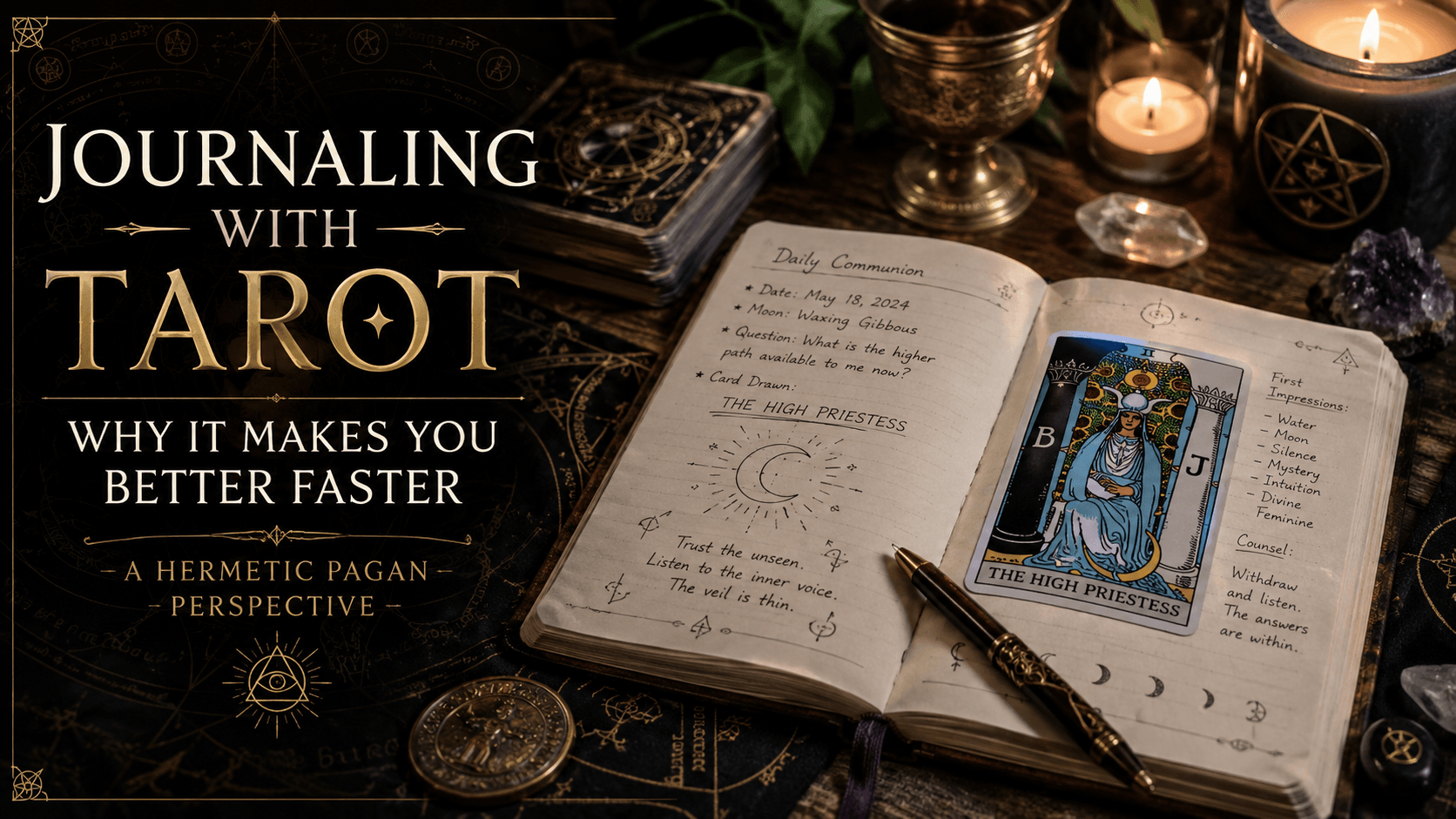
1. The Daily One-Card Communion
Each morning, draw one card.
Do not immediately consult a book.
Look at the card.
Write what you see.
Then ask:
“What quality should I embody today?”
At night, return to the page.
What happened?
Where did the card appear in your experience?
Did you notice its symbolism in an unexpected place?
This simple practice can transform your familiarity with the deck surprisingly quickly.
2. The Threefold Entry
After a reading, interpret it on three levels.
Intellectual
What does the card suggest according to traditional symbolism?
Emotional
What did the card make you feel?
Did you feel resistance, attraction, fear, relief, excitement?
Spiritual
If you approached the card as a doorway into deeper wisdom, what did it seem to communicate?
This prevents you from reducing tarot to either cold intellectual analysis or uncontrolled intuition.
You are developing both.
3. The Dialogue Method
Choose the central figure in a card.
Then write a conversation.
You might begin:
Me: Why have you appeared?
The Hermit: What are you refusing to hear because you are surrounded by noise?
Then continue.
Do not worry about whether the dialogue is literally supernatural.
Treat it as a contemplative exercise.
The purpose is to allow the symbol to become active within consciousness rather than remaining a static image.
4. The Alchemical Review
Once each lunar cycle, read your previous entries.
Look for transformations.
Ask:
- What themes keep returning?
- Which cards have appeared repeatedly?
- What fears have changed?
- What lessons have become clearer?
- Where did I misread the cards?
- Where did my intuition prove accurate?
- What am I currently being asked to transform?
This is where the journal begins functioning as an alchemical vessel.
You are looking at the raw material of experience and asking what it is becoming.
5. Dream and Card Weaving
Keep dreams and tarot readings in the same journal.
When you wake, record the dream before drawing your morning card.
Then compare them.
Do the same symbols appear?
Water?
Birds?
Doors?
Serpents?
Mountains?
Crowns?
The Moon?
The Sun?
Do not force connections.
Simply observe.
Over time, recurring symbols may become part of your personal symbolic vocabulary.
A Simple Consecration for Your Tarot Journal
You do not need an elaborate ceremony.
Place the journal before you.
Set your tarot deck beside it.
Light a candle if appropriate and sit quietly for several breaths.
Then say:
May this book become a vessel for truth, wisdom, and remembrance.
May what is hidden be brought into understanding.
May what is learned here be used with courage, discernment, and reverence.
Let every word serve the work of illumination.
So may it be.
Touch the cover.
Imagine the journal becoming a container for your work.
Then begin.
The ritual is not about magically charging an ordinary notebook with unlimited supernatural power.
It is about changing your relationship with the object.
You are declaring that this book matters.
That declaration changes how you approach it.
A Sample Tarot Journal Entry
Date: August 27
Question: What quality should I cultivate today?
Card: The Hermit
First impression: The figure feels completely alone, but not lonely. The lantern is important. He is holding the light rather than searching for someone else to provide it.
Elemental impression: Earth. Stillness. Cold air. Mountain.
Emotional reaction: I initially felt resistance. I wanted a more active card.
Reflection: Perhaps that resistance is itself the message. I have been looking for external confirmation instead of becoming quiet enough to hear my own judgment.
Counsel: Reduce unnecessary noise today. Spend time alone without treating solitude as something that needs to be escaped.
Action: No unnecessary social media until evening. Spend thirty minutes reading and reflecting.
Evening review: I noticed how often I reached for outside opinions whenever I felt uncertain. The Hermit was less about isolation than about learning to carry my own lantern.
Notice what happened here.
The reader did not simply write:
“The Hermit means solitude.”
They observed the image, recorded their reaction, identified resistance, extracted practical counsel, and then returned to see what happened.
That is a much more powerful form of learning.
Common Obstacles
“I Don’t Know What to Write.”
Begin with description.
Forget interpretation.
Write:
“There are three figures. The sky is gray. One figure is looking away. The water is moving toward the shore.”
You have already begun.
Meaning often emerges after observation.
“I’m Afraid of Difficult Messages.”
Do not confuse discomfort with danger.
A difficult tarot card can point toward something you would rather avoid seeing.
That can be precisely why it is useful.
Approach difficult cards with courage and discernment rather than superstition.
The purpose of spiritual practice is not to guarantee that you will only receive pleasant messages.
It is to become capable of meeting reality.
“I Can’t Stay Consistent.”
Do not make the practice unnecessarily complicated.
One card.
Five minutes.
One paragraph.
Attach the practice to something you already do.
Morning coffee.
Evening incense.
Your first meditation.
The beginning of a new lunar cycle.
Consistency is more valuable than elaborate enthusiasm that disappears after a week.
“I Want Every Entry to Be Perfect.”
Don’t.
Your journal is a working magical record, not a book you are preparing for publication.
Write badly.
Write honestly.
Write contradictions.
Write things that later turn out to be wrong.
Those mistakes may become some of your best teachers.
Your Tarot Journal Becomes a Mirror and a Map
Eventually, something interesting happens.
You stop needing to ask:
“What does this card mean?”
You begin asking:
“What does this card mean here, for me, now?”
That is a profound transition.
The tarot becomes less like a dictionary and more like a language.
Your journal records the process.
It shows you the symbols that repeatedly follow you.
It exposes your habitual projections.
It documents your successes and mistakes.
It reveals which lessons you keep avoiding.
And, perhaps most importantly, it allows you to watch yourself change.
The practitioner who reads a card learns once.
The practitioner who reads, writes, acts, and reviews learns repeatedly.
That is why tarot journaling can make you better faster.
Not because writing magically grants greater psychic ability.
Because attention compounds.
Every entry gives you another opportunity to observe.
Every review gives you another opportunity to correct yourself.
Every mistake gives you another opportunity to develop discernment.
Every symbol you contemplate becomes another thread in the language you are learning.
Your tarot journal eventually becomes both mirror and map.
The mirror shows you who you have been.
The map quietly shows you where you might go next.
So begin simply.
Take an ordinary notebook.
Place your deck beside it.
Draw one card.
Look at it longer than you normally would.
Write what you see.
Write what you feel.
Write what you think it is saying.
Then return tomorrow.
And return again.
A month from now, read the first entry.
You may be surprised by how much has already changed.