There is something powerful about giving a practice a boundary in time.
Thirty days.
One lunar cycle.
A season.
A year.
The cards themselves have no need for a schedule. Tarot can be consulted whenever the need arises, whether that means a single card drawn before breakfast or an elaborate reading performed at a significant turning point.
Yet there is another way to approach the cards.
Rather than pulling whenever curiosity strikes, we can establish a deliberate period of communion.
This is the deeper potential behind tarot challenges.
Online, the phrase often brings to mind social-media prompts, daily photographs of cards, themed challenges, and public reading exercises. There is nothing inherently wrong with this. Such activities can be enjoyable and can help people develop familiarity with the Tarot.
But from a Hermetic Pagan perspective, a structured challenge can become something much more meaningful.
It can become a temporal rite.
A defined period in which the practitioner agrees to meet the cards consistently, observe their symbols carefully, record what unfolds, and allow the passage of time itself to become part of the practice.
The goal is not to complete thirty random readings.
The goal is to cultivate relationship, discipline, observation, and awareness.
Whether you undertake a 30 day tarot challenge, a year-ahead reading, a lunar practice, or another structured experiment, the real work happens through attention.
The Spiritual Value of Structured Challenges
Spiritual practice becomes stronger when it has a vessel.
Without some structure, even sincere intentions can dissolve into inconsistency. We may read about Tarot for hours but rarely sit with the cards. We may purchase a beautiful deck but leave it untouched for weeks. We may perform an occasional reading without ever developing the deeper familiarity that comes from sustained contact.
A structured practice changes this.
The commitment does not need to be dramatic.
One card every morning can be enough.
What matters is that you return.
Again.
And again.
And again.
This repetition gradually creates a relationship between the practitioner and the symbolic language of the Tarot.
A card that once seemed abstract begins to acquire texture. The Three of Cups becomes associated not merely with a textbook definition, but with particular experiences, emotional states, conversations, and forms of connection.
The Eight of Pentacles begins to speak through actual experiences of repetition, craftsmanship, patience, and improvement.
The Tower ceases to be merely “sudden change” and becomes something you recognize through lived experience.
This is how magical memory develops.
A time-bound practice also creates something resembling a temenos: a defined space set apart for particular work.
For thirty days, the ordinary flow of life becomes the laboratory.
You observe.
You record.
You compare.
You begin noticing patterns that would otherwise disappear into the noise of daily existence.
This is one of the greatest benefits of a tarot challenge.
It trains the eye.
And the trained eye sees more.
The 30-Day One-Card Pull
The 30 day tarot challenge is one of the simplest structured practices you can undertake.
It is also one of the most effective.
The basic method requires only a Tarot deck, a journal, and a willingness to show up.
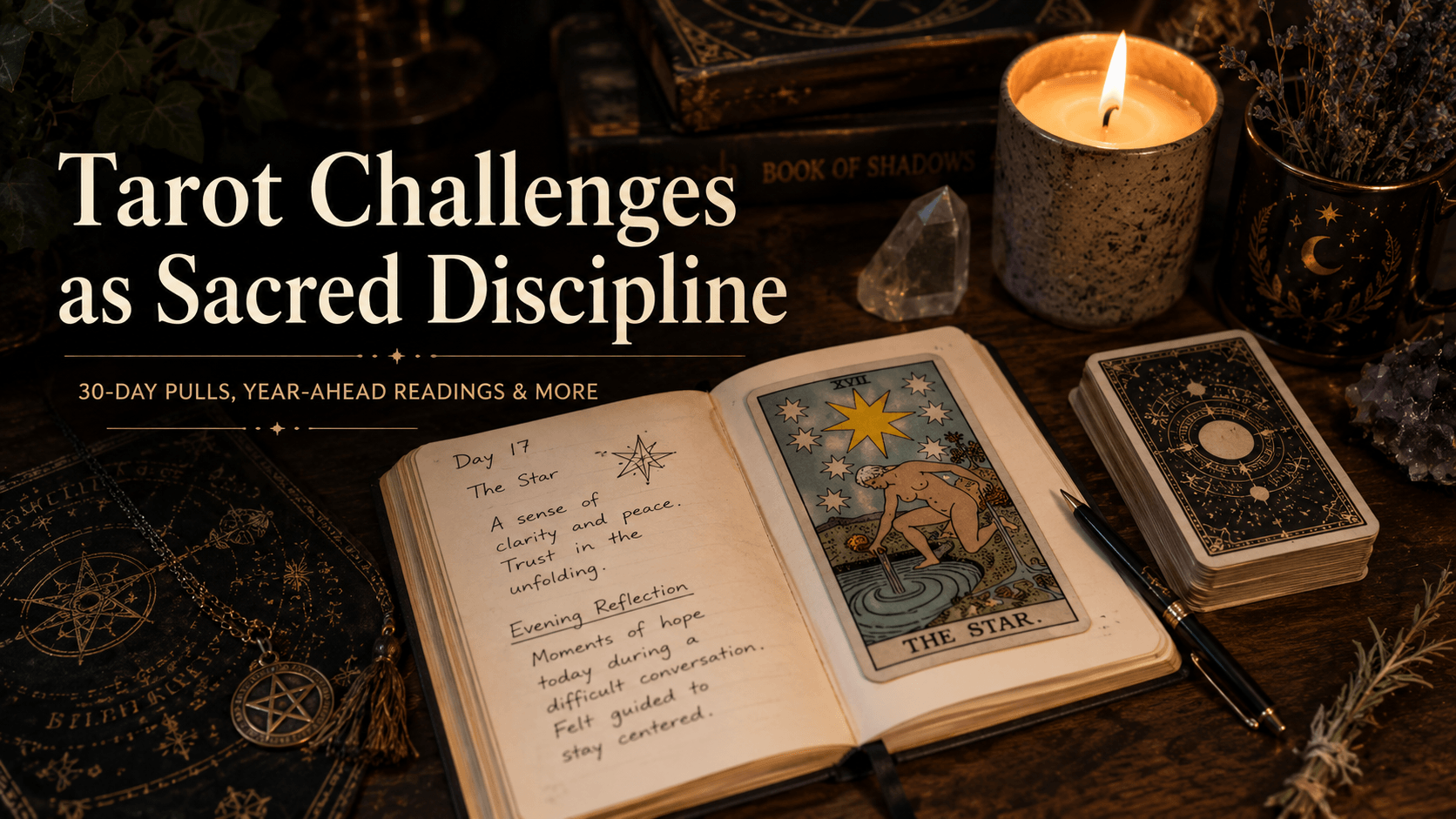
Each morning, at approximately the same time, draw one card.
Do not immediately pull five clarifiers.
Do not ask ten different questions.
Do not attempt to predict every event that will happen during the day.
Simply observe the card.
Ask:
What current is this card inviting me to notice today?
Record the card and your initial impressions.
Then live your day.
In the evening, return to the card.
Ask yourself:
- Where did this archetype appear today?
- Did I experience its energy externally or internally?
- Did the card manifest literally, symbolically, emotionally, or not at all?
- What did I misunderstand about it this morning?
- What did I learn from encountering it in ordinary life?
This transforms a daily tarot pull challenge from a fortune-telling exercise into a practice of observation.
The morning draw establishes the symbol.
The day provides the experience.
The evening reflection creates the synthesis.
In this sense, the card becomes almost like a daily audience with a particular power.
You meet it in the morning.
You watch for its presence throughout the day.
And in the evening, you report back to yourself.
Variations on the 30-Day Practice
The basic one-card practice can be modified according to your purpose.
You might spend thirty days working exclusively with the Major Arcana.
Or devote a month to one suit.
A month of Wands can illuminate desire, will, creativity, courage, and action.
A month of Cups can turn attention toward emotion, relationship, intuition, and receptivity.
A month of Swords can sharpen awareness of thought, language, conflict, discernment, and truth.
A month of Pentacles can ground the practice in material reality, work, resources, embodiment, and practical responsibility.
You could also dedicate the month to the Court Cards.
Instead of asking, “What will happen today?” ask:
What quality of consciousness is asking to be developed today?
This subtle change can completely transform the practice.
The Year-Ahead Tarot Reading
If a thirty-day practice creates a small vessel, a year ahead tarot reading creates a much larger one.
Year-ahead readings are traditionally performed around significant thresholds: the calendar New Year, a birthday, the beginning of an astrological year, Samhain, or another personally meaningful turning point.
The exact date matters less than the conscious recognition:
One cycle is ending. Another is beginning.
A simple year-ahead spread can contain twelve cards, with one card representing each month.
You may then add several overarching positions.
For example:
Card 1 — The Year’s Central Current
What force or archetype defines the overall cycle?
Card 2 — The Principal Lesson
What is this year asking me to understand?
Card 3 — The Greatest Challenge
Where will discipline, courage, or awareness be required?
Card 4 — The Greatest Gift
What resource or opportunity may become available?
Cards 5–16 — January through December
What symbolic current characterizes each month?
This creates a map.
But it should not be mistaken for a fixed script.
A Hermetic approach recognizes the importance of correspondence, movement, and relationship. The card does not imprison the future. It gives us a symbolic image through which we can contemplate possible currents.
Think of it as weather rather than destiny.
A weather forecast may indicate rain.
You still decide whether to carry an umbrella.
Likewise, a year-ahead reading may reveal a recurring theme of discipline, transition, conflict, expansion, solitude, or opportunity.
The purpose is not to surrender your agency to the card.
The purpose is to become more conscious of the forces with which you are working.
Revisit the Reading
Do not perform your year-ahead reading and then put it away for twelve months.
Return to it.
A useful practice is to review the spread at the equinoxes and solstices, or approximately every three months.
Ask:
- Which predictions or themes have already manifested?
- Which cards look different in hindsight?
- What patterns are emerging?
- Which cards have appeared repeatedly in subsequent readings?
- What did I initially misunderstand?
- What choices have changed the trajectory of the year?
The meaning of a card is often clarified by time.
This is one reason structured practice is so valuable.
Time becomes part of the interpretation.
Other Valuable Tarot Challenge Forms
The thirty-day pull and year-ahead reading are only two possibilities.
There are many other ways to structure your relationship with Tarot.
The Lunar Cycle Challenge
Work with the cards for one complete lunar cycle.
You might draw at the New Moon, First Quarter, Full Moon, and Last Quarter, using each phase as a different stage of reflection.
Alternatively, draw one card each day and organize your journal according to the lunar phases.
This can help you observe cycles of initiation, development, culmination, and release.
The Elemental Season
Choose one suit and work with it for an entire month or season.
Study its symbolism.
Observe its cards.
Meditate on its element.
Notice how its qualities appear in your life.
This is particularly useful for anyone wishing to develop a deeper understanding of the relationship between the Tarot suits and elemental symbolism.
Court Card Immersion
Spend a defined period studying the sixteen Court Cards.
Rather than treating them simply as “people,” observe them as patterns of consciousness.
What does a King of Swords actually feel like?
How does a Queen of Pentacles express herself through different circumstances?
When does the Knight of Wands represent healthy movement, and when does that same energy become impulsive?
Court Cards become much easier to understand when they are encountered repeatedly rather than memorized from a list of keywords.
Major Arcana Journey
Work through the Major Arcana sequentially.
Draw one Major each day, or one each week.
Study its imagery.
Journal about its number.
Consider its elemental, planetary, or archetypal correspondences.
Then observe how the sequence itself creates a journey.
The Major Arcana can be approached not merely as thirty-two? No—the twenty-two Major Arcana can be contemplated as a symbolic progression through different modes of consciousness, transformation, and integration.
Shadow and Integration Challenge
A structured period can also be dedicated to the cards we find uncomfortable.
The Devil.
The Tower.
Death.
Ten of Swords.
Five of Pentacles.
Nine of Swords.
Instead of avoiding difficult cards, spend time asking what they actually reveal.
But this should be approached with grounding and discernment.
The purpose is not to manufacture suffering or interpret every uncomfortable experience as evidence of some hidden catastrophe.
The purpose is honest observation.
What am I unwilling to see?
What am I resisting?
What needs to be released?
What part of this archetype already exists within me?
The Gratitude and Resource Challenge
Not every tarot challenge needs to focus on problems.
For thirty days, draw a card asking:
What resource is available to me today?
Or:
What deserves my gratitude today?
This can shift the practice away from constantly searching for danger and toward recognizing existing strengths, relationships, opportunities, skills, and sources of support.
Tarot becomes not merely an instrument for diagnosing problems, but a means of perceiving what is already working.
How to Design a Challenge That Actually Serves the Work
The best tarot challenge is not necessarily the most ambitious one.
It is the one you can actually complete.
Before beginning, establish four things.
1. Define the Intention
Know why you are doing the challenge.
“I want to get better at Tarot” is a reasonable beginning, but it can be refined.
For example:
“For the next thirty days, I will use one daily card to deepen my understanding of Tarot symbolism and observe how archetypal patterns manifest in ordinary life.”
Now the practice has direction.
2. Choose a Sustainable Commitment
Do not create a practice that requires an hour every morning if you realistically have ten minutes.
A five-minute practice performed consistently is more valuable than an elaborate ritual performed three times before being abandoned.
Discipline is not the same thing as unnecessary difficulty.
3. Record the Work
Keep a dedicated section of your magical or Tarot journal.
Record:
- Date
- Card
- Initial impression
- Question or intention
- Significant events
- Evening reflection
- Recurring symbols or themes
Over time, this becomes far more valuable than isolated readings.
You are creating a record of lived correspondence.
4. Establish Review Points
Do not simply accumulate entries.
Stop periodically.
Look backward.
After seven days, ask:
What am I beginning to notice?
After fifteen days:
What patterns have become undeniable?
At the end:
What has changed in my understanding?
Reflection turns repetition into learning.
You may also choose to open the entire practice with a small dedication.
Light a candle.
Hold the deck.
State your intention.
Ask for clarity, discipline, honesty, and discernment.
At the conclusion, offer a simple expression of gratitude and consciously close the period.
The ritual does not need to be elaborate.
Intentionality is what matters.
Common Pitfalls of Tarot Challenges
Even a well-designed practice can become distorted.
One of the most common problems is turning spiritual practice into performance.
If every card must become a social-media post, the relationship with the card can become secondary to producing content.
Sometimes the most valuable reading is the one nobody sees.
Another problem is forcing meaning.
Not every card produces a dramatic revelation.
Some days the card may seem almost painfully ordinary.
That is acceptable.
The purpose of a long-term practice is not to experience thirty consecutive mystical revelations.
Sometimes the card simply accompanies you.
Sometimes you notice it clearly.
Sometimes you notice nothing.
Record that honestly.
There is also the problem of perfectionism.
You miss Day 17.
The challenge is ruined.
It is not.
Resume on Day 18.
A spiritual discipline should develop perseverance, not create an obsession with perfect performance.
Continuity of intention is more important than maintaining an immaculate streak.
Finally, do not allow structured Tarot practice to become an excuse for avoiding deeper work.
Thirty daily cards cannot substitute for honest introspection.
A year-ahead spread cannot replace practical decision-making.
A beautiful Tarot journal cannot compensate for refusing to act upon what you already understand.
The cards are tools.
The work remains yours.
Integrating Challenge Work With the Larger Path
A tarot challenge becomes particularly powerful when it does not exist in isolation.
Let your observations feed into your larger journal.
If the same card appears repeatedly, record it.
If the same suit dominates your readings for several weeks, notice it.
If a particular archetype appears during moments of decision, record the circumstances.
Patterns are often more informative than individual cards.
Imagine that during a thirty-day challenge you repeatedly encounter the Eight of Pentacles, Three of Pentacles, and Emperor.
Individually, each card has its own meaning.
Together, they might suggest an unmistakable curriculum involving discipline, craftsmanship, structure, mastery, and responsibility.
This is where the challenge begins to reveal something greater than individual card definitions.
The period itself has developed a theme.
At the end of the challenge, perform a deliberate review.
Read the first entry.
Read the final entry.
Compare your understanding.
Ask what has changed.
Then close the practice.
This final step is important.
Not every spiritual practice needs to continue forever.
A form that once served you can eventually become empty habit.
The wise practitioner knows when to continue, when to modify, and when to release.
Tarot Challenges as Temporal Magic
Time is often treated as something that happens to us.
Days pass.
Months disappear.
Years accumulate.
But structured spiritual practice allows us to relate to time differently.
A thirty-day period can become a vessel.
A lunar cycle can become a rite.
A season can become a study.
A year can become an initiatory map.
This is the deeper potential of tarot challenges.
They take the ordinary passage of time and make it conscious.
The cards become companions within that passage.
You draw.
You observe.
You record.
You reflect.
You return.
And slowly, the symbolic language of Tarot becomes less something you study and more something you live.
That is the real value of a 30 day tarot challenge.
It is not the number thirty.
It is the decision to show up thirty times.
The value of a year ahead tarot reading is not that it gives you twelve guaranteed predictions.
It is that it gives you twelve symbolic mirrors through which you can contemplate the unfolding year.
The deeper principle is simple:
Consistency creates relationship.
Attention creates understanding.
Reflection creates wisdom.
Whether you choose thirty days, one lunar cycle, a season, or an entire year, approach the practice with sincerity.
Do not perform it merely because it is popular.
Do not force revelations because you think something profound must happen.
Sit with the cards.
Watch the world.
Keep the record.
And allow time itself to become part of the oracle.
A Simple Closing Practice
When your challenge is complete, shuffle the deck one final time.
Draw a card asking:
What has this period taught me?
Then draw another:
What should I carry forward?
And finally:
What am I ready to release?
Record all three.
Close your journal.
Give thanks for the discipline you maintained, the insights you received, and even the days when nothing seemed to happen.
Then put the cards away.
The challenge is complete.
The next chapter belongs to you.