There are moments when the inner world becomes difficult to navigate.
Anxiety can make the future feel enormous.
Grief can make the present feel empty.
Depression can make even simple actions feel impossibly heavy.
Periods of transition can leave us questioning who we are, where we are going, and what we are supposed to do next.
It is natural, during such times, to reach for whatever tools have helped us make sense of life before.
For many people, Tarot is one of those tools.
A quiet room.
A shuffled deck.
A single card placed upon the table.
Sometimes this simple ritual creates enough space to breathe and hear our own thoughts more clearly.
From a Hermetic Pagan perspective, Tarot can be a profound instrument of self-knowledge. The cards provide archetypal images through which we can contemplate our emotions, habits, fears, relationships, choices, and inner conflicts.
But there is an important boundary that must never be blurred:
Tarot can support reflection. It cannot replace mental health care.
The cards are not therapists, psychiatrists, doctors, or crisis counselors.
Knowing the difference is not a rejection of spiritual practice.
It is part of spiritual maturity.
A wise practitioner learns not only how to use a tool, but also when that tool is insufficient for the task.
How Tarot Can Support Mental and Emotional Well-Being
Used carefully, Tarot can provide a structured way to examine experiences that may otherwise feel chaotic.
One of its greatest strengths is that it externalizes inner material.
An emotion can be difficult to describe when it exists only as a vague sensation inside the body.
But place a card on the table and suddenly there is an image to contemplate.
The Hermit might give language to a need for solitude.
The Five of Cups might help someone recognize grief.
The Eight of Swords might provide a useful metaphor for feeling trapped by one’s own thinking.
The Strength card might invite reflection upon patience, courage, gentleness, or self-regulation.
The card does not diagnose the experience.
It gives you something to think with.
This distinction matters.
Tarot can provide archetypal language for experiences that are difficult to articulate.
It can also encourage a longer perspective.
When someone is overwhelmed, the current moment can feel like the entirety of existence.
A Tarot journal can create distance.
You can look back over several weeks and notice that your emotional landscape has changed.
Perhaps the same card appeared repeatedly during a difficult period.
Perhaps a particular suit dominated your readings.
Perhaps cards associated with isolation gradually gave way to cards associated with connection.
Such observations can encourage the recognition that inner states are often processes rather than permanent identities.
You are experiencing despair.
That does not necessarily mean you are despair.
You are experiencing fear.
That does not mean fear is your permanent nature.
The cards can help create that distinction.
The Proper Attitude: Ally, Not Authority
If Tarot is being used alongside emotional or psychological struggles, the relationship with the cards matters enormously.
Approach them as allies in self-understanding, not authorities over your life.
A healthy reading should increase your ability to engage with reality.
It should not make you increasingly dependent upon the deck.
There is a major difference between:
“What might this card help me consider?”
and:
“I cannot make this decision until the cards tell me what to do.”
The first encourages reflection.
The second can create dependency.
This is especially important when anxiety is already present.
Someone who is anxious may repeatedly pull cards seeking reassurance:
“What if I pull another card?”
“What if that card means something bad?”
“Maybe I should ask again.”
Soon the reading is no longer providing clarity.
It is feeding the anxiety.
A Hermetic approach calls for sovereignty.
The purpose of divination is not to surrender your agency.
It is to cultivate awareness so that you can exercise your agency more consciously.
Difficult cards should therefore be treated as information and invitation, not as verdicts.
The Tower does not mean catastrophe is destined to happen.
Death does not mean literal death.
The Devil does not prove that you are spiritually corrupted.
Ten of Swords does not mean that your life is doomed.
The cards are symbolic instruments.
Their imagery can provoke useful questions, but it should never be used to frighten someone into believing that terrible events are inevitable.
Gentle Tarot Practices for Emotional Support
If you are emotionally well enough to engage with Tarot, simple practices are generally more useful than increasingly elaborate readings.
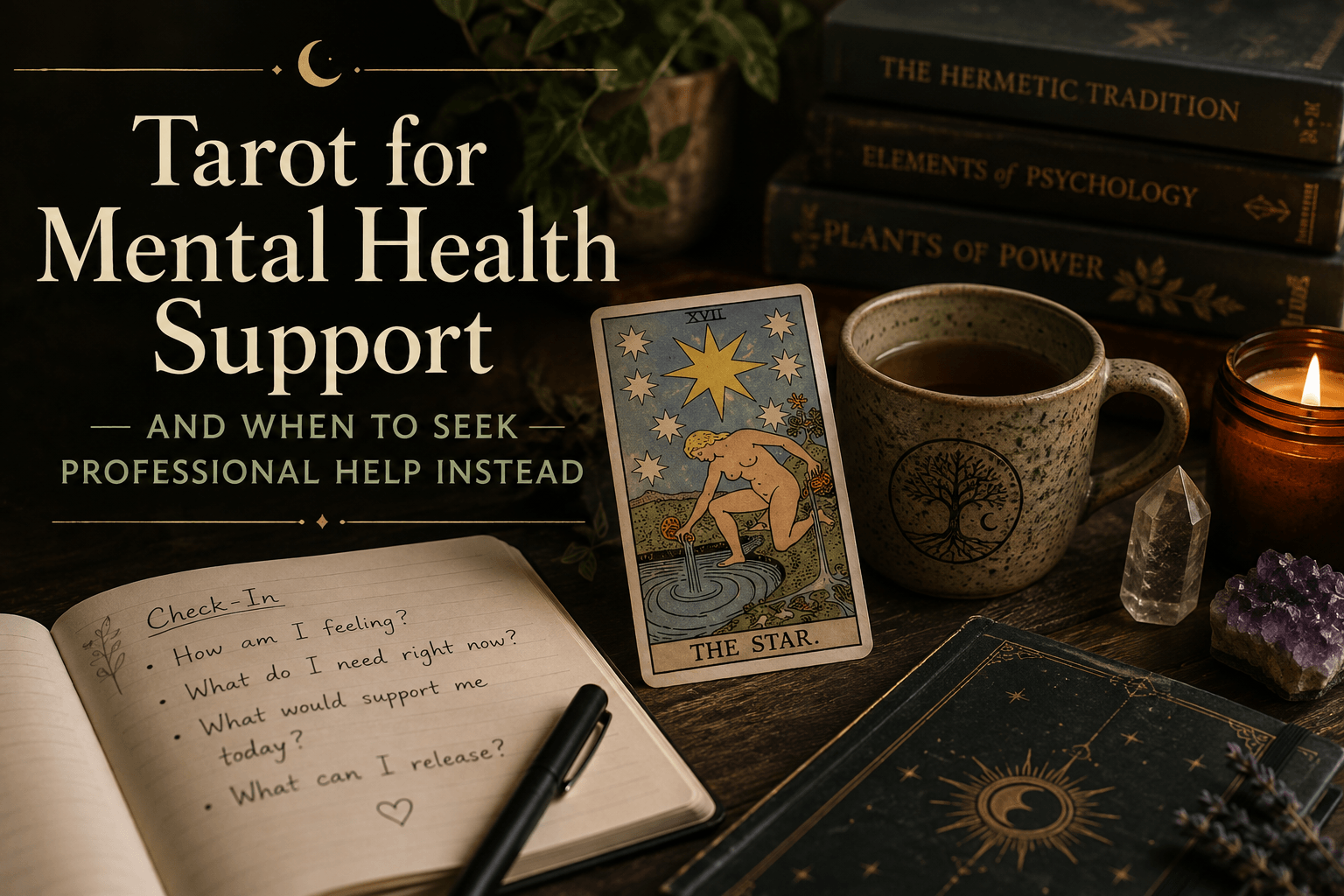
The One-Card Check-In
Draw one card with the question:
What do I need to tend today?
Or:
What quality would support me today?
The emphasis is not prediction.
It is attention.
Perhaps the answer is rest.
Perhaps boundaries.
Perhaps patience.
Perhaps asking for help.
Perhaps doing one practical thing you have been avoiding.
The card becomes a prompt for conscious action.
The Self-Compassion Spread
You might use three cards:
1. What am I experiencing?
2. What do I need to understand with compassion?
3. What is one small supportive action I can take?
This type of reading keeps the focus on awareness and constructive action rather than attempting to uncover frightening hidden causes.
The Resource Spread
When life feels overwhelming, ask:
What strength do I already possess?
What support is available to me?
What am I overlooking?
What is one practical step I can take?
This is particularly valuable because spiritual practice can sometimes become excessively focused on problems, wounds, shadows, and obstacles.
Healing also involves recognizing resources.
Friendship is a resource.
Rest is a resource.
Professional support is a resource.
A safe home is a resource.
A creative practice is a resource.
The ability to ask for help is a resource.
Tarot can help bring these things into conscious awareness.
Tarot Journaling and the Inner Weather
One of the most constructive ways to combine Tarot with emotional self-reflection is through journaling.
Instead of trying to obtain a definitive answer from the cards, use them as starting points.
Write down the card.
Then write what you feel before interpreting it.
This is important.
If you immediately consult a list of meanings, you may miss what the image actually evokes within you.
Ask:
What does this image make me feel?
What memory does it bring forward?
Where does this pattern appear in my life?
What am I resisting?
What would compassion look like here?
Over time, the journal becomes a record of your inner weather.
You can see changes that are difficult to recognize when living through them day by day.
This can be a meaningful complement to other forms of self-care and professional support.
But it remains a complement.
The Limits of Tarot in Mental Health
Here the boundary must be exceptionally clear.
Tarot cannot diagnose mental health conditions.
A Tarot card cannot tell you whether you have depression, an anxiety disorder, PTSD, bipolar disorder, psychosis, or another clinical condition.
It cannot determine what treatment you need.
It cannot prescribe medication.
It cannot provide trauma-informed psychotherapy.
And it cannot safely manage an acute mental health crisis.
These are tasks for appropriately trained professionals.
Even an experienced Tarot reader does not possess the clinical role of a psychologist, psychiatrist, physician, therapist, or crisis counselor simply because they have extensive knowledge of symbolism or spiritual practice.
This distinction protects both the person seeking help and the spiritual practitioner offering it.
There is also another danger.
During periods of severe distress, Tarot can sometimes reinforce anxiety or magical thinking.
A person may begin interpreting every card as an omen.
Every coincidence becomes significant.
Every difficult card becomes evidence that something terrible is approaching.
Repeated readings can become compulsive.
Instead of helping someone engage with life, the cards become a mechanism for avoiding it.
That is the point at which stepping away from Tarot may itself be the wise spiritual action.
When to Seek Professional Help Instead of Tarot
There are circumstances in which the cards should be put aside and professional support should take priority.
Seek qualified mental health or medical support if you are experiencing persistent:
- Hopelessness or despair
- Severe emotional distress
- Loss of interest in ordinary life
- Significant anxiety that interferes with functioning
- Trauma-related symptoms
- Major changes in sleep, appetite, concentration, or daily functioning
- Difficulty maintaining work, relationships, hygiene, or other basic responsibilities
- Emotional symptoms that persist or worsen despite your usual coping strategies
You should also seek professional help when your relationship with Tarot itself becomes unhealthy.
For example:
You repeatedly pull cards because you cannot tolerate uncertainty.
You feel compelled to keep drawing until you receive the answer you want.
You become terrified by particular cards.
You use readings to avoid making necessary real-world decisions.
You believe the cards are controlling your actions.
Or Tarot has become your primary source of psychological support while your relationships and responsibilities are deteriorating.
These are signs that the cards may no longer be serving their proper function.
And there is one boundary more important than all the others.
If You Are Thinking About Suicide or Self-Harm
Do not turn to a Tarot reading for an answer.
Do not ask the cards whether you should live.
Do not attempt to divine whether your suffering will end.
Reach out to another human being.
A trusted person.
A doctor.
A therapist.
A crisis counselor.
Emergency services if you are in immediate danger.
If you are in the United States or its territories, the 988 Suicide & Crisis Lifeline provides free, confidential support 24/7 by call, text, or chat. You do not need to be actively suicidal to contact 988; it also supports people experiencing emotional distress and other mental-health-related crises.
988 Suicide & Crisis Lifeline — Get Help
If you are elsewhere, contact your local crisis line or emergency service. If you believe you may act on thoughts of harming yourself or someone else, seek immediate emergency assistance rather than attempting to manage the situation through spiritual practice alone. The World Health Organization similarly advises contacting emergency services or a crisis line when someone is in immediate danger of self-harm.
Asking for professional help is not spiritual failure.
It is an act of responsibility.
Tarot and Therapy Can Exist Together
There is no inherent conflict between Tarot and therapy.
In fact, they can occupy very different but complementary spaces.
Therapy provides a relationship with a trained professional who can help you understand patterns, develop coping strategies, process difficult experiences, and work toward psychological well-being.
Tarot can provide symbolic reflection between those sessions.
You might draw a card and discover an interesting question.
You might journal about it.
You might then bring that question into therapy.
For example:
“I keep drawing cards about isolation, and I realize I’ve been withdrawing from everyone around me. I’d like to understand why.”
That is a productive use of Tarot.
The card has not diagnosed you.
It has helped you formulate a question.
And questions are often where meaningful self-examination begins.
If your therapist is comfortable discussing spiritual practices, Tarot may become part of the broader conversation about meaning, identity, values, or personal symbolism.
But the clinical guidance remains with the qualified professional.
The oracle does not outrank the clinician.
The Ethics of Reading for Someone in Distress
The responsibility becomes even greater when reading Tarot for another person.
If someone sits across from you crying, panicking, severely depressed, or expressing thoughts of suicide, your role is not to become their therapist.
You are a Tarot reader.
Know your scope.
This does not mean becoming cold or dismissive.
It means recognizing when the appropriate response is no longer a reading.
A responsible practitioner should be willing to say:
“I care about what you’re going through, but I don’t think Tarot is the right tool for this situation. I think you deserve direct support from someone qualified to help.”
That is not abandoning someone.
It is refusing to pretend that you possess a skill you do not possess.
If you regularly read for others, it is wise to know the crisis and mental health resources available in your community.
You should also maintain boundaries around your own emotional capacity.
You cannot carry every person’s suffering.
Compassion without boundaries can eventually become exhaustion.
And an exhausted practitioner is not necessarily a helpful practitioner.
Spiritual Practice Should Increase Your Agency
There is a useful principle for evaluating any spiritual practice:
Does this make me more capable of meeting reality, or less?
If Tarot helps you identify an emotion and speak about it, it may be serving you.
If it helps you recognize that you need rest, support, or a difficult conversation, it may be serving you.
If it encourages you to reflect rather than react, it may be serving you.
If it helps you discover strengths you had forgotten, it may be serving you.
But if it makes you afraid to act without consulting the cards, something has gone wrong.
If it convinces you that every painful experience is supernatural punishment, something has gone wrong.
If it replaces human connection, professional care, medication prescribed by a qualified clinician, or necessary practical action, something has gone wrong.
The spiritual path should not require abandoning common sense.
Quite the opposite.
Discernment is itself a spiritual virtue.
Knowing Which Tool Belongs to Which Task
There is a temptation in spiritual communities to search for one practice capable of addressing everything.
Tarot for relationships.
Tarot for money.
Tarot for health.
Tarot for grief.
Tarot for trauma.
Tarot for destiny.
But no single tool needs to carry the entire weight of human existence.
A hammer is useful.
So is a compass.
So is a map.
So is a physician.
So is a therapist.
So is a trusted friend.
So is prayer.
So is Tarot.
Wisdom lies partly in knowing which instrument belongs to which task.
The Hermetic Pagan practitioner does not need to choose between spiritual practice and responsible care.
There is no contradiction in lighting a candle and making a therapy appointment.
There is no contradiction in keeping a Tarot journal and taking prescribed medication.
There is no contradiction in performing a ritual for courage and calling a crisis counselor.
The sacred and the practical do not have to be enemies.
Sometimes the most sacred act available to you is the practical one.
The Cards as Companions, Not Physicians
Tarot can be a beautiful companion during the difficult work of becoming more conscious.
It can help us name experiences.
It can reveal patterns.
It can encourage reflection.
It can remind us that the emotional landscape changes.
It can give symbolic form to questions that have been difficult to articulate.
It can invite compassion toward parts of ourselves we have rejected.
But the cards should never be asked to carry what belongs to trained human care.
A mature relationship with Tarot therefore includes boundaries.
You can love the oracle without making it your doctor.
You can trust the symbolism without surrendering your judgment.
You can use spiritual tools while accepting professional help.
And you can recognize that asking another human being to help you carry your suffering is not weakness.
It is relationship.
It is responsibility.
It is, in its own way, an act of courage.
The cards may accompany you through the forest.
But sometimes another person needs to walk beside you.
And sometimes you need someone who knows the terrain professionally.
Let Tarot remain what it can be at its best:
a mirror, a language, a companion, and an invitation to deeper self-knowledge.
When the suffering becomes too great for the cards alone, put them down.
Reach outward.
Ask for help.
The path does not become less spiritual because you do.
Sometimes knowing when to seek another kind of guidance is one of the clearest expressions of wisdom you can practice.