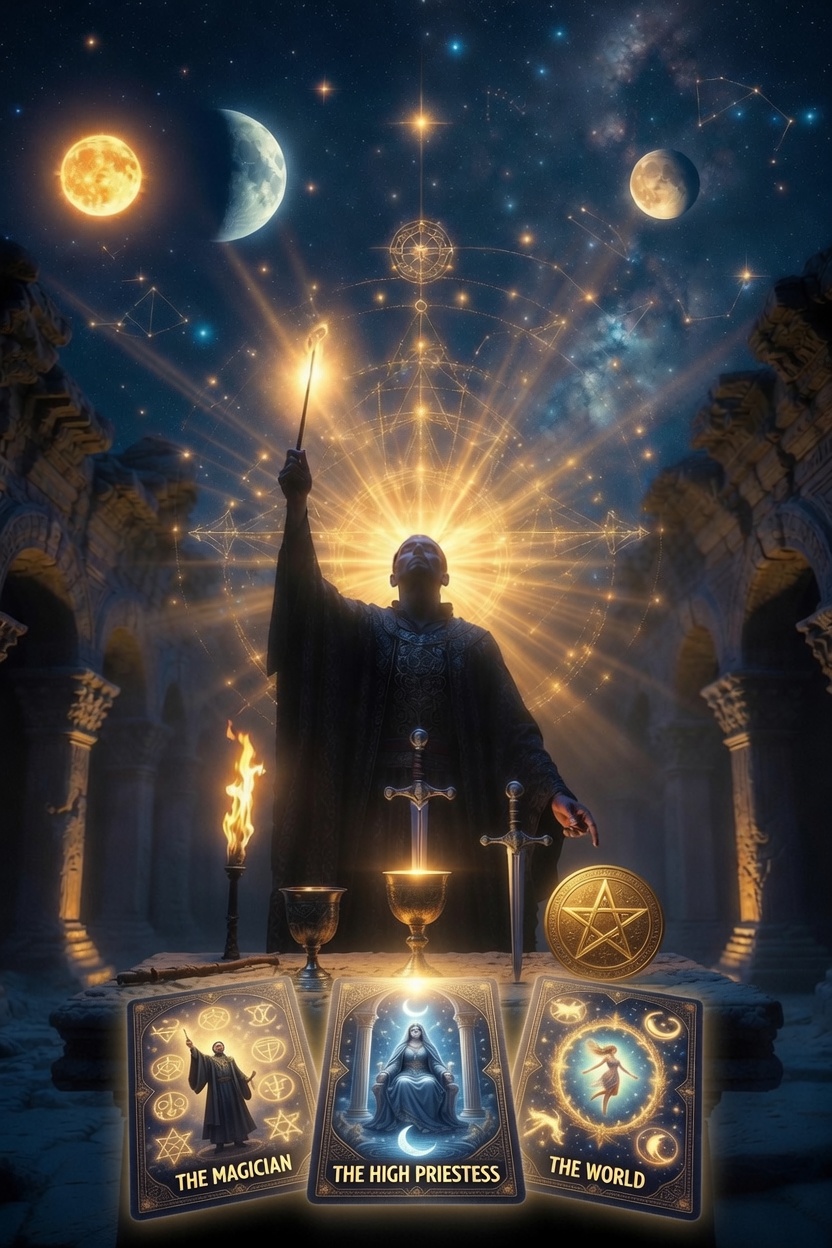
Have you ever felt that someone was interested in you, yet their behavior seemed to tell a different story?
Perhaps they seek your attention but become distant when the conversation turns personal. Maybe they flirt with you, remember small details about your life, or look at you in a way that feels significant, only to act indifferent the next time you meet. They might seem emotionally guarded, leaving you wondering whether they are hiding an attraction, struggling with their feelings, or simply not interested.
Few romantic situations are as frustrating as trying to understand what another person will not openly express.
Tarot offers a way to explore the emotional patterns surrounding these situations. Through its archetypes, elemental correspondences, and symbolic imagery, the cards can help you examine possible motivations, recognize contradictory behavior, and distinguish romantic intuition from wishful thinking.
In the Hermetic Pagan tradition, tarot is not merely a method of predicting events. It is a symbolic instrument for investigating the relationship between the visible and invisible dimensions of experience. What appears on the surface may not tell the whole story, and the cards invite us to look more deeply at the forces that shape human behavior.
However, there is an important distinction: tarot cannot independently verify another person’s private thoughts. A reading can illuminate possibilities and help you interpret the situation, but their genuine feelings become clearer through their actions, communication, and willingness to participate in a relationship.
In this guide, you will learn how to read tarot when someone appears to be hiding their true feelings, which cards often symbolize emotional concealment, and how to perform a seven-card spread designed to bring greater clarity to an uncertain romantic situation.
Why People Hide Their True Feelings
Before interpreting the cards, consider why someone might conceal their emotions in the first place.
Emotional concealment does not always mean secret romantic attraction. People hide feelings for many different reasons, and understanding the possibilities helps prevent a reading from becoming a projection of your own hopes.
Fear of Rejection
Someone may be attracted to you but afraid that expressing their interest will damage an existing friendship or expose them to humiliation.
They might approach you indirectly, test your reactions, or alternate between warmth and distance because they do not know whether their feelings are reciprocated.
In tarot, this dynamic may be symbolized by the Nine of Swords, the Eight of Swords, or the Two of Swords. These cards can represent anxiety, indecision, and the difficulty of acting when the outcome feels uncertain.
Yet nervousness is not proof of attraction. A person may also be anxious because they are uncomfortable, uncertain about their boundaries, or dealing with unrelated personal concerns.
A Desire to Maintain Control
Some people find emotional vulnerability difficult because they associate it with losing control.
They may prefer to observe rather than reveal, maintain a composed exterior, or avoid conversations that require them to acknowledge what they feel.
The King of Swords can symbolize emotional restraint expressed through logic and discipline. The Four of Pentacles may suggest guardedness or a reluctance to relinquish control.
Neither card automatically indicates hidden love. Their meaning depends on the question and the wider reading.
Conflicting Desires
A person can experience attraction while simultaneously recognizing reasons not to pursue it.
They may be uncertain about compatibility, concerned about circumstances, emotionally unavailable, or unwilling to enter a relationship.
This is where cards such as the Two of Swords, The Lovers, and the Hanged Man can become particularly interesting.
They may invite you to explore tension between desire and decision, but they cannot establish which private feelings another person is experiencing.
Sometimes the most important distinction is between what someone might feel and what they are actually willing to do.
Feelings That Have Not Yet Become Clear
Not everyone understands their own emotions immediately.
Someone might enjoy your company without knowing whether the attraction is romantic. They may feel curious, intimidated, or emotionally stirred without having decided what those feelings mean.
The Moon can symbolize this ambiguity, while the Page of Cups may represent emerging emotional awareness or tentative expressions of affection.
In such situations, patience may be more useful than trying to extract certainty from every interaction.
A Lack of Romantic Interest
This possibility deserves equal consideration.
Sometimes a person is friendly because they are friendly. Sometimes inconsistent behavior reflects limited interest rather than concealed passion. Sometimes distance is a clear indication that someone does not want a closer relationship.
A responsible tarot reading must leave room for these possibilities instead of interpreting every obstacle as evidence of a secret connection.
The purpose of tarot is to improve your discernment, not to turn uncertainty into a romantic certainty that reality has not confirmed.
The Tarot Cards That Symbolize Hidden Feelings
Certain cards are particularly useful when examining emotional restraint, unspoken attraction, secrecy, or uncertainty.
Their meanings become more informative when you consider their positions in the spread and the cards surrounding them.
The High Priestess: What Remains Unspoken
The High Priestess is one of the most intriguing cards to encounter when asking about concealed emotions.
She sits between visible and invisible worlds, guarding knowledge that has not yet been revealed. Her symbolism includes intuition, silence, mystery, and the wisdom of observing before acting.
In a romantic reading, the High Priestess may suggest that important information remains unknown. There could be feelings that have not been expressed, but the card may just as easily indicate that you do not yet have enough information to understand the situation.
Pay attention to whether the card appears alongside Cups cards, Swords cards, or cards associated with withdrawal.
With the Page of Cups, it might invite you to consider whether a tentative emotional expression is possible. With the Hermit, it may emphasize privacy and the need for reflection. With the Moon, it may highlight how much remains uncertain.
The High Priestess does not mean that someone is secretly in love with you. Her deeper lesson is to recognize the difference between what you sense and what you know.
Questions to ask:
- What remains unknown about this person’s intentions?
- Am I observing meaningful patterns, or interpreting silence according to my hopes?
- What information would help me understand the situation more clearly?
The Moon: Confusion, Ambiguity, and Projection
The Moon is particularly relevant when someone’s behavior seems contradictory.
It represents the uncertain territory between perception and understanding, where intuition, fear, imagination, and incomplete information can become difficult to separate.
Perhaps someone appears interested in person but rarely initiates contact. Maybe their messages seem flirtatious, yet they avoid making plans. You may feel that something is happening beneath the surface without being able to explain what it is.
The Moon encourages you to examine the ambiguity itself.
When it appears beside the Seven of Cups, the reading may emphasize fantasy, multiple interpretations, or the tendency to imagine possibilities that have not been confirmed.
Beside the Two of Swords, it may highlight indecision or the difficulty of confronting an uncomfortable question.
Beside the Queen of Swords, it may encourage you to separate emotional impressions from observable evidence.
The Moon’s appearance should not automatically be interpreted as deception. Sometimes the confusion exists because neither person has communicated clearly.
Questions to ask:
- What am I assuming about this person?
- Could their behavior have an explanation unrelated to romantic feelings?
- What would help me see this situation more clearly?
The King of Swords: Feelings Governed by Logic
The King of Swords represents intellectual discipline, rational judgment, authority, and emotional restraint.
When he appears in a reading about hidden feelings, he may symbolize someone who prefers to maintain a composed exterior rather than reveal vulnerability.
Perhaps the person communicates thoughtfully but avoids discussing emotions. They may seem attentive while remaining difficult to read, or they may prefer practical conversations over expressions of affection.
However, this card can also describe the kind of clarity you need to bring to the situation.
The King of Swords asks you to evaluate behavior carefully rather than allowing desire to dictate your conclusions.
When paired with the Two of Cups, he might invite you to consider how emotional connection and clear communication could work together. With the Four of Pentacles, he may emphasize guardedness. With Justice, he can reinforce the importance of honesty and accountability.
Do not assume that emotional restraint necessarily conceals romantic desire. Some people are naturally reserved, while others simply do not wish to establish a romantic connection.
Questions to ask:
- Does this person communicate more through actions than emotional language?
- Is their restraint consistent with their personality, or does it change noticeably in certain situations?
- Am I respecting what they actually communicate?
The Four of Pentacles: Emotional Guarding
The Four of Pentacles depicts the desire to hold tightly to what one possesses.
In emotional readings, it can symbolize defensiveness, possessiveness, fear of vulnerability, or reluctance to risk an established sense of security.
A person represented by this card might prefer to keep interactions within familiar boundaries rather than risk a more intimate connection.
They may enjoy your attention while avoiding conversations that would clarify the relationship. Alternatively, the card may reflect your own reluctance to ask direct questions because you are afraid of losing the possibility of romance.
Its placement matters.
If it appears in a position representing your own emotional state, consider whether you are protecting yourself from disappointment. If it appears in a position exploring the relationship’s obstacles, examine whether guardedness or fear of change is preventing greater clarity.
Questions to ask:
- What might vulnerability require from me?
- Am I holding on to a possibility that the other person has not reciprocated?
- Is emotional caution protecting me, or keeping me stuck?
The Two of Swords: The Conflict Between Feeling and Decision
The Two of Swords often represents indecision, avoidance, and the difficulty of making a choice when important information is missing.
In a romantic reading, it can symbolize a situation in which feelings, practical concerns, and personal boundaries have not been reconciled.
Someone might be uncertain about whether to pursue a connection, but the card does not prove that romantic attraction exists. The indecision could concern the relationship itself, an uncomfortable conversation, or your own next step.
The card can also suggest that you are waiting for the other person to reveal something that only a direct conversation can clarify.
Its most useful message is to identify the decision being avoided.
Questions to ask:
- What question am I afraid to ask?
- What decision am I postponing?
- Am I waiting for certainty when a small, honest action would give me more information?
The Page of Cups: Tentative Emotional Expression
The Page of Cups represents emotional curiosity, sensitivity, imagination, and the early stages of expressing affection.
In a reading about hidden feelings, this card may symbolize a tentative gesture: a playful message, a thoughtful compliment, an invitation, or an attempt to create a more personal connection.
It can also represent your own willingness to approach someone with openness and curiosity.
The Page is not a guarantee of romantic love. Instead, it encourages you to notice small expressions of interest without exaggerating their significance.
A compliment might indicate attraction, but it might also be friendly. A meaningful pattern emerges when gestures are supported by consistency, mutual interest, and a willingness to spend time together.
Questions to ask:
- Are there genuine signs of emotional openness?
- Does the person follow small gestures with consistent effort?
- How can I respond warmly without assuming more than has been expressed?
The Knight of Cups: Romantic Expression and Idealization
The Knight of Cups is associated with romance, charm, emotional pursuit, and the desire to follow the heart.
When this card appears in a reading about concealed feelings, it may encourage you to examine the possibility of romantic expression or a desire for emotional closeness.
However, the Knight can also symbolize idealization: the tendency to become enchanted by a romantic possibility before its practical foundations have been established.
If the Knight of Cups appears alongside the Moon, for example, consider whether charming gestures are accompanied by ambiguity. With the Three of Pentacles, you might reflect on whether romantic interest is supported by cooperation and follow-through.
The key question is not whether someone can behave romantically in a particular moment, but whether their behavior supports a genuine connection over time.
The Hermit: Withdrawal and Private Reflection
The Hermit represents solitude, introspection, and the search for understanding.
In romantic readings, it can symbolize someone who keeps their inner life private or needs time to understand their own thoughts.
But the Hermit may also suggest that the healthiest response is to stop trying to interpret another person and return your attention to yourself.
If someone consistently withdraws, you do not need to pursue them indefinitely in the hope that they will eventually reveal a hidden attraction.
Respect their need for space, and consider whether the relationship offers enough reciprocity to justify your continued investment.
The Hermit’s central question is this: What can you learn by stepping back instead of searching for another sign?
A Seven-Card Tarot Spread for Hidden Feelings
This spread is designed to explore an emotionally ambiguous romantic situation without treating the cards as direct access to another person’s private thoughts.
It examines your perception of the situation, the observable relationship dynamic, possible obstacles, and the actions that can help you gain clarity.
You will need your tarot deck, a quiet space, and a notebook.
Before shuffling, take a few slow breaths. Bring the person to mind, but avoid mentally rehearsing the answer you hope to receive.
Ask:
What do I need to understand about this person’s behavior, the emotional dynamic between us, and the wisest way to seek clarity?
Draw seven cards and place them in a horizontal line or in a gentle arc.
Card 1 — What I Am Sensing
What feelings or dynamics am I noticing in this situation?
This card explores the impressions that have drawn your attention.
The High Priestess might symbolize silence, subtlety, or information that remains unknown. The Page of Cups could reflect tentative emotional gestures. The Moon might suggest that your impressions are mixed with uncertainty.
Pay attention to what the card brings to mind about your actual experiences.
For example, if you have noticed that someone frequently initiates conversations but avoids personal topics, consider that specific pattern rather than concluding that they must be hiding romantic feelings.
This position helps you identify your perception without automatically treating it as fact.
Card 2 — What Their Observable Behavior Communicates
What can I reasonably infer from the way this person acts toward me?
This card is best interpreted through the person’s visible behavior, not as a literal revelation of their private thoughts.
The Knight of Pentacles may prompt you to look for consistency. The Three of Pentacles can emphasize mutual effort. The Eight of Cups might encourage you to acknowledge emotional distance or a lack of engagement.
If the Two of Cups appears, consider whether your interactions actually demonstrate reciprocity.
The purpose is to connect the symbolic meaning to real-world evidence.
Ask yourself whether the person initiates contact, makes time for you, follows through on plans, respects your boundaries, and shows genuine curiosity about your life.
Card 3 — What May Be Complicating the Situation?
What obstacle or uncertainty could be affecting this connection?
This position explores the factors that may be making the situation difficult to understand.
The Two of Swords might suggest indecision or avoidance. The Four of Pentacles may emphasize guardedness. The Ten of Wands could symbolize stress, competing responsibilities, or an overwhelming set of circumstances.
The Devil might prompt reflection on unhealthy attachment, control, or a pattern of seeking validation.
These cards offer possible themes to investigate. They cannot establish that a particular obstacle exists in the other person’s mind.
Consider what is already known about the situation and whether the card’s symbolism provides a useful way to think about it.
Card 4 — What I May Be Projecting Onto This Person
How might my desires, fears, or expectations be shaping my interpretation?
This is one of the most important positions in the spread.
The Seven of Cups may invite you to examine romantic fantasy. The Nine of Swords can highlight anxiety and repetitive thinking. The Six of Cups may bring attention to nostalgia or familiar emotional patterns.
If The Lovers appears, consider whether you are interpreting the intensity of your attraction as proof of compatibility.
Projection is not the same as dishonesty. It is a natural possibility whenever we care about an outcome and lack complete information.
The goal is to recognize where your imagination may be filling gaps that reality has not yet addressed.
Card 5 — What Would Help Reveal the Truth?
What information, conversation, or experience would provide greater clarity?
This card shifts the reading toward practical discovery.
The Ace of Swords may encourage honest communication. The Page of Wands could suggest initiating a lighthearted conversation. Justice may emphasize directness and the importance of matching words with actions.
The Hermit might recommend observing the situation a little longer, particularly if you have only recently met.
Interpret the card as guidance about how you can gain information, rather than as a prediction that the other person will reveal a secret.
You may discover more through one sincere conversation than through repeated readings about the same unanswered question.
Card 6 — What Boundary or Lesson Do I Need to Honor?
How can I protect my emotional well-being while exploring this situation?
The Queen of Swords may encourage you to maintain clear standards. Strength can symbolize patience and emotional self-command. The Empress may remind you to preserve your sense of worth and avoid treating another person’s attention as a measure of your value.
The Eight of Cups could suggest that stepping away may become necessary if the situation remains consistently unfulfilling.
This card is not about suppressing your feelings. It is about ensuring that your feelings do not require you to abandon your needs, boundaries, or dignity.
Card 7 — My Wisest Next Step
What should I do to move toward greater clarity?
The final card turns reflection into action.
The Page of Cups may suggest expressing interest gently. The Ace of Swords could point toward a direct conversation. Temperance may recommend allowing the connection time to develop without forcing an immediate declaration.
The Chariot might encourage you to take initiative, while the Hermit may suggest stepping back and redirecting your attention toward your own life.
Choose an action that fits the circumstances.
If you barely know the person, start with a conversation. If you already have a close relationship, consider expressing your interest honestly. If they have repeatedly shown disinterest, respect that information instead of searching for hidden meanings.
The purpose of the spread is not to make someone reveal their feelings. It is to help you decide how to respond to the situation with clarity.
How to Interpret Combinations of Cards About Hidden Feelings
Individual cards offer useful themes, but combinations often provide a richer interpretation.
In tarot, the meaning of a card changes according to its position, its relationship with other cards, and the question being asked.
Here are several combinations to explore when reading about emotional concealment.
The High Priestess + The Moon
This combination emphasizes mystery, uncertainty, and the limits of what you currently know.
It can invite you to slow down, observe your assumptions, and acknowledge that the situation has not yet become clear.
Rather than interpreting the combination as proof of secret love, ask what information is missing and how you might obtain it.
The King of Swords + The Two of Cups
Symbolically, this combination brings together emotional connection and intellectual restraint.
It may invite you to explore how affection can coexist with a reserved communication style, or how an emotionally significant connection might benefit from clearer conversations.
Look for evidence of reciprocity rather than assuming that a composed exterior conceals strong feelings.
The Page of Cups + The Knight of Pentacles
This combination suggests the themes of tentative emotional expression and steady development.
It can serve as a useful reminder that small gestures become more meaningful when supported by consistency.
A flirtatious message may be exciting, but a pattern of thoughtful communication and reliable follow-through provides a stronger basis for understanding someone’s interest.
The Devil + The Seven of Cups
This combination invites reflection on desire, fantasy, and fixation.
It may be especially relevant when you find yourself imagining multiple romantic outcomes or becoming increasingly preoccupied with someone whose intentions remain unclear.
Ask whether the attraction is helping you discover a genuine connection or drawing you into a cycle of speculation.
The Hermit + The Four of Pentacles
Together, these cards emphasize privacy, withdrawal, and guardedness.
They may encourage you to consider whether the person is emotionally unavailable, whether you are protecting yourself from vulnerability, or whether the relationship simply needs more space.
Do not assume that persistence will necessarily overcome emotional distance. Sometimes the wisest response is to respect the distance and reassess what you need.
The Ace of Swords + Justice
This combination strongly emphasizes clarity, honesty, and fair judgment.
It is a reminder that direct communication and consistent behavior are more reliable than endlessly decoding ambiguous gestures.
If you have been wondering where you stand with someone, a respectful conversation may be the most constructive next step.
How to Tell the Difference Between Hidden Attraction and Disinterest
One of the most important skills in romantic tarot is learning not to interpret every difficult card as a sign of concealed passion.
The Devil does not automatically mean someone is obsessed with you. The Moon does not prove deception. The Hermit does not guarantee that someone is secretly longing for you from a distance.
A more grounded approach is to compare your interpretation with the person’s behavior.
Signs That May Justify Exploring a Romantic Possibility
A person may be interested in you if they regularly initiate conversations, seek opportunities to spend time with you, remember details about your life, show curiosity about your experiences, or respond positively when you express interest.
These behaviors do not guarantee romantic attraction, but they can provide reasonable grounds for further exploration.
A tarot reading may help you reflect on whether you are comfortable taking the next step.
Signs That Require Caution
Be careful when the relationship depends on occasional flirtation without follow-through, inconsistent attention that leaves you constantly anxious, or repeated promises that never become actions.
Someone might have complicated feelings, but complicated feelings do not automatically create a healthy relationship.
If you are always initiating contact, always interpreting ambiguous signals, and always finding reasons to excuse a lack of reciprocity, pause and consider what the relationship is actually offering you.
When Distance Is the Answer
If someone tells you they are not interested, avoids your attempts to communicate, or consistently declines opportunities to spend time together, respect that information.
You do not need to prove that they have no hidden feelings. You only need to decide whether their expressed intentions and actual behavior meet your needs.
Even if someone privately experiences attraction, that attraction does not establish that they are available, willing, or prepared to build a relationship.
A hidden feeling that never becomes respectful, reciprocal action cannot serve as the foundation for a relationship you can actually experience.
What If the Cards Keep Suggesting That Someone Is Hiding Something?
Repeated readings can become especially tempting when you feel emotionally invested in someone.
You might draw the High Priestess several times, encounter The Moon in multiple spreads, or repeatedly see the Two of Cups whenever you ask about the connection.
It is natural to wonder whether the repetition means the person has feelings they are concealing.
However, repeated cards do not independently confirm another person’s private emotions. They may reflect the recurring themes of the question, your own emotional focus, or the symbolic patterns you are repeatedly exploring.
Instead of asking the same question again, consider changing your approach.
Rather than asking, “What are they hiding from me?” try asking:
- What do I actually know about this connection?
- What am I finding difficult to accept?
- What would help me communicate more honestly?
- What boundary would protect my emotional well-being?
- What action would provide clarity without pressuring the other person?
These questions move the reading away from speculation and toward self-knowledge.
If you notice that tarot readings are making you more anxious, encourage you to pause and return to the situation when you feel calmer. The purpose of divination should be to support discernment, not to trap you in an endless search for reassurance.
The Hermetic Pagan Perspective: The Visible and the Invisible
Hermetic philosophy encourages the exploration of relationships between different dimensions of experience. In tarot, this is reflected in the interaction between the visible scene depicted on a card and the deeper symbolic meanings it may express.
When someone appears emotionally guarded, you may be tempted to assume that their visible behavior conceals an entirely different inner reality.
Sometimes people do hide their feelings. Yet the fact that an unseen dimension exists does not mean we can accurately identify it without evidence.
The Hermetic principle of correspondence, often expressed as As above, so below, can be applied here as an invitation to examine how inner patterns and outer experiences relate to one another.
What you perceive in another person may awaken something within you: a desire for intimacy, a fear of rejection, a fascination with mystery, or a longing to be chosen.
The cards can help you explore those responses and consider how they influence your interpretation of the relationship.
In this sense, tarot becomes a tool for discernment. It allows you to investigate the symbolism of attraction without confusing symbolic meaning with established fact.
You can acknowledge the possibility that someone has unspoken feelings while also recognizing that you do not yet know what those feelings are.
You can honor your intuition without treating it as infallible.
And you can remain open to a meaningful connection without abandoning your ability to evaluate what is happening in the world around you.
Final Thoughts: You Do Not Need to Solve Someone’s Heart to Find Clarity
When someone hides their feelings, the temptation to search for answers can become overwhelming.
Every glance seems significant. Every delayed message raises questions. A small act of kindness becomes a possible confession, while a moment of distance leaves you wondering whether you have misunderstood everything.
Tarot can help you navigate this uncertainty by giving you a symbolic language for examining emotional restraint, attraction, fear, projection, and communication.
The High Priestess reminds you that not everything is known. The Moon invites you to examine uncertainty. The King of Swords encourages clear judgment, while the Page of Cups reminds you that emotional openness can begin with small gestures.
The seven-card spread brings these themes together, helping you identify what you sense, what you can reasonably infer, what remains unknown, and what you can do to gain clarity.
But remember that the ultimate purpose of a romantic reading is not to discover a secret that another person refuses to share at any cost.
It is to understand your own position in the situation and decide how you wish to proceed.
If there is mutual interest, honest communication and consistent effort can give it room to develop. If the other person remains unavailable or uninterested, you can acknowledge that reality without questioning your worth.
You do not have to interpret every silence, decode every glance, or prove that someone secretly desires you.
Let tarot illuminate the possibilities, let observation ground your interpretation, and let honest communication reveal what the cards cannot confirm.
The goal is not simply to discover whether someone is hiding their true feelings. It is to develop the discernment to recognize a connection that is capable of meeting you openly, honestly, and in return.