There is something strangely intimate about opening a new tarot deck for the first time.
The cards are crisp. The edges are untouched. The images have never been handled by your hands, and yet the moment you begin shuffling, it can feel as though you are holding something that has been waiting for you.
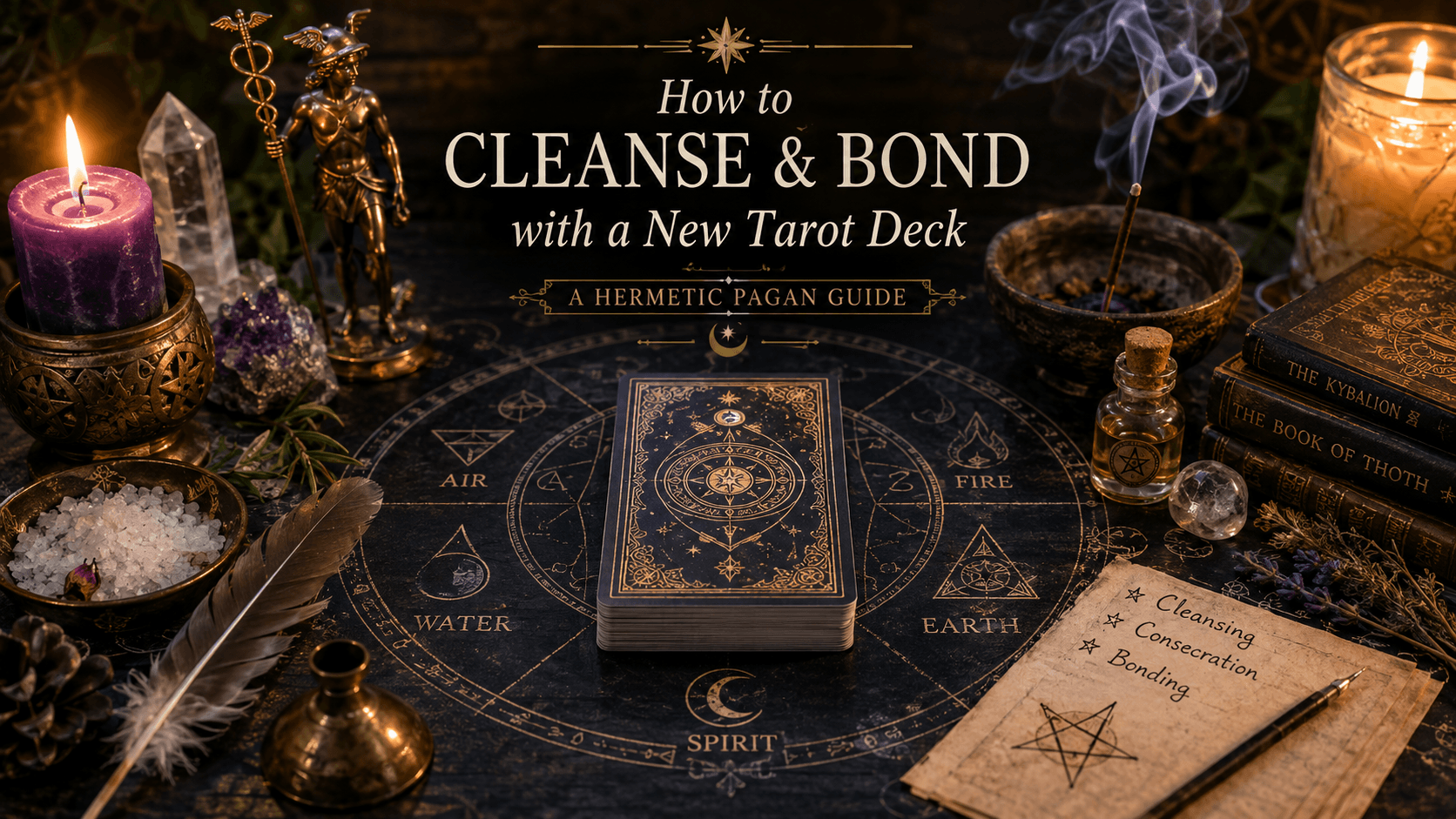
From an esoteric Hermetic and Pagan perspective, a tarot deck can be approached as more than a collection of printed cards. It is a symbolic microcosm: a complete language of archetypes, elements, planets, numbers, and spiritual principles condensed into physical form.
Before using a new deck for a tarot reading, some practitioners therefore choose to cleanse, consecrate, and bond with it.
The purpose isn’t necessarily to believe that cardboard literally becomes alive. Rather, the ritual establishes a relationship between your conscious will and the symbolic system represented by the tarot cards.
In Hermetic terms, the material object becomes a vessel through which higher patterns can be contemplated. In Pagan practice, it can become a sacred tool placed within relationship with the elements, spirits, deities, ancestors, or powers recognized by the practitioner.
The important thing is not having the most elaborate ritual.
It is focused intention.
Why Cleanse and Bond With a New Tarot Deck?
A new deck has passed through many hands before reaching yours.
It may have been printed, packaged, transported, displayed, opened by other people, and handled repeatedly during manufacturing and distribution. For an esoteric practitioner, cleansing provides a symbolic way of saying:
Whatever came before this moment is finished. This deck now begins its relationship with me.
Cleansing creates a sense of separation between the deck’s previous circumstances and your own magical practice.
Bonding goes one step further.
Instead of merely removing what you don’t want, you establish what you do want.
You begin teaching yourself the visual language of the deck. You learn its particular imagery, symbolism, emotional atmosphere, and patterns. At the same time, you allow your own intuition to become more familiar with it.
This is particularly important because tarot meaning is not created exclusively by memorizing definitions.
A traditional meaning provides a foundation, but a particular image can speak to you differently depending on the question, surrounding cards, position in a spread, and circumstances of the reading.
Hermetically, the tarot can be contemplated as a microcosm reflecting the macrocosm.
The Major Arcana can be approached as great archetypal principles. The four suits express elemental patterns through which those principles manifest in the everyday world.
The deck becomes a symbolic mirror.
And the reader learns how to look into it.
Preparing Your Sacred Space
You don’t need an elaborate temple to perform this work.
A clean table, a candle, a quiet room, and a few minutes of uninterrupted attention can be enough.
If you already maintain an altar or sacred space, you can perform the rite there.
Choosing the Time
Timing can add another layer of symbolism.
For a ritual focused on developing your relationship with a deck, consider:
- Waxing Moon: attraction, growth, development, and strengthening the relationship
- Full Moon: illumination, intuition, revelation, and heightened symbolism
- Wednesday: associated traditionally with Mercury, making it particularly appropriate for communication and divination
- Monday: associated with the Moon, intuition, dreams, and psychic receptivity
- Mercury Hour: useful when emphasizing communication, interpretation, and intellectual understanding
- Moon Hour: useful when emphasizing intuition and receptivity
You do not have to wait weeks for the “perfect” astrological moment.
If you have just received a deck and feel strongly called to work with it tonight, that intention matters more than perfectionism.
Hermetic practice is not about becoming paralyzed by correspondences.
It is about learning to work deliberately with them.
Gather the Four Elements
You can create a simple elemental arrangement using:
Earth: salt, a stone, soil, or a crystal
Water: a bowl of spring or purified water
Fire: a candle
Air: incense, a feather, or simply your breath
You may also want:
- Frankincense
- Myrrh
- Mugwort
- Sandalwood
- A consecrated oil
- Clear quartz
- Amethyst
- Black tourmaline
- A bell
- A singing bowl
- A favorite altar cloth
Use whatever fits your tradition.
If you work with particular deities, spirits, ancestors, or planetary powers, you may also place an appropriate symbol on the altar.
Above all, remember that the tools support the ritual; they do not replace your will.
The Four Elements of Tarot Cleansing
There are many ways to cleanse tarot cards. You don’t need to perform every method.
Choose one that feels appropriate, or combine several into a single rite.
1. Earth: Grounding and Absorption
Earth represents stability, manifestation, embodiment, and the physical foundation of the magical work.
One traditional approach is to place the deck in a bowl containing salt and leave it there for a short period.
However, modern tarot cards can be easily damaged by moisture and salt, so do not allow salt to come into direct contact with the cards unless you are certain your deck can tolerate it.
A safer symbolic alternative is to place the deck inside its box or a protective cloth and set it beside a bowl of salt or on top of a clean layer of earth.
Place your hands over the deck and say:
Earth below me, Earth around me,
make firm what is uncertain.
Let all that is foreign fall away.
Let only what serves the work remain.
Visualize the deck becoming still, grounded, and quiet.
2. Water: Purification and Intuition
Water corresponds to emotion, intuition, dreams, receptivity, and the unconscious.
Do not submerge a tarot deck.
Instead, place a bowl of consecrated water beside the cards and sprinkle a tiny amount around the deck rather than directly onto it.
You can also pass your hand over the water and symbolically draw a blessing over the cards.
Say:
Waters of the deep,
cleanse what is clouded.
Wash away confusion and bring forth clarity.
May these cards become a clear mirror.
If you want to incorporate lunar symbolism, place the bowl of water in moonlight beforehand and use it during the ritual.
3. Fire: Transformation Through Smoke
Smoke cleansing is one of the easiest ways to incorporate Fire and Air simultaneously.
Light your chosen incense and allow the smoke to rise.
Hold the deck safely above or beside the smoke rather than exposing the cards to excessive heat.
Frankincense is particularly appropriate for sacred work, while sandalwood, myrrh, or other traditional incense can also be used according to your practice.
Move the deck slowly through the smoke while imagining dull or unwanted impressions dissolving.
Say:
Fire transforms.
Fire illuminates.
Let all that does not belong to this work be consumed.
Let clarity remain.
Never leave candles or burning incense unattended.
4. Air: Breath, Sound, and the Word
Air governs thought, speech, communication, and the movement of consciousness.
This makes it especially appropriate for a divination tool.
Hold the deck between your hands.
Take three slow breaths.
On the final breath, gently breathe toward the deck or simply exhale above it while concentrating on your intention.
You can also ring a bell, strike a singing bowl, or speak a sacred name.
Then say:
By breath and word,
awaken understanding.
May these images speak clearly.
May my mind be still enough to hear.
This is particularly powerful because it emphasizes something important:
The deck does not replace the reader.
You are cultivating the capacity to interpret.
The Hermetic Principle: As Above, So Below
Once the four elements have been used, hold the deck in both hands.
Bring it toward your heart.
Then raise it toward your brow.
This simple movement creates a symbolic connection between feeling and intellect, intuition and interpretation.
You might say:
As above, so below.
As within, so without.
May the greater pattern be reflected in the lesser.
May these cards become a mirror of truth,
and may I have the wisdom to read what they reveal.
Take a moment of silence.
Don’t immediately move to the next step.
Allow the deck to become associated with stillness.
Consecrating Your Tarot Deck
Cleansing removes.
Consecration dedicates.
This distinction is important.
You are now declaring what the deck is for.
Place the deck before you.
If you use consecrated oil, you may anoint the outside of the box or a protective cloth rather than putting oil directly onto the cards.
Hold the deck against your heart.
Then touch it lightly to your brow.
Invoke whatever powers are appropriate to your tradition.
A Hermetic practitioner might invoke Hermes or Mercury. A Pagan practitioner might work with a deity associated with magic, crossroads, wisdom, divination, or sovereignty.
You might also work without invoking a deity at all.
Your own magical current and personal gnosis are sufficient.
Then speak clearly:
I dedicate these cards as a mirror of the divine order,
a tool of contemplation,
a vessel for wisdom,
and an instrument of true seeing.
May they reveal what is useful to know.
May illusion be distinguished from truth.
May my interpretation be guided by wisdom, clarity, and integrity.
So I will it.
If you work with a personal magical seal, planetary symbol, pentagram, or caduceus, you can trace it symbolically above the deck.
The gesture is less important than the meaning behind it.
Bonding With Your Deck
Consecration establishes the purpose.
Bonding develops the relationship.
Think of this stage less as “charging an object” and more as learning a symbolic language.
Sleep Beside the Deck
One traditional approach is to keep the deck near your bed for several nights.
Some practitioners place it beneath their pillow, although keeping it beside the bed is safer for delicate cards.
Three to seven nights is a simple period to use.
Before sleeping, hold the deck and think about your intention.
Then go to sleep.
Pay attention to dreams, recurring symbols, unusual memories, or feelings associated with the cards.
Don’t force a supernatural interpretation.
Simply observe.
The One-Card Communion
For the first seven or thirty days, draw one tarot card each morning.
Before looking up its traditional meaning, study the image.
Ask yourself:
What do I notice first?
What emotion does this card evoke?
Where does my eye go?
What appears active in the image?
What feels hidden?
Then write down the traditional tarot meaning.
Over time, you’ll begin developing a personal vocabulary for the deck.
This is one of the most useful forms of bonding because it combines intuition with disciplined study.
Awaken the Four Suits
You can also work with each suit individually.
Hold the Cups and contemplate Water.
Hold the Wands and contemplate Fire.
Hold the Swords and contemplate Air.
Hold the Pentacles and contemplate Earth.
Then contemplate the Major Arcana as the overarching symbolic journey connecting them.
You can say:
Water, awaken your wisdom within these Cups.
Fire, awaken your will within these Wands.
Air, awaken your understanding within these Swords.
Earth, awaken your manifestation within these Pentacles.
And through them all, may Spirit reveal the greater pattern.
This exercise can be especially valuable when learning tarot spreads because the elemental relationships between cards become easier to recognize.
What About Blood, Hair, or Other Offerings?
Some magical traditions use personal bodily material as a symbolic link between practitioner and magical object.
You don’t need to do this.
If the idea appeals to your tradition, consider gentler symbolic alternatives such as:
- Your breath
- A spoken vow
- A strand of hair
- A handwritten dedication
- A personal sigil
The important concept is kinship and commitment, not physical sacrifice.
Your deck should become a tool through which you develop greater awareness—not something that makes you surrender your personal sovereignty.
Caring for Your Deck After the Ritual
A magical relationship is maintained through use.
Keep the deck somewhere clean and respectful.
Some practitioners wrap their tarot cards in silk, cotton, or another natural cloth. Others keep a crystal with the deck or store it inside a dedicated box.
You can periodically cleanse the cards after particularly intense tarot readings.
You might also refresh the relationship through:
- Moonlight
- Incense
- Meditation
- Gratitude
- Regular one-card readings
- Study of tarot symbolism
- Journaling
- Elemental contemplation
Over time, you may notice that certain cards begin to feel particularly vivid.
Perhaps The High Priestess repeatedly appears when you’re ignoring your intuition.
Perhaps The Tower consistently appears when something needs to be radically reconsidered.
Perhaps The Empress begins to acquire a personal meaning that goes beyond any book’s definition.
This is where personal tarot meaning begins to develop.
The deck becomes familiar.
You begin recognizing its language.
A Complete New-Deck Consecration Rite
If you want a single ritual combining everything above, use this simple sequence.
Step 1: Prepare
Clean your working space.
Place Earth, Water, Fire, and Air representations around the deck.
Light your candle and incense.
Center yourself.
Step 2: Ground
Place both feet firmly on the floor.
Take three slow breaths.
Imagine yourself rooted into the Earth.
Step 3: Earth
Place the deck beside your salt or stone.
Say:
Earth, ground and purify this tool.
Pause.
Step 4: Water
Pass your hand over the bowl of water.
Sprinkle a tiny amount around—not onto—the deck.
Say:
Water, cleanse and clarify this tool.
Step 5: Fire
Pass the deck safely through the incense smoke.
Say:
Fire, transform and illuminate this tool.
Step 6: Air
Ring a bell or breathe gently over the deck.
Say:
Air, awaken communication and understanding.
Step 7: Spirit
Place your hands over the deck.
Close your eyes.
Visualize a sphere of light surrounding the cards.
You can use whatever imagery corresponds to your tradition.
Then say:
As above, so below.
As within, so without.
I awaken this deck as a sacred instrument of wisdom.
May it serve truth, clarity, insight, and understanding.
May I approach its symbols with an open mind and a disciplined heart.
May I recognize what is revealed without forcing what I wish to see.
I dedicate this tarot to the work of true seeing.
So I will it.
Step 8: Heart and Brow
Hold the deck against your heart.
Then touch it gently to your brow.
Feel the connection between intuition and reason.
Step 9: Shuffle
Shuffle slowly.
Don’t ask a question yet.
Simply become familiar with the physical sensation of the cards.
Step 10: Draw Your First Card
When you feel ready, draw one card.
Place it before you.
Don’t immediately consult a guidebook.
Look at the image.
Ask:
What is this card saying to me tonight?
Write down your impressions.
Then compare them with the traditional tarot meaning.
This becomes the first entry in your relationship with the deck.
The Real Secret of Bonding With Tarot
It is easy to become obsessed with finding the perfect cleansing ritual.
Salt or smoke?
Moonlight or sunlight?
Wednesday or Monday?
Three nights or seven?
But these details are secondary.
The real foundation of magical work is attention.
A tarot deck becomes meaningful because you repeatedly approach it with intention, study, contemplation, and respect.
The external ritual creates a threshold.
You are telling yourself:
This is no longer merely an object I purchased. This is now a tool of my practice.
That shift in consciousness matters.
From a Hermetic perspective, the tarot can become a miniature universe in which the relationships between numbers, elements, planets, archetypes, and human experience can be contemplated.
From a Pagan perspective, it can become a sacred instrument through which you explore nature, deity, spirit, myth, intuition, and personal gnosis.
And from a practical perspective, it becomes something even simpler:
A visual language you learn to speak.
The more carefully you study your tarot cards, the more naturally you begin to recognize their patterns.
Your tarot reading becomes less about desperately searching for a definition and more about seeing relationships.
One card speaks.
Another answers.
A third changes the meaning of both.
Eventually, even a complex tarot spread begins to feel less like a puzzle and more like a sentence.
That is when your relationship with the deck truly begins.
Cleanse it if cleansing feels meaningful. Consecrate it if consecration strengthens your intention. Bond with it through practice. But above all, learn to see.
Because the deepest purpose of tarot is not simply to tell you what will happen.
It is to teach you how to look.