How to Read Reversed Cards (and When You Might Skip Them)
Few subjects in tarot create as much confusion as reversed cards.
Some readers treat them as essential. Others never use them.
Some insist that a reversed card always means the opposite of its upright meaning. Others interpret reversals as blocked energy, internalized energy, shadow expressions, delays, or simply a different angle on the same archetype.
And somewhere along the way, the beginner is left wondering:
“What am I actually supposed to do when the card comes out upside down?”
The answer is simpler than many tarot books make it.
You do not need a rigid dictionary of reversed meanings.
You need to understand how the power represented by the card is moving.
From a Hermetic Pagan perspective, every tarot image can be contemplated as an expression of an archetypal power or divine idea. The orientation of the card does not transform that power into its opposite.
It shows us something about its direction, condition, polarity, or stage of manifestation.
The upright and reversed card therefore belong to the same mystery.
One may represent force moving outward.
The other may show that force turning inward.
One may indicate free expression.
The other may reveal blockage, excess, gestation, withdrawal, or integration.
The important question is not:
“What does this card mean upside down?”
It is:
“How is this power moving right now?”
What Does a Reversed Tarot Card Mean?
The first principle is worth remembering:
A reversal is not automatically negative.
If the upright Emperor represents authority, structure, sovereignty, and ordered will, a reversed Emperor does not necessarily mean tyranny.
It might indicate authority turned inward.
Perhaps you need to establish greater internal discipline before attempting to control external circumstances.
It might indicate blocked authority.
Perhaps you know what needs to be done but refuse to take responsibility.
It might represent excessive authority.
Perhaps your desire for control has become the problem.
Or it might indicate a period in which your relationship with authority is being dismantled and reconstructed.
The same archetypal power remains present.
Its mode of expression has changed.
This makes reversals especially interesting from an alchemical perspective.
Nature itself moves through cycles of expansion and contraction, manifestation and dissolution, growth and decay.
The seed does not cease being a seed because it is beneath the earth.
The Sun does not cease to exist because it has set.
A reversed card can therefore represent something that has not disappeared at all.
It may simply have turned inward.
Six Ways to Understand a Reversed Card
There is no need to force every reversal into one category.
Instead, consider several possible lenses.
1. Internalized Force
The archetypal power exists, but it is primarily operating within.
The upright Magician might indicate external manifestation: tools are being gathered and directed toward a result.
The reversed Magician might indicate that the real work is happening internally.
Perhaps you need to develop confidence, skill, or clarity before acting.
The force has not vanished.
It has turned inward.
2. A Blocked or Resisted Current
Sometimes the power wants to move but something is preventing it.
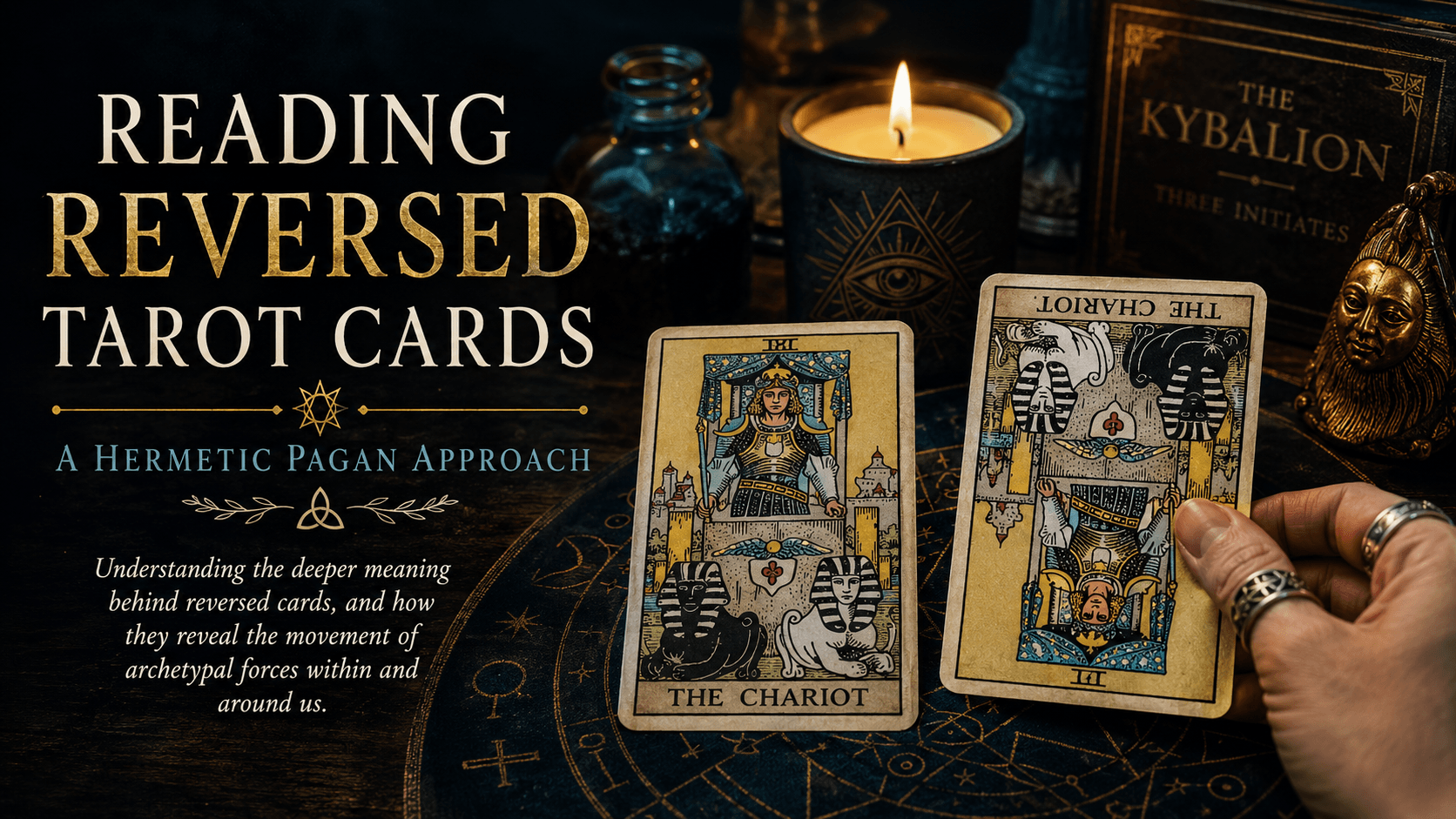
Consider the upright Chariot.
It represents directed movement, will, discipline, and the ability to bring opposing forces under conscious direction.
Reversed, it may show that the horses are pulling in different directions.
The problem is not a lack of energy.
There may actually be too much energy without coordination.
This distinction can completely change a reading.
The question becomes:
“What is preventing the current from flowing?”
3. The Shadow Aspect
Every archetypal force has expressions that can become unconscious or distorted.
The Emperor can become domination.
The Hermit can become isolation.
Justice can become cold judgment.
The Devil can become destructive attachment.
The reversed card can sometimes expose precisely this less conscious aspect.
But be careful.
A shadow interpretation is not automatically the correct interpretation.
Context determines whether the card is showing shadow, blockage, internalization, or something else.
4. Excess and Imbalance
Sometimes the problem is not too little of an energy.
It is too much.
The upright Queen of Cups may represent emotional sensitivity, compassion, receptivity, and intuition.
Reversed, she might indicate emotional overwhelm.
The person is not lacking Water.
They are drowning in it.
This is why simply memorizing:
Queen of Cups reversed = emotional instability
is inferior to understanding the underlying archetype.
You want to know why the imbalance is occurring.
5. Seed and Gestation
This is one of the most beautiful ways to understand certain reversals.
Imagine an Ace.
Upright, the Ace may represent the emergence of a new elemental force.
Reversed, the force may be present but not yet ready to emerge.
The seed exists.
The conditions are forming.
The manifestation has not yet broken through the soil.
This interpretation can be particularly useful when a reversal appears alongside cards suggesting patience, preparation, retreat, or incubation.
Not every delay is failure.
Some things must develop underground.
6. Return to Source
Finally, a reversed card can represent withdrawal.
The energy that previously manifested outwardly is returning inward.
This can correspond beautifully with the alchemical principle of solve: dissolution, breaking apart, returning a form to its constituent material so that transformation can occur.
Something may be ending.
Something may be composting.
Something may be withdrawing so that it can eventually return in another form.
The reversed card may therefore be less a warning than a statement:
“This cycle is turning.”
How to Read Reversed Tarot Cards in Practice
When a card appears reversed, resist the temptation to immediately consult a list of keywords.
Pause.
Look at the card.
Feel its presence.
Then ask:
How is this power oriented?
Is it moving outward?
Inward?
Downward?
Back toward its source?
Is the energy flowing?
Or is something obstructing it?
Is there too much of the energy?
Or too little?
Is this a shadow expression?
Or simply a quieter one?
Is something gestating?
Perhaps the upright expression is not absent.
Perhaps it is not ready.
Then compare the reversed card with its upright essence.
Speak both aloud.
For example:
“The upright Emperor is sovereignty, order, and directed will. Reversed, I am seeing that sovereignty turned inward—or perhaps obstructed.”
That small exercise keeps you connected to the living archetype instead of replacing it with a memorized definition.
Then examine the surrounding cards.
Tarot is relational.
A reversed card beside the Hermit may suggest withdrawal and contemplation.
The same reversed card beside the Tower might indicate resistance to necessary change.
Beside an Ace, it might suggest delayed manifestation.
The neighboring cards help determine how the reversal is behaving.
Four Examples of Reversed Cards
The Empress Reversed
The Empress upright expresses fertility, abundance, creativity, sensuality, nature, nourishment, and generative power.
Reversed, she does not suddenly become “bad.”
Consider several possibilities.
Perhaps creativity has become blocked.
Perhaps you are giving nourishment to everyone except yourself.
Perhaps abundance exists but you cannot receive it.
Perhaps sensuality has become disconnected from genuine embodiment.
Or perhaps something is gestating and requires patience before becoming visible.
The correct interpretation depends upon the question and surrounding cards.
The Tower Reversed
The Tower upright represents sudden revelation, collapse, liberation, and the destruction of unstable structures.
Reversed, one possibility is resistance.
You know something needs to change, but you are attempting to preserve it.
Another possibility is an internal Tower: the outer structure remains standing while your beliefs about it are collapsing internally.
A third possibility is that the disruption is delayed.
Again, the reversal does not necessarily mean “less Tower.”
It may mean Tower turned inward or resisted.
The Hermit Reversed
The Hermit upright is solitude, contemplation, wisdom, withdrawal, and the inward search for illumination.
Reversed, solitude may have become isolation.
The lantern is still present—but perhaps you have begun using solitude to avoid the world rather than understand yourself.
Alternatively, the card may indicate that you have spent enough time in contemplation and now need to return to ordinary life.
The same symbol can therefore ask two opposite questions:
“Why are you hiding?”
or:
“Why are you refusing to withdraw?”
Context decides.
The Devil Reversed
The Devil is particularly interesting.
Upright, the card can reveal attachment, compulsion, material fixation, temptation, bondage, or unconscious patterns.
Reversed, it may indicate the beginning of liberation.
The chain is loosening.
But it can also indicate a hidden attachment that has not yet been acknowledged.
The distinction is important.
A reversal does not automatically mean:
“You are free.”
It may instead ask:
“Are you actually ready to become free?”
Sometimes liberation begins with recognizing the chain.
Should You Read Reversed Cards?
Here is where many tarot teachers become unnecessarily dogmatic.
You do not have to.
Reading reversals is a method, not a religious obligation.
Some practitioners find that reversals greatly enrich their readings.
Others find that turning the cards upside down introduces unnecessary complexity and makes their intuitive relationship with the images less clear.
Both approaches can be legitimate.
When You Might Use Reversals
Reversals can be especially useful when you want additional information about:
- Internal psychological processes
- Blocked energy
- Shadow material
- Delays
- Imbalances
- Hidden potential
- Withdrawal
- Transformation
- The difference between internal and external manifestation
They can add another dimension to a reading.
But another dimension is not automatically a better reading.
More complexity does not always produce more wisdom.
When You Might Skip Reversals
There are several good reasons to work with upright cards only.
When You’re Learning the Deck
If you are still learning the 78 cards, adding a separate reversed vocabulary for every card can overwhelm you.
Learn the archetypes first.
Understand the upright cards deeply.
Then experiment with reversals.
You may find that your understanding of reversals becomes much more intuitive once the foundations are secure.
During Devotional or Theurgical Work
Some practitioners may prefer to use only upright cards when working devotionally with particular divine powers.
The purpose may be to contemplate the pure or clearly expressed form of an archetype rather than diagnose its obstruction or shadow.
In such a context, upright-only work can be intentional and perfectly complete.
When Reversals Create Noise
This is perhaps the simplest reason.
If you consistently look at a reversed card and immediately become confused, anxious, or dependent upon keyword lists, remove reversals.
Clarity is more valuable than complexity.
Your tarot practice should make you more perceptive, not less.
When Your Deck Is Difficult to Orient
Some decks have artwork that makes orientation ambiguous.
Others are deliberately symmetrical.
If the physical mechanics of determining a reversal become distracting, there is no spiritual prize for persevering.
The cards are tools.
Use the method that allows you to work with them most clearly.
An Experiment: One Lunar Cycle With Reversals, One Without
If you cannot decide whether you should read reversed cards, stop debating and experiment.
For one lunar cycle, use reversals.
Record your readings.
Pay particular attention to what reversed cards actually do in your personal practice.
Then, for another lunar cycle, use only upright cards.
Compare the two periods.
Ask:
- Which method produced clearer readings?
- Which helped me notice more?
- Did reversals consistently indicate specific themes?
- Did certain cards reverse repeatedly?
- Did the additional information actually improve my decisions?
- Did I become more intuitive or more dependent upon memorized meanings?
- Which method felt more sacred and focused?
This is a much better approach than blindly accepting someone else’s rule.
Your practice should eventually develop its own internal evidence.
Pay Attention to Repeating Reversals
If one particular card repeatedly appears reversed, take note.
Do not immediately assume that the universe is shouting at you.
Instead, investigate.
Suppose the Eight of Pentacles repeatedly appears reversed.
Perhaps you are struggling with discipline.
Perhaps you are avoiding practice.
Perhaps you are becoming obsessed with perfection.
Perhaps your current work simply needs a different method.
The repetition gives you a reason to investigate the archetype more deeply.
This is where tarot journaling becomes invaluable.
Record the card.
Record your interpretation.
Then record what happened.
After several months, you may discover that particular cards have developed remarkably consistent behaviors in your readings.
That is personal gnosis built through observation rather than assumption.
A Short Rite for Choosing Your Reversal Practice
If you want to make your choice consciously, place your deck before you.
Light a candle.
Take several breaths.
Then say:
I seek clarity rather than complexity.
I seek relationship rather than dogma.
May these images teach me to see.
May I recognize the movement of their powers
without surrendering my sovereignty.
Let the method serve the Work,
and not the Work serve the method.
Then ask yourself:
“Do reversals deepen my relationship with the cards?”
Do not force an immediate answer.
Write whatever comes.
You may decide to use reversals.
You may decide not to.
You may even decide that different forms of work require different methods.
That is acceptable.
Reversals and the Great Work
There is a useful Hermetic lesson hidden within the entire question of reversed cards.
The universe does not move in a straight line.
Things emerge.
They grow.
They mature.
They decline.
They dissolve.
They return.
They emerge again in another form.
The same is true of consciousness.
There are times when the will must move outward.
There are times when it must withdraw.
There are times when a power is fully expressed.
There are times when it is blocked.
There are times when something must descend into darkness before it can emerge transformed.
A reversed card can therefore become a miniature lesson in polarity.
The question is not whether upright is “good” and reversed is “bad.”
The question is:
Where is the current in its cycle?
That is a much richer question.
The Whole Mystery
Ultimately, upright and reversed cards belong to the same whole.
The Sun does not become its opposite when the card turns upside down.
The Hermit does not cease being the Hermit.
The Empress does not lose her generative nature.
The archetype remains.
What changes is the relationship between the archetype and the situation before you.
Perhaps the force is flowing.
Perhaps it is blocked.
Perhaps it is turning inward.
Perhaps it is excessive.
Perhaps it is gestating.
Perhaps it is dissolving.
Your task is to learn the difference.
And if you discover that reversals do not help you make that distinction, leave them aside.
There is no failure in an upright-only tarot practice.
There is no requirement that every practitioner use every technique.
The purpose of tarot is not to obey a collection of rules invented by other readers.
It is to cultivate attention, discernment, relationship, and wisdom.
Use reversals if they deepen those qualities.
Set them aside if they obscure them.
Either way, approach the cards consciously.
The wheel turns.
The powers wax and wane.
What descends will eventually rise.
What withdraws may return.
What appears blocked may be gestating.
And what appears upright may still contain a shadow.
The wise reader learns to recognize not merely what the card is, but how the power is moving.
That is where reversed tarot cards cease to be confusing.
They become another language for the movement of the Great Work.