There is a particular intimacy in reading tarot for yourself.
When you read for another person, you can observe their reactions, their questions, and the subtle ways they respond to the cards. When you read for yourself, there is nowhere to hide.
Your hopes are sitting at the table with you.
So are your fears.
This is precisely why a self-reading can become such powerful spiritual work.
From a Hermetic Pagan perspective, reading tarot for yourself is not a lesser form of divination. It can become an exercise in gnosis, contemplation, and self-theurgy—a deliberate attempt to bring the conscious mind into relationship with the deeper symbolic forces represented by the cards.
The tarot cards become a mirror.
You ask.
You observe.
You interpret.
And then you decide what to do.
The cards do not replace your sovereignty.
They help you see.
A simple three-card tarot spread is ideal for developing this relationship because it gives you enough information to recognize a pattern without drowning you in symbols.
Three cards can tell a story.
Three cards can reveal a tension.
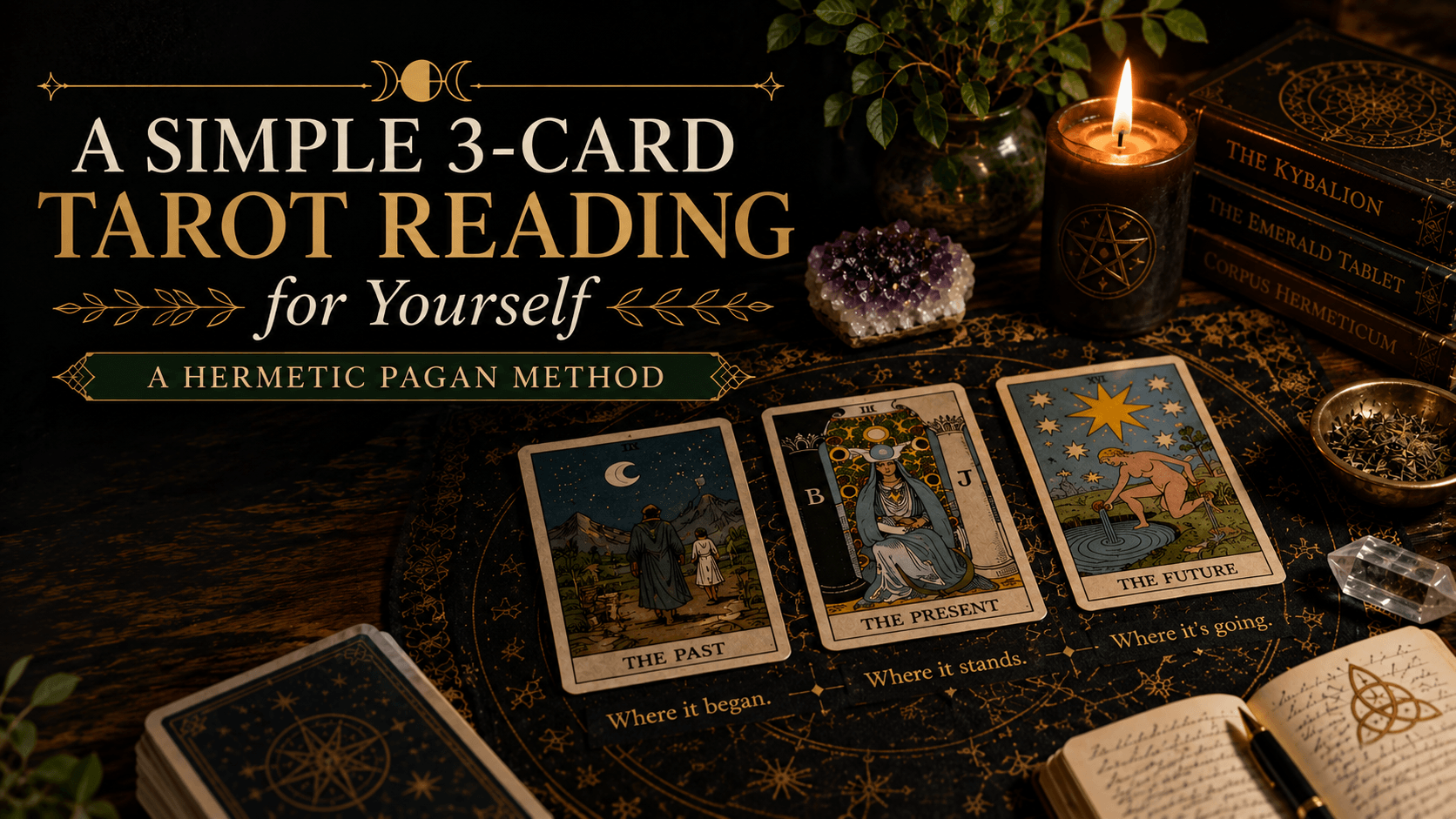
Three cards can show where something began, where it stands, and where it may be going.
And through a Hermetic lens, three is particularly rich: beginning, middle, and end; above, below, and the relationship between them; thesis, tension, and resolution.
Let’s turn this simple practice into a small sacred rite.
The Purpose of a Self-Reading
Before touching the deck, understand what you are actually trying to accomplish.
You are not asking the cards to take responsibility for your life.
You are not surrendering your decisions to an oracle.
You are not asking:
“What am I allowed to do?”
Instead, ask:
“What am I not seeing?”
That small change makes an enormous difference.
A tarot reading can reveal currents operating within and around you. It can expose assumptions, illuminate possibilities, and show where your present trajectory may be leading.
The Hermetic principle of correspondence suggests that the inner and outer worlds are not completely separate.
Your circumstances affect your consciousness.
Your consciousness affects how you interpret and respond to your circumstances.
The tarot provides a symbolic meeting place between the two.
A self-reading therefore becomes an opportunity to examine both:
What is happening around me?
and
What is happening within me?
That is where the practice becomes transformative.
Preparing Your Sacred Space
You don’t need an elaborate temple.
A quiet table is enough.
If you maintain an altar, however, this can be an excellent place for your reading.
Choose a time when your mind is reasonably clear.
Dawn can be beautiful for readings involving beginnings.
Dusk can be appropriate for reflection and transition.
A Mercury hour can be chosen for questions involving communication, decisions, learning, and interpretation.
A lunar period can be appropriate for emotional or intuitive questions.
But don’t become so obsessed with timing that you never actually perform the reading.
A clear mind is more valuable than a perfect planetary hour.
Before beginning, clean the physical space.
You can light incense, ring a bell, sprinkle a little consecrated water nearby, or simply wipe the table clean.
If you practice ceremonial magic, you may use whatever opening or banishing ritual belongs to your tradition.
If you practice Paganism more informally, you might simply acknowledge the four directions and the center.
For example:
Earth beneath me,
Air around me,
Fire within me,
Water flowing through me.
Let this space become a place of clear seeing.
Then sit quietly.
Take three slow breaths.
Let your body settle.
Let your emotions settle.
Let your thoughts become less frantic.
A Simple Opening Invocation
If you work with Hermes, Thoth, Mercury, a particular deity, your ancestors, or another spiritual current, you can make a brief invocation according to your tradition.
You might say:
Powers of wisdom and clear sight,
guardians of sacred knowledge,
guide my understanding as I open these cards.
Let what is useful become visible.
Let confusion fall away.
Let me see without fear
and interpret without deception.
May wisdom guide my will.
You don’t need to invoke anything if that isn’t part of your practice.
You can simply dedicate the reading to truth, wisdom, and honest self-knowledge.
Choose Your Three-Card Tarot Spread
There are countless tarot spreads, but you don’t need twenty positions to perform a meaningful reading.
Choose one of the following.
The Simple Current
This is perhaps the easiest spread for beginners.
Card 1 — The Root
What force or pattern gave rise to the current situation?
Card 2 — The Present
What is unfolding now?
Card 3 — The Emerging Path
What is developing, or what wisdom should I consider moving forward?
This spread is excellent for general questions.
It creates a simple movement:
Origin → Present → Emerging Future
Remember that the third card does not have to be interpreted as an unavoidable prediction.
Think of it as the direction toward which the current is flowing.
The Threefold Path
This spread approaches the situation through three levels of experience.
Card 1 — Body
What is happening in the material or practical realm?
Card 2 — Heart
What is happening emotionally or relationally?
Card 3 — Spirit
What higher principle, lesson, or spiritual orientation should I contemplate?
This is particularly useful when your mind, emotions, and practical circumstances seem to be pulling in different directions.
The goal isn’t to make one level more important than the others.
It is to understand the relationship between them.
Situation – Veil – Way Forward
This is an excellent spread when you’re confused about something.
Card 1 — Situation
What is actually happening?
Card 2 — Veil
What is preventing me from seeing clearly?
Card 3 — Way Forward
What would represent the wiser course of action?
This spread is particularly useful because the second card forces you to look for the distortion.
Perhaps fear is obscuring the situation.
Perhaps wishful thinking is.
Perhaps another person’s influence is.
Perhaps you simply don’t have enough information yet.
The “Veil” card isn’t necessarily negative.
Sometimes the veil is simply ignorance waiting to become knowledge.
Speak the Positions Aloud
Before drawing, name each position.
For example:
“This card represents the root.”
Draw.
Then:
“This card represents the present.”
Draw.
Then:
“This card represents the emerging path.”
Draw.
This simple practice makes the reading feel intentional rather than random.
You have established a symbolic contract with yourself.
You have defined what each position means before the cards appear.
That helps prevent you from changing the rules afterward to obtain the answer you wanted.
How to Perform the Reading
Now we come to the heart of the practice.
1. Form Your Question
Make the question specific enough to be useful.
Instead of:
“What will happen to me?”
try:
“What do I need to understand about my current career situation?”
Instead of:
“Will this relationship work?”
try:
“What is the most important dynamic I need to understand in this relationship?”
Good tarot questions invite understanding.
They don’t simply demand certainty.
2. Shuffle With Focused Will
Hold the question in your mind while shuffling.
Don’t strain.
Don’t try to force a particular card.
Simply let your attention remain with the question.
Some readers cut the deck.
Some draw from the top.
Some spread the cards across the table and choose intuitively.
Some allow cards to jump or fall.
There is no single universally correct method.
Choose one and use it consistently enough to develop familiarity.
3. Lay Out the Three Cards
Place them from left to right.
You can also arrange them as a triangle.
Don’t turn them over immediately.
Take a breath.
Look at the backs of the cards.
Notice your emotional response.
Are you nervous?
Excited?
Expecting something?
That reaction is information too.
Then turn the cards over one at a time.
4. Look Before You Interpret
This is one of the most important habits you can develop.
Do not immediately reach for a tarot guidebook.
Look at the image first.
Ask:
What do I notice?
What emotion does the image create?
Where does my eye go?
What element dominates the card?
Is the figure moving or still?
Does the image feel open or closed?
What detail seems strangely important?
Only after observing the card should you bring in traditional tarot meaning.
This keeps the reading from becoming a mechanical exercise in memorization.
5. Speak the Cards
Say their names aloud.
For example:
“The Hermit.”
“Five of Cups.”
“The Sun.”
Notice what happens when the three names are spoken together.
The Hermit.
Five of Cups.
The Sun.
Suddenly you have a narrative.
Someone withdraws.
Someone grieves.
Then illumination arrives.
Perhaps the reading is suggesting that solitude is allowing grief to be processed before a clearer and more hopeful perspective emerges.
The individual tarot cards haven’t changed.
Their relationship has.
That relationship is where much of the real reading happens.
Reading the Cards Through a Hermetic Pagan Lens
A Hermetic approach asks you to look beyond isolated definitions.
Think in terms of correspondences.
Which elements appear?
Are there many Cups?
Perhaps Water dominates the reading.
Are there numerous Swords?
Perhaps Air—thought, conflict, communication, analysis—is demanding attention.
Are there many Pentacles?
The practical and material world may be central.
Are the Wands everywhere?
Perhaps will, passion, creativity, and action are driving the situation.
Then look at the Major Arcana.
If several Major Arcana appear, you might interpret the reading as involving larger archetypal or developmental forces rather than merely mundane circumstances.
Numbers can also speak.
Repeated numbers may establish a pattern.
Court cards may represent people, aspects of yourself, stages of development, or particular modes of behavior.
And then there are the planetary correspondences.
If you have studied astrology alongside tarot, you can begin layering those relationships into the interpretation.
The cards become increasingly interconnected.
This is the Hermetic method at its most beautiful:
Nothing exists in isolation.
Are the Gods or Spirits Speaking?
For practitioners who incorporate deity or spirit work, this question may naturally arise.
Perhaps a particular card repeatedly appears when you work with a specific deity.
Perhaps a symbol on a card immediately reminds you of a god, goddess, ancestor, or spirit.
You can record that impression.
But maintain discernment.
Personal gnosis is meaningful within personal practice, but it should not automatically be treated as universal doctrine.
You can write:
“This card reminds me strongly of Hermes.”
without claiming:
“Hermes has objectively commanded me to do this.”
That distinction protects your sovereignty.
A tarot reading is counsel.
It is not a substitute for judgment.
A Short Example Reading
Imagine that you ask:
“What do I need to understand about my creative work right now?”
You draw:
Card 1 — Root: The Hermit
Card 2 — Present: Eight of Pentacles
Card 3 — Emerging Path: The Sun
A superficial reading might say:
“You will become successful.”
But a deeper reading tells a much more interesting story.
The Hermit suggests that the root of the situation lies in solitude, study, and searching for your own light.
The Eight of Pentacles says that the present requires repetition, craftsmanship, and disciplined practice.
The Sun suggests that continued development can eventually bring greater confidence, visibility, vitality, and expression.
The cards therefore don’t simply predict success.
They describe a path.
Study.
Practice.
Then illumination.
The Hermit leads naturally into the disciplined craftsmanship of the Eight of Pentacles, which eventually opens toward the radiance of the Sun.
This is the difference between memorizing tarot meanings and actually reading tarot.
Closing the Reading
When the reading feels complete, don’t simply scoop up the cards and walk away.
Close the space intentionally.
Say:
I give thanks for the wisdom revealed.
May what is useful remain with me.
May confusion fall away.
May I carry this knowledge into wise action.
The reading is complete.
If you invoked particular deities, spirits, or elemental powers, thank them according to your tradition.
You can leave a small offering if that is appropriate to your practice.
An offering doesn’t have to be elaborate.
Incense, flowers, water, food, or simply a moment of sincere gratitude can be enough.
Then extinguish the candle.
Take a few breaths.
Touch the floor or Earth.
Eat something if you feel ungrounded.
The reading is finished.
Record Everything
Keep a tarot journal.
Write down:
- The date
- Your question
- The spread used
- Each card
- Your first impressions
- Traditional meanings
- Elemental correspondences
- Astrological associations
- Any intuitive impressions
- Your interpretation
- What eventually happened
This transforms your readings into a personal archive.
After months or years, you may begin noticing patterns that no textbook could teach you.
Perhaps certain cards repeatedly appear before particular kinds of events.
Perhaps you discover personal meanings for certain images.
Perhaps your intuition becomes faster and more precise.
Your journal becomes a kind of personal book of correspondences.
In a very real sense, you are writing your own relationship with the tarot.
The Biggest Mistake: Asking Again and Again
There is one habit that can destroy the clarity of a self-reading faster than almost anything else.
Asking the same question repeatedly because you don’t like the answer.
You draw the Three of Swords.
You don’t like it.
So you shuffle again.
You get The Tower.
You panic.
You shuffle again.
You get The Devil.
Now you are convinced something terrible is coming.
Stop.
This isn’t deeper divination.
It’s anxiety masquerading as divination.
Repeatedly asking the same question can produce increasingly confusing readings because you’re no longer approaching the cards with an open mind.
You’re trying to negotiate with them.
Instead, sit with the original reading.
Journal it.
Ask yourself what uncomfortable truth you may be avoiding.
Then act.
The purpose of divination is not to make you dependent upon divination.
It is to help you see clearly enough to act consciously.
What If You Draw a Difficult Card?
The appearance of Death, The Devil, The Tower, Ten of Swords, or another challenging tarot card does not mean you have been cursed.
A difficult archetype can describe:
- Transformation
- Attachment
- Necessary endings
- Psychological patterns
- Conflict
- Truth coming to light
- The collapse of something unstable
- A process that requires courage
Tarot isn’t a system where “positive” cards are good and “negative” cards are evil.
The Tower can liberate you.
Death can release you.
The Devil can expose your chains.
The Five of Cups can teach you where grief remains unresolved.
Even the most difficult tarot card can contain medicine.
The Threefold Mirror
A three-card reading may look simple.
But simplicity is not the same as superficiality.
Three cards can become three mirrors:
What created this?
What is happening now?
What is emerging?
Or:
Body.
Heart.
Spirit.
Or:
Situation.
Veil.
Way forward.
The structure gives your intuition boundaries.
The cards provide the symbols.
Your consciousness creates the interpretation.
And, for those who practice Hermetic Paganism, the entire process can become an act of correspondence between the visible and invisible worlds.
You aren’t merely asking:
“What will happen?”
You are asking:
“What is the pattern here, and how should I meet it?”
That is a much more powerful question.
Make the Practice Your Own
There is no need to make every reading elaborate.
You can perform a three-card tarot reading in ten minutes.
Light a candle.
Center yourself.
State your question.
Shuffle.
Draw three cards.
Look.
Listen.
Journal.
Close.
That is enough.
Over time, however, the practice may deepen.
You may begin incorporating elemental invocations, planetary hours, lunar timing, deity work, sacred geometry, meditation, or other forms of magical practice.
But don’t rush toward complexity.
Master the simple three-card tarot spread first.
Learn how your deck speaks.
Learn how your intuition behaves.
Learn when you are projecting what you want to hear.
Learn when fear is distorting your interpretation.
Learn how to distinguish a genuine insight from an anxious thought.
This is where the real discipline of tarot begins.
A self-reading is not an opportunity to surrender your power to the cards.
It is an opportunity to take greater responsibility for how you see.
And perhaps that is the deepest Hermetic lesson of all:
The oracle does not live somewhere outside you, waiting to dictate your life.
The cards provide the mirror.
You must learn how to look into it.