Tarot has always attracted a strange mixture of fascination and fear.
To some people, tarot cards are little more than a colorful game. To others, they are mysterious objects capable of revealing forbidden knowledge, summoning spirits, or predicting an unavoidable future.
And within modern occult culture, tarot has accumulated its own collection of rules: Never buy your own deck. Never let anyone touch your cards. Never read yourself. Never use reversed cards incorrectly. Never read at night.
Some of these traditions can be meaningful within particular practices.
Others are simply myths.
From a Hermetic Pagan perspective, clearing away these misconceptions is itself a kind of purification. Just as we might cleanse a new tarot deck before using it, we can also cleanse the ideas surrounding the tarot.
The cards do not need fear and superstition to make them sacred.
They are already fascinating enough.
Tarot can be approached as a symbolic system of archetypes, elements, planets, numbers, virtues, vices, cycles, and stages of spiritual development. For the Hermetic practitioner, it can become a miniature reflection of the greater cosmos—the microcosm reflecting the macrocosm.
For the Pagan practitioner, it can become a way of contemplating divine powers, myths, spirits, nature, and the mysteries of existence.
And for the practical reader, it can simply be an extraordinarily effective language for examining situations from perspectives that ordinary thinking tends to overlook.
So let’s clear away some of the fog.
Myth #1: “Tarot Is Evil, Satanic, or Demonic”
This is perhaps the oldest and most persistent fear surrounding the cards.
But the historical story is considerably more complicated.
Tarot emerged in Renaissance Europe as a card game before its later association with occultism and divination. Its esoteric interpretations developed much later through European occult and magical traditions.
In other words, the tarot did not originate as a Satanic system.
Its later occult development became intertwined with Hermeticism, astrology, ceremonial magic, Kabbalah, Neoplatonic philosophy, and other esoteric currents.
From a Hermetic Pagan perspective, the imagery can therefore be approached through a very different framework.
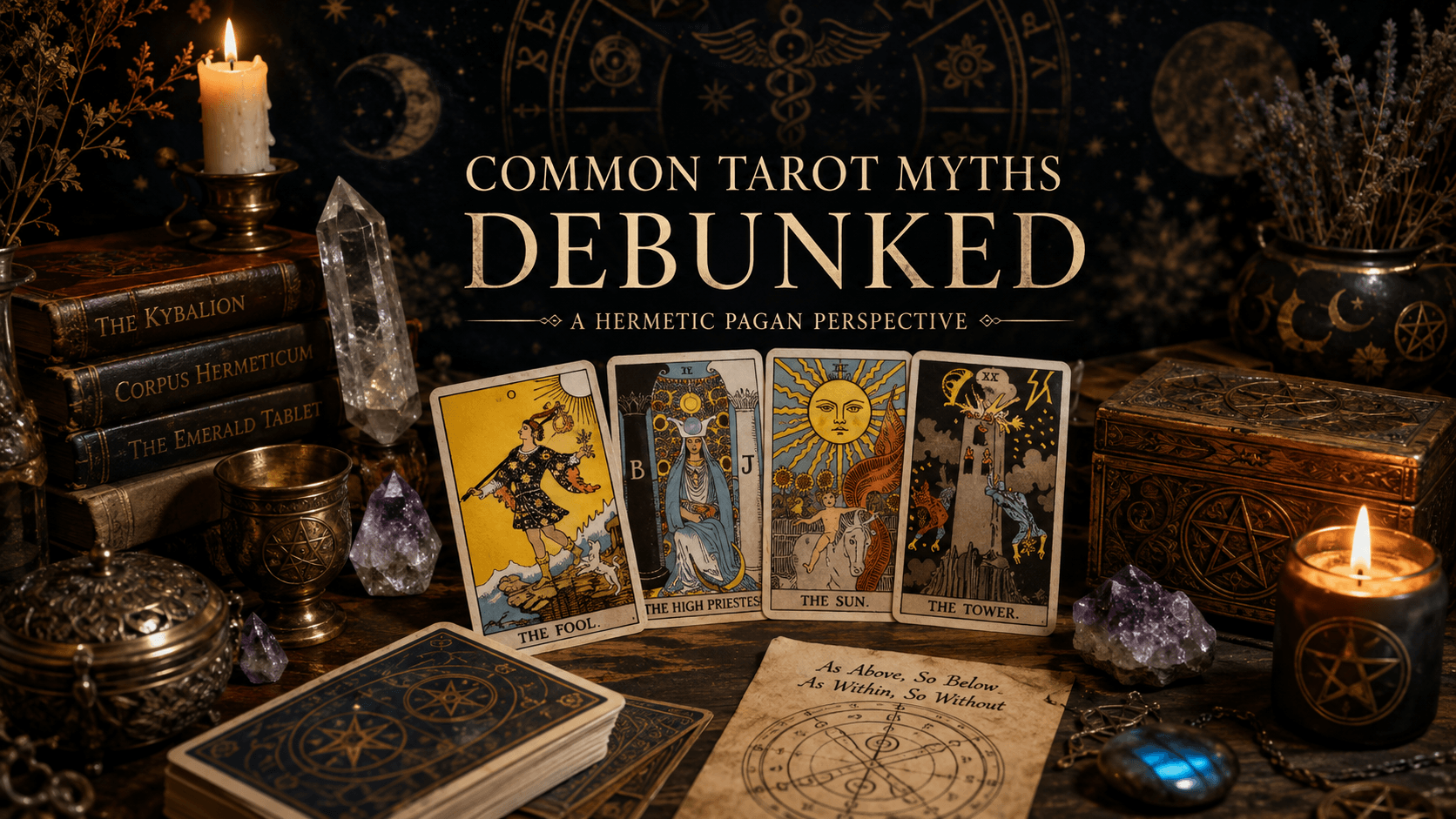
The Emperor can be contemplated through authority and ordered manifestation.
The High Priestess can evoke hidden wisdom and the mysteries of the lunar realm.
The Sun can represent illumination, vitality, consciousness, and divine radiance.
The Tower can represent the destruction of false structures.
The four suits can be contemplated through the elemental powers of Fire, Water, Air, and Earth.
None of this requires a Satanic interpretation.
Nor does working with tarot require worshipping or invoking anything at all.
A Pagan or Hermetic practitioner who chooses to incorporate deities or spirits into their practice may develop relationships with particular divine powers, but that is a matter of personal religious practice—not an inherent property of the cards.
Calling tarot “evil” simply because it deals with invisible realities confuses mystery with malevolence.
Myth #2: “Tarot Predicts a Fixed and Unchangeable Future”
This misconception can make tarot seem much more frightening than it actually is.
Imagine being told that a particular card guarantees something terrible will happen to you.
What could you possibly do about it?
From a Hermetic perspective, this interpretation misunderstands divination.
The famous Hermetic principle of correspondence—often summarized as “As above, so below”—is about relationships between levels of reality.
It does not necessarily imply that every event is predetermined.
A tarot reading can be understood as a snapshot of the currents surrounding a situation.
It can reveal:
- Present tendencies
- Psychological patterns
- Possible developments
- Hidden influences
- Conflicting desires
- Opportunities
- Obstacles
- Probable consequences of current choices
This is very different from saying, “This must happen.”
Consider The Fool.
The Fool represents movement into the unknown.
The Magician represents directed will and the ability to work with available resources.
Together, these archetypes make an important philosophical statement:
The future is not merely something you watch arrive. Your consciousness participates in what comes next.
This is why tarot can be particularly useful for decision-making.
A reading doesn’t have to tell you what fate has already decided.
It can show you what your current path is likely to produce—and give you an opportunity to choose differently.
That is the essence of tarot free will.
Myth #3: “Only Psychics Can Read Tarot”
You do not need to be born with supernatural powers to learn tarot.
You need to learn a symbolic language.
A person learning tarot is doing something remarkably similar to learning another language.
At first, the images seem disconnected.
Then individual words begin to make sense.
Eventually, combinations become understandable.
Finally, you can have a conversation.
The Hermetic tradition places enormous importance on the faculty of intellect, contemplation, and the divine intelligence often described through the concept of Nous.
The ability to contemplate symbols isn’t reserved for a tiny class of gifted people.
It can be cultivated.
Intuition can also be cultivated.
The beginner who studies the cards, journals readings, compares predictions with outcomes, learns elemental correspondences, studies astrology, and practices regularly can become dramatically better over time.
You don’t have to wait for lightning to strike.
Practice is itself a magical discipline.
Myth #4: “The Cards Themselves Are Inherently Magical or Dangerous”
A tarot deck can certainly become a sacred object.
But this does not mean that every printed deck is automatically charged with supernatural power.
Think about a ritual object such as a statue, wand, altar tool, or ceremonial blade.
Within a magical tradition, an object may be consecrated and assigned a particular purpose.
The same principle can apply to tarot.
A deck becomes meaningful through symbolism, intention, ritual, repeated use, and relationship.
This is why cleansing and consecrating a new tarot deck can be meaningful even if you don’t believe that manufacturing or shipping literally leaves behind supernatural residue.
The ritual establishes a psychological and spiritual boundary.
You are declaring:
This object now belongs to my sacred practice.
The danger is therefore not necessarily in the cardboard itself.
The greater danger is allowing fear to replace discernment.
A responsible practitioner learns how to establish boundaries, recognize unhealthy obsession, distinguish intuition from anxiety, and maintain personal sovereignty.
Myth #5: “You Must Never Buy Your Own Tarot Deck”
This is one of the most widespread modern tarot superstitions.
And it is difficult to find a compelling universal basis for it.
The idea that a tarot deck must be received as a gift may be meaningful within certain families, traditions, or personal practices.
But it is not a universal law of tarot.
Hermetic and Pagan practitioners have long worked with magical tools that were purchased, constructed, inherited, commissioned, or gifted.
What matters is how the tool is subsequently integrated into the practice.
Buying your own deck can actually carry powerful symbolism.
You are choosing the images.
You are choosing the system.
You are choosing to begin studying.
You are making an intentional commitment to your path.
If a deck feels right to you, you do not need to wait for someone else to buy it.
You can buy it yourself, cleanse it, consecrate it, and begin your relationship with it.
That isn’t bad luck.
It can be an act of magical sovereignty.
Myth #6: “Tarot Is Only for Fortune-Telling”
This is perhaps the greatest reduction of tarot.
Divination is certainly an important use of tarot.
But it is only one.
A Hermetic Pagan approach can use the cards for:
Self-Knowledge
The images can reveal patterns you habitually overlook.
Shadow Work
Difficult cards can provide symbolic language for confronting fear, denial, obsession, anger, grief, and other uncomfortable aspects of the psyche.
Meditation
A single card can become an object of contemplation for an entire ritual.
Theurgy
For practitioners who incorporate deity work, tarot can provide a symbolic framework for contemplating divine qualities and relationships.
Spirit Work
Some practitioners use tarot as one method of communicating with spirits or ancestors, although discernment and clear boundaries are essential.
Magical Timing
Cards can be combined with planetary and elemental correspondences when planning magical or practical actions.
Philosophical Study
The Major Arcana can be contemplated as a symbolic journey through different states of consciousness and stages of existence.
Decision-Making
A tarot spread can illuminate competing possibilities and consequences.
Reducing all of this to “predicting the future” is like reducing astrology to reading your horoscope in a newspaper.
There is considerably more beneath the surface.
Myth #7: “Reversed Tarot Cards Are Always Negative”
A reversed card isn’t automatically a bad card.
In fact, there is no single universal interpretation of reversals.
Some readers use them.
Some don’t.
Both approaches can work.
For readers who use reversals, a reversed card might indicate:
- Internalized energy
- Blocked expression
- Excess
- Deficiency
- Delay
- A hidden dimension of the archetype
- Something developing internally rather than externally
The upright Five of Wands, for example, might describe visible conflict.
Reversed, the same archetype could suggest internal conflict, suppressed competition, or tension that has moved beneath the surface.
The card hasn’t suddenly become “evil.”
Its expression has changed.
This is an important principle for understanding tarot meaning generally:
An archetype can manifest in many ways.
Myth #8: “Tarot Is a Completely Closed or Forbidden Practice”
There are certainly initiatory traditions within occultism.
Some magical systems have specific teachings, rituals, symbols, or initiations that should be approached within their original context.
Respecting those boundaries is important.
But that does not mean tarot itself is universally closed.
Tarot has been studied, interpreted, redesigned, and incorporated into numerous spiritual and occult systems.
Modern practitioners approach it through many different frameworks: psychological, Pagan, Hermetic, ceremonial magical, mystical, artistic, and secular.
You don’t need to claim initiation into a tradition you haven’t entered.
But you also don’t need to be frightened away from studying tarot because someone on the internet declares that you are “not allowed” to touch it.
Study honestly.
Credit your sources.
Respect traditions.
And distinguish personal gnosis from historical fact.
That is a much healthier foundation for magical practice.
Myth #9: “Using Tarot Will Automatically Invite Dark Forces”
This fear often comes from treating the cards as if they were magical portals that automatically summon whatever happens to be lurking nearby.
A more mature magical perspective emphasizes intention, boundaries, discernment, and relationship.
If your tradition includes banishing rituals, purification, protective prayers, ancestor work, or other spiritual safeguards, use them according to your practice.
But don’t confuse the existence of spiritual discernment with the belief that every tarot deck is dangerous.
A deck sitting on your bookshelf is not necessarily an open door to anything.
And if you use tarot as a secular tool for reflection, there is no reason to assume that drawing a card automatically summons a spirit.
The practitioner determines the framework.
That distinction matters.
So What Is Tarot?
After removing all these misconceptions, what remains?
Something much more interesting.
From a Hermetic perspective, tarot can be approached as a visual grammar of correspondences.
The cards contain relationships between:
- Elements
- Planets
- Numbers
- Archetypes
- Human experiences
- Virtues and vices
- Cycles of growth and decline
- Consciousness and manifestation
The Major Arcana can be viewed as a great symbolic journey.
The Minor Arcana brings those archetypal principles into the elemental world of everyday experience.
The four suits become four modes of manifestation.
A tarot spread then becomes more than a random collection of pictures.
It becomes a temporary symbolic universe.
Each position establishes a relationship.
Each card modifies the others.
And the reader’s task is to perceive the pattern.
This is why becoming proficient with tarot takes more than memorizing 78 definitions.
You are learning to recognize relationships between symbols.
Tarot as a Mirror of the Microcosm and Macrocosm
One of the most powerful ways to approach tarot through Hermetic philosophy is to see the cards as a bridge between the inner and outer worlds.
The outer event affects the inner world.
The inner state influences the way we experience the outer event.
The tarot sits between these realms as a symbolic mirror.
You ask a question.
You encounter an image.
The image activates memory, intuition, association, emotion, and reason.
Suddenly you are looking at your situation from an angle you might never have considered.
This is why tarot can reveal things even when you don’t approach it as literal supernatural prediction.
And for those who do practice divination as a spiritual art, the same symbolic language can become part of a deeper relationship with deity, spirit, or the unseen dimensions of reality.
The important thing is to approach that relationship with humility.
A Simple Ritual for Releasing Fear of Tarot
If you’ve inherited fear around tarot, try this simple exercise.
Place your deck before you.
Light a candle.
Take several slow breaths.
Look at the cards without performing a reading.
Then say:
I release fear that does not belong to me.
I release superstition that obscures understanding.
I approach these symbols with discernment, respect, and sovereignty.
May I see clearly.
May I interpret wisely.
May I remain grounded in my own will.
Shuffle the deck.
Draw one card.
Don’t ask about your future.
Ask instead:
“What can this symbol teach me?”
Spend several minutes studying the image.
Write down what you notice.
That is enough.
You have transformed fear into contemplation.
The Deeper Mystery
Perhaps the most interesting thing about tarot is that you don’t need to believe every supernatural claim about it to recognize its power.
And you don’t need to dismiss every spiritual interpretation to remain rational.
There is a middle ground between blind superstition and cynical dismissal.
That middle ground is practice.
Study the cards.
Learn their history.
Explore their symbolism.
Experiment with tarot spreads.
Journal your readings.
Compare your interpretations with traditional tarot meaning.
Develop your intuition.
Question your assumptions.
And if you work within a Hermetic or Pagan tradition, bring the cards into conversation with the larger symbolic universe of your practice.
The goal isn’t to become frightened of the deck.
It is to become fluent in it.
Tarot does not need to be a forbidden object.
It does not need to be an infallible oracle.
It does not need to be a supernatural weapon.
And it certainly does not need to be reduced to a party trick.
It can be a mirror.
A meditation tool.
A divinatory system.
A symbolic language.
A philosophical map.
A devotional instrument.
A companion in the Great Work.
And, perhaps most importantly, a way of learning to look beneath the surface of things.
Clearing away misconceptions is therefore more than an intellectual exercise.
It is a form of purification.
When fear falls away, the cards become easier to approach.
When superstition falls away, discernment becomes possible.
And when you stop asking whether tarot is “good” or “evil,” you can finally begin asking the more interesting question:
What can these symbols teach me about the universe—and about myself?