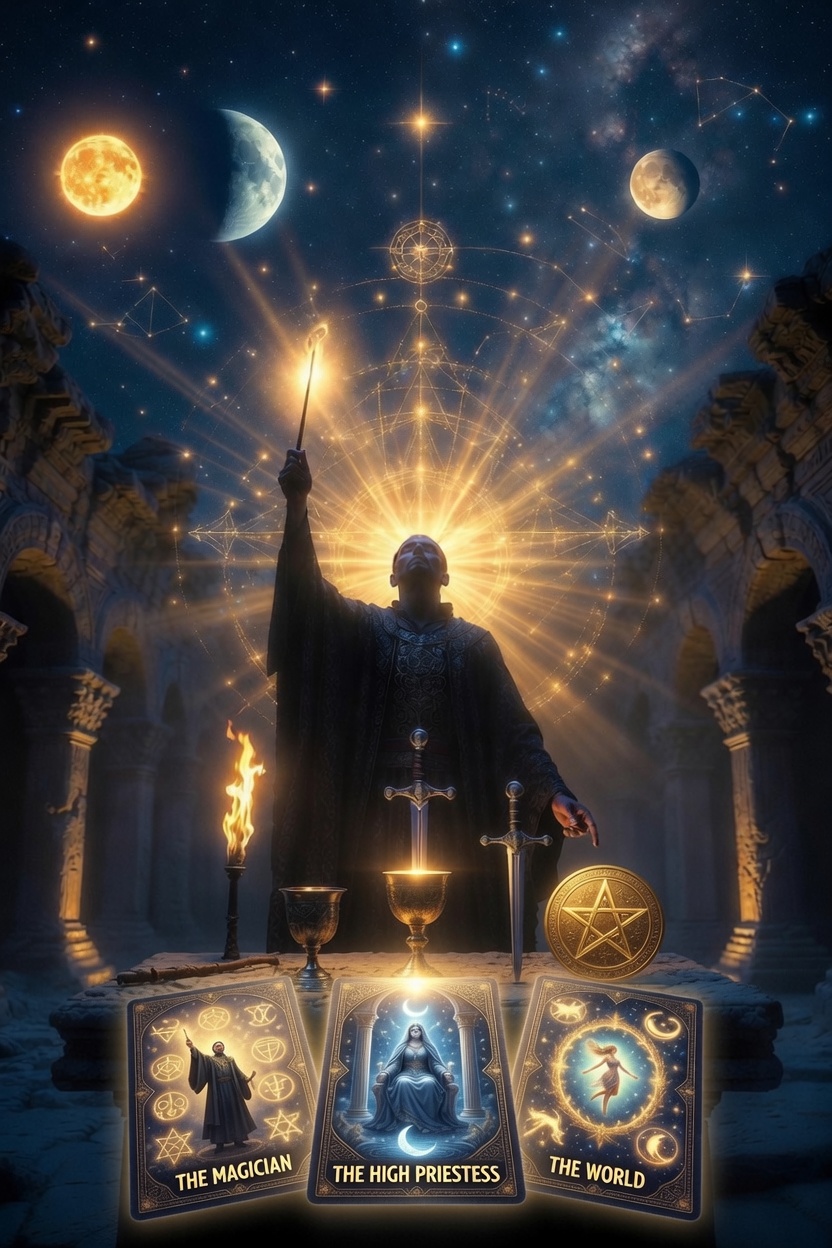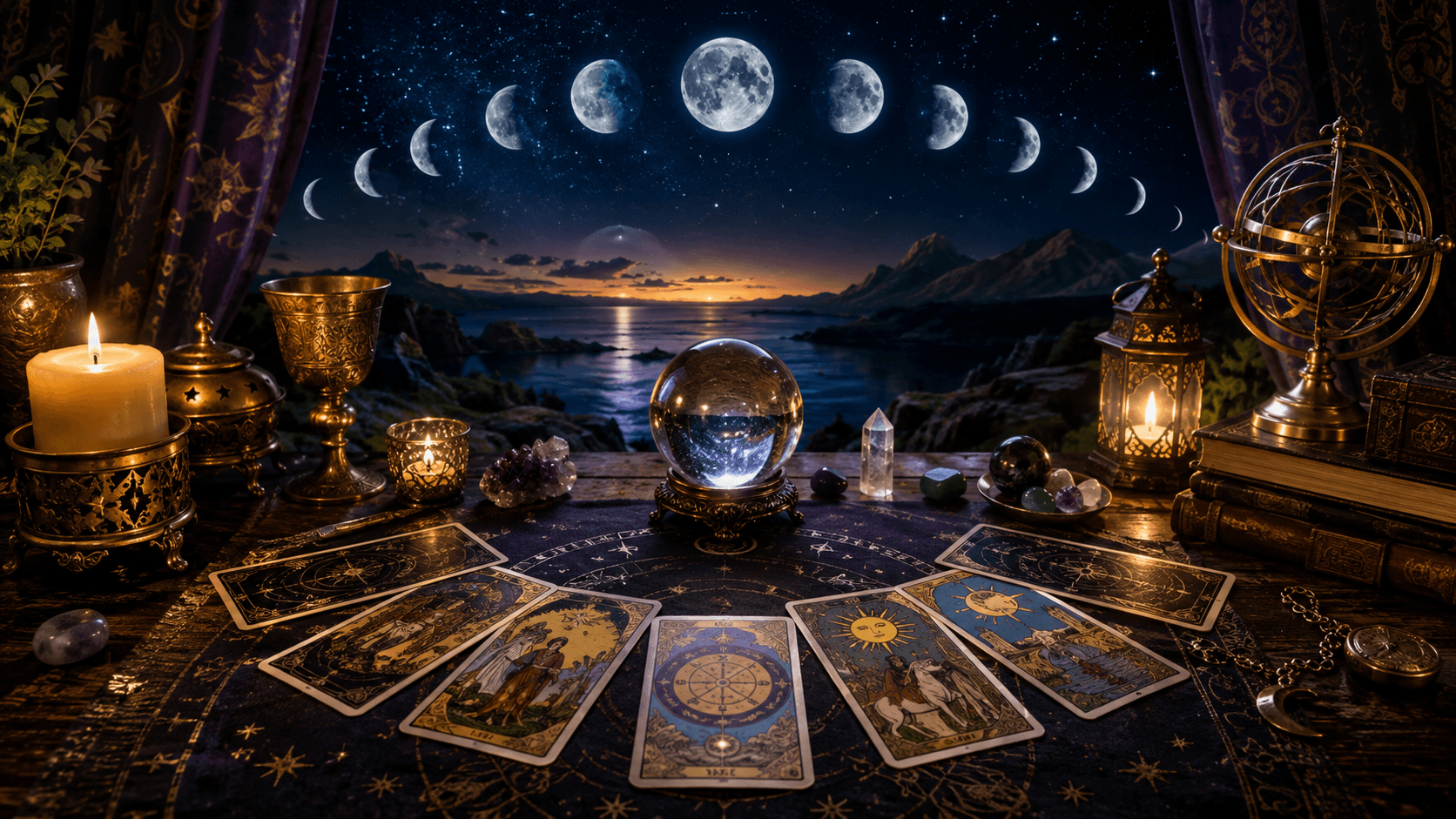
As above, so below.
The heavens move, and so do we.
The Moon waxes and wanes. The planets travel their ancient courses. Light increases, reaches its fullness, diminishes, and returns. The tides answer the Moon without being commanded. Seeds rise from darkness toward the Sun. Seasons turn according to laws far older than human memory.
And within this same living order, we practice Tarot.
Tarot is often approached as though it were an isolated system: seventy-eight cards placed upon a table, interpreted according to a fixed collection of meanings. But from a Hermetic Pagan perspective, the cards do not exist apart from the cosmos. They participate in it.
The Tarot is another language of correspondence.
The principle is beautifully expressed by the ancient Hermetic maxim:
As above, so below. As within, so without.
The movements of the heavens can therefore become part of our Tarot practice. The phase of the Moon, the planetary day, and even the planetary hour can provide a celestial context for a reading.
This does not mean that the Moon forces a particular card to appear or that Saturn condemns us to difficulty on Saturday. Rather, celestial timing gives us another layer through which to understand the symbolic atmosphere surrounding our work.
A lunar tarot reading performed beneath a Full Moon is approached differently from one performed during the Dark Moon.
A question about love asked on Friday carries a different symbolic emphasis from a question asked on Tuesday.
A reading undertaken during a Jupiterian hour may naturally invite attention toward expansion, opportunity, wisdom, and abundance.
The heavens become part of the conversation.
The Moon as the Great Mirror
Of all the celestial bodies, the Moon has perhaps the most intimate relationship with divination.
She does not generate her own light. She reflects.
And this makes her an extraordinary symbol for Tarot.
The cards, too, reflect.
They do not necessarily tell us something that exists nowhere else. Instead, they bring patterns into consciousness. They illuminate what has been overlooked, give symbolic form to what has remained unconscious, and provide a reflective surface upon which the inner world can become visible.
The Moon has traditionally been associated with intuition, dreams, the subconscious, imagination, the astral realm, fertility, receptivity, and the changing tides of emotion.
Her phases also provide a natural magical cycle:
increase → fullness → decrease → darkness → renewal.
This rhythm can be applied directly to Tarot practice.
Rather than asking, “What does the Moon mean for my reading?” we can ask a more useful question:
What kind of work is this phase inviting me to undertake?
The answer changes throughout the lunar cycle.
Tarot Practice Through the Lunar Cycle
You do not need elaborate astrology software or a complicated magical system to begin working with lunar timing.
Simply observe the Moon.
Then allow the symbolic quality of the current phase to influence the questions you bring to the cards.
New Moon — Planting the Seed
The New Moon is a beginning.
The sky is dark, but the darkness is not empty. Something is being prepared.
This makes the New Moon particularly suitable for questions concerning beginnings, intentions, possibilities, and potential.
Instead of asking:
“Will this work?”
try:
“What wants to begin through me?”
Or:
“What seed should I plant during this cycle?”
A simple New Moon spread
Card 1 — The Seed: What wants to emerge?
Card 2 — The Soil: What conditions will support it?
Card 3 — The First Action: What should I do now?
The New Moon is especially appropriate for Tarot readings concerning new projects, relationships, spiritual practices, personal transformations, and intentions for the coming cycle.
Do not demand immediate results from a New Moon reading.
A seed does not become a tree overnight.
Waxing Moon — Growth and Attraction
As the Moon increases in light, so too does the symbolic emphasis on growth.
The Waxing Moon is traditionally associated with attraction, development, strengthening, building, and drawing things toward oneself.
This is an excellent period for readings concerning:
- personal development
- increasing confidence
- attracting opportunities
- strengthening relationships
- developing creative projects
- building prosperity
- cultivating spiritual practices
A useful three-card spread is:
Card 1 — What is growing?
Card 2 — What will strengthen it?
Card 3 — What should I give more energy to?
During the Waxing Moon, pay particular attention to cards suggesting movement, fertility, expansion, creativity, vitality, and opportunity.
The cards may reveal where your energy is already producing results — and where it is being wasted.
Full Moon — Revelation and Illumination
The Full Moon is the moment of maximum lunar light.
Symbolically, what was hidden may become visible.
This makes the Full Moon particularly powerful for illumination, culmination, revelation, gratitude, consecration, and shadow work.
The Full Moon is not necessarily “better” for Tarot than every other phase.
It is simply different.
The increased symbolic emphasis on illumination can make it particularly useful when you want to see something clearly.
Ask:
“What am I not seeing?”
“What has reached its culmination?”
“What truth is ready to be acknowledged?”
“What has been growing beneath the surface?”
Full Moon spread
Card 1 — What is illuminated?
Card 2 — What has reached fullness?
Card 3 — What must now be acknowledged?
This can be an especially potent time to revisit a question you asked during the New Moon.
What seemed like a possibility two weeks ago may now reveal itself as something entirely different.
Waning Moon — Release and Purification
The Moon begins to diminish.
Symbolically, this is the time for release.
The Waning Moon lends itself naturally to questions about endings, purification, banishing, clearing, forgiveness, and letting go.
Rather than asking what you can attract, ask what you can release.
What am I carrying that no longer belongs to me?
What habit is draining my energy?
What attachment needs to be surrendered?
What has completed its purpose?
Waning Moon spread
Card 1 — What must I release?
Card 2 — Why am I holding onto it?
Card 3 — What becomes possible when I let it go?
This phase is particularly useful for shadow work because it encourages honest examination of what has become burdensome, stagnant, or unconscious.
Dark Moon — The Sacred Silence
Before the next New Moon comes the deepest darkness.
This is not necessarily a time for asking more questions.
Sometimes the most advanced form of divination is silence.
The Dark Moon can be used for meditation, dream work, shadow work, spiritual cleansing, and quiet communion.
You might draw a single card and refuse to interpret it immediately.
Place it before you.
Look at the image.
Breathe.
Ask nothing.
Allow the symbol to work upon you.
The purpose is not always to obtain information.
Sometimes it is to become receptive enough to hear what information has already been given.
Planetary Influences and the Tarot
The Moon is only one part of the celestial picture.
Traditional astrology assigns each day of the week to one of the seven classical planets. These planetary powers can also provide a useful framework for Tarot practice.
The correspondences are:
| Day | Planet | Themes |
|---|---|---|
| Sunday | Sun | Vitality, purpose, success, illumination |
| Monday | Moon | Intuition, emotion, dreams, home |
| Tuesday | Mars | Action, courage, conflict, desire |
| Wednesday | Mercury | Communication, divination, commerce, skill |
| Thursday | Jupiter | Expansion, wisdom, opportunity, abundance |
| Friday | Venus | Love, beauty, relationships, pleasure |
| Saturday | Saturn | Discipline, structure, limitation, endings |
These correspondences give you a simple way to practice tarot planetary influences without becoming overwhelmed by technical astrology.
Sunday — The Sun
Sunday belongs to the Sun.
It is naturally suited to questions concerning identity, vitality, purpose, success, confidence, leadership, and illumination.
Ask:
“Where am I meant to shine?”
“What is my true purpose in this situation?”
“What deserves greater confidence?”
Cards associated with illumination, sovereignty, vitality, and achievement may feel especially resonant.
Monday — The Moon
Monday belongs to the Moon.
This is a natural day for intuitive Tarot, dream interpretation, emotional questions, domestic matters, and spiritual reflection.
Rather than trying to force certainty, experiment with receptive readings.
Ask:
“What is my intuition showing me?”
“What emotion needs my attention?”
“What is beneath the surface?”
Tuesday — Mars
Tuesday carries the current of Mars.
This makes it suitable for readings about courage, action, competition, conflict, boundaries, ambition, and desire.
Mars asks a simple question:
What are you going to do?
A Tuesday reading can therefore be especially useful when you already understand the problem but need clarity about action.
Wednesday — Mercury
Wednesday belongs to Mercury, the messenger.
This is an excellent day for questions involving communication, writing, learning, contracts, business, commerce, study, and divination itself.
Mercury also reminds us that interpretation is an art of translation.
The Tarot gives us symbols.
We translate those symbols into meaning.
Thursday — Jupiter
Thursday belongs to Jupiter.
This is the day of expansion, abundance, wisdom, generosity, opportunity, and higher understanding.
It can be particularly useful for readings about:
- career expansion
- financial opportunities
- education
- travel
- spiritual development
- prosperity
- long-term possibilities
Ask:
“Where is growth available to me?”
But remember that Jupiter expands whatever it touches.
A reading performed under Jupiter should therefore not be reduced to “good luck.”
Expansion without wisdom can become excess.
Friday — Venus
Friday belongs to Venus.
Naturally, this makes it an appealing day for questions concerning love, attraction, relationships, friendship, beauty, pleasure, creativity, and values.
But Venus is not merely romance.
She also asks:
What do you value?
What brings harmony?
What deserves to be cultivated because it gives life meaning?
A Venusian Tarot reading can therefore reveal much about self-worth and personal values in addition to romantic relationships.
Saturday — Saturn
Saturday belongs to Saturn.
Saturn is perhaps the most misunderstood of the planetary powers.
His current concerns boundaries, responsibility, time, discipline, structure, consequences, maturity, and endings.
Saturday can therefore be an excellent day for difficult but necessary Tarot questions.
What must I take responsibility for?
What structure is missing from my life?
What needs to end?
What am I building for the long term?
Saturn does not necessarily bring misfortune.
He brings reality.
And reality, when faced consciously, can become the foundation of genuine transformation.
Bringing Celestial Weather Into Your Readings
You do not need to redesign your entire Tarot practice around astrology.
Begin with something much simpler.
Before shuffling, pause.
Look at the sky — literally or through a lunar calendar.
Ask:
What is the celestial weather today?
Note the Moon phase.
Note the planetary day.
If you work with planetary hours, note the current hour as well.
Then formulate your question accordingly.
For example, during a waning Moon, instead of asking:
“How can I attract more into my life?”
you might ask:
“What is preventing me from receiving what I desire?”
During a waxing Moon, reverse the emphasis:
“What can I actively cultivate?”
During a Full Moon:
“What has become visible?”
During a Dark Moon:
“What requires silence rather than action?”
The cards themselves may then seem to participate in the celestial symbolism.
Perhaps you draw The Moon on Monday during a Dark Moon.
Perhaps The Sun appears repeatedly on Sunday.
Perhaps The Empress emerges during a waxing Moon when you are working on growth and creation.
Do not immediately assume that these occurrences are supernatural commands.
Observe them.
Record them.
Look for patterns.
Divination becomes more refined through disciplined observation.
Planetary Hours and Advanced Timing
For those who want to go deeper, the planetary day is only the beginning.
Traditional planetary magic divides each day and night into planetary hours, each governed by one of the seven classical planets.
This allows timing to become considerably more precise.
A Venusian planetary hour on Friday might be chosen for a relationship-focused Tarot ritual.
A Jupiterian hour could be used for a prosperity reading.
A Mercurial hour might be appropriate for divination, study, or important communication.
This is where Tarot begins to intersect more explicitly with ceremonial and Hermetic astrology.
There are also more advanced considerations.
Some practitioners observe void-of-course Moon periods when planning significant operations. Others pay particular attention to eclipses, which can symbolize profound changes, reversals, revelations, and resets.
Eclipses can be powerful symbolic moments, but their intensity is precisely why they should not automatically be treated as ideal windows for ordinary predictive readings.
Sometimes the heavens do not offer calm weather.
Sometimes they offer transformation.
The skilled practitioner learns to recognize the difference.
Celestial Timing Is Not Fatalism
There is an important distinction between timing and fate.
Working with planetary and lunar cycles should never become an excuse for paralysis.
You do not need to refuse every important decision because Saturn is prominent.
You do not need to postpone your life until the Moon enters the “perfect” sign.
And you certainly do not need to believe that a difficult planetary configuration has condemned you to a negative outcome.
The celestial currents describe conditions.
They do not abolish human agency.
A sailor respects the wind without believing that the wind controls every movement of the ship.
Likewise, the Tarot practitioner observes the heavens without surrendering responsibility for action.
The purpose of celestial timing is not fear.
It is harmony.
Developing Celestial Sensitivity
The most powerful way to develop this practice is not by memorizing hundreds of correspondences.
It is through observation.
For one complete lunar cycle, record the Moon phase beside every Tarot reading you perform.
Write down:
- the date
- the Moon phase
- the planetary day
- the question
- the cards drawn
- your interpretation
- what eventually happened
- how the reading felt
After several weeks, review your journal.
Do certain cards appear more frequently during particular phases?
Do your readings feel different during the Full Moon?
Are you more intuitive during certain lunar periods?
Does your approach change between Venusian and Martian days?
Do you naturally ask different kinds of questions on different days?
These observations are valuable because they transform abstract correspondence into lived experience.
Tradition gives you the map.
Experience teaches you the terrain.
And in Hermetic practice, personal observation matters.
Gnosis completes tradition.
A Simple Celestial Tarot Practice
If all of this seems complicated, begin with one small ritual.
Before your next reading:
1. Identify the Moon phase.
Is it New, Waxing, Full, Waning, or Dark?
2. Identify the planetary day.
What planetary current governs today?
3. Choose your question accordingly.
Let the celestial atmosphere influence what you ask.
4. Shuffle deliberately.
Take a moment to become still before drawing.
5. Record everything.
Write down the celestial conditions alongside the cards.
6. Review later.
Do not judge the practice after one reading.
Watch the pattern develop over an entire lunar cycle.
This simple discipline can gradually transform Tarot from something you merely “do” into something you observe as part of a larger living rhythm.
Tarot as a Voice Within the Cosmos
The deepest lesson of working with lunar and planetary timing is not that every Tarot reading requires elaborate astrological calculations.
It is that Tarot becomes richer when we remember that it belongs to a living symbolic universe.
The Moon reflects.
The Sun illuminates.
Mercury communicates.
Venus harmonizes.
Mars acts.
Jupiter expands.
Saturn crystallizes and teaches through limitation.
And the Tarot speaks through images that allow these same principles to become visible within human experience.
The cards are not isolated pieces of cardboard.
They are symbols.
And symbols participate in networks of correspondence.
When we place Tarot beneath the changing Moon, when we observe the planetary day, when we allow celestial timing to influence our questions and magical practices, we begin to experience the cards differently.
Not as a machine that mechanically predicts the future.
Not as an authority that removes our responsibility.
But as an oracle situated within the great pattern of existence.
As above, so below.
The heavens move.
The tides move.
The seasons move.
Our lives move.
And the wise practitioner learns to move consciously with them.
For your next lunar cycle, try one simple experiment:
Record the Moon phase beside every Tarot reading you perform.
After one month, look back.
You may discover that the cards were not simply answering your questions.
They were teaching you how to listen to the rhythm in which those questions arose.
And that is where Tarot becomes something more than divination.
It becomes a practice of alignment.