There comes a point in every Tarot practitioner’s development when the spreads created by others no longer seem quite sufficient.
The familiar three-card spread is useful.
The Celtic Cross has its place.
Relationship spreads, career spreads, shadow-work spreads, and countless other layouts can provide valuable structures for inquiry.
But eventually, you encounter a question that does not fit neatly into an existing pattern.
Perhaps you are working through a particular spiritual initiation.
Perhaps you are trying to understand a complicated crossroads.
Perhaps you are undertaking magical work connected with a particular deity, planetary power, elemental current, or phase of transformation.
At that moment, you may realize something important:
You do not always need to find the right spread. Sometimes you need to build one.
From a Hermetic Pagan perspective, creating a Tarot spread is more than arranging cards on a table.
A spread is a temporary temple.
Each position is a throne.
Each card is invited to occupy a particular place within that structure.
The geometry creates relationships between the positions, while your intention determines what kind of question the temple is designed to answer.
You are, in a small but meaningful way, practicing ritual architecture.
You are taking an intention and giving it symbolic form.
And when the structure is well made, the cards have room to speak with remarkable clarity.
Why Create Your Own Tarot Spreads?
There are countless excellent Tarot spreads already available.
So why create another?
Because no existing spread can perfectly anticipate every question you will ever ask.
A custom spread allows you to construct a reading around the actual architecture of your problem.
Imagine that you are facing a major decision.
A generic three-card reading might ask:
Past — Present — Future.
Useful, perhaps.
But perhaps that is not what you actually need.
You may need to understand:
What am I being called toward?
What am I afraid of?
What am I failing to see?
What consequence am I avoiding?
What is within my power to change?
What is the next right action?
Now you have the beginnings of a spread specifically designed for your situation.
Creating your own Tarot spreads also deepens your relationship with the cards.
You are no longer merely using structures created by someone else.
You are learning how symbolic systems are constructed.
You are discovering how intention, language, geometry, sequence, and correspondence can work together.
This is a form of magical thinking in its healthiest sense:
the ability to translate an intention into symbolic structure.
The Spread as a Temporary Temple
The word “spread” can make the practice sound purely mechanical.
Shuffle.
Draw.
Place.
Interpret.
But consider another image.
Imagine that you are constructing a small temple.
You establish its boundaries.
You determine where the altar will stand.
You decide which powers have a place within it.
You establish the direction of movement.
Then you invite something into the space.
This is much closer to the Hermetic Pagan approach to spread design.
The physical layout matters because geometry carries meaning.
A line suggests progression.
A triangle suggests relationship and interaction.
A cross suggests intersection, tension, and balance.
A circle suggests cycles, wholeness, and continuity.
A central card surrounded by others suggests a center around which forces organize themselves.
The spread therefore communicates before you have interpreted a single card.
Its architecture is already asking a question.
The Six Principles of Sacred Spread Design
Before creating a custom Tarot spread, keep several principles in mind.
1. Clarity of Intention
A good spread begins with a clear purpose.
Do not start by thinking:
“How many cards should I use?”
Start with:
“What am I trying to understand?”
A spread designed to explore a relationship should not simultaneously attempt to predict your career, reveal your past lives, identify your spiritual destiny, and tell you what will happen next year.
The more precise the intention, the more useful the reading becomes.
2. Economy
More cards do not automatically mean more wisdom.
Every additional position creates another interpretive relationship.
A seven-card spread can be powerful.
A twenty-five-card spread can also become an enormous swamp of ambiguity.
Every position should earn its place.
Ask of every proposed card:
“What information does this position provide that I cannot obtain elsewhere in the spread?”
If the answer is “not much,” remove it.
A small temple built with intention is better than a palace with no purpose.
3. Logical Flow
Your spread should take the reader somewhere.
The positions should ideally create a progression.
For example:
Situation → Hidden Influence → Challenge → Guidance → Action
is more useful than five unrelated questions.
Think of the spread as a conversation.
One position should naturally lead toward the next.
The reader should feel that understanding is accumulating.
4. Balance
Balance can be introduced in many ways.
You might balance:
- conscious and unconscious
- active and receptive
- light and shadow
- problem and solution
- internal and external
- spiritual and practical
Not every spread requires perfect symmetry.
But deliberate imbalance can also be meaningful.
If your intention is shadow work, for example, you might intentionally give greater space to what is hidden.
The important thing is that the structure is conscious rather than accidental.
5. Empowerment
This principle is especially important.
A Tarot spread should ideally return power to the person receiving the reading.
Avoid constructing every position around:
“What will happen to me?”
Instead include questions such as:
“What can I do?”
“What must I understand?”
“What is within my control?”
“What is the next right action?”
The oracle may reveal conditions.
It should not become an excuse to surrender agency.
6. Resonance
Finally, there is something that cannot be reduced to a formula.
The spread must feel right.
You may create something mathematically perfect and spiritually lifeless.
Another arrangement may be incredibly simple but immediately feel charged with meaning.
Sit with the layout before using it.
Look at it.
Imagine the cards occupying their positions.
Does the structure communicate your intention?
If it does, you may have found your temple.
How to Design a Tarot Spread Step by Step
Now we can turn the principles into a practical method.
Step 1: Define the Purpose
Write one sentence.
Be specific.
For example:
“This spread is designed to help me understand what is blocking my progress toward a new career.”
Or:
“This spread is designed to reveal what I need to understand about the spiritual lesson within this relationship.”
That sentence becomes the foundation of your design.
Step 2: Identify the Essential Aspects
Now ask:
What must I understand in order to answer this question?
Write down three to seven aspects.
For a decision, perhaps you need:
- what attracts me toward the choice
- what warns me against it
- what I am not seeing
- what the likely consequence is
- what action belongs to me
Those become your positions.
Do not begin with the number of cards.
Begin with the necessary information.
Step 3: Name the Positions
Position names matter.
Compare:
Card 1 — Fear
with:
Card 1 — The Fear That Governs My Choice
The second is more precise.
Poetic language can also be useful:
The Gate
What threshold am I standing before?
The Guardian
What challenge must I meet?
The Hidden Chamber
What remains unconscious?
The Key
What understanding unlocks movement?
Evocative language can deepen the ritual atmosphere, provided it remains clear enough to interpret.
Mystery is useful.
Confusion is not.
Step 4: Choose the Geometry
Now decide how the cards will physically relate to one another.
The Line
Best for:
- progression
- timelines
- stages
- processes
Example:
Past → Present → Emerging Future
The Triangle
Best for:
- three interacting forces
- mind/body/spirit
- problem/action/outcome
- relationships
The Cross
Best for:
- conflict
- opposing forces
- choices
- intersections
The Circle
Best for:
- cycles
- lunar work
- relationships
- holistic readings
- repeating patterns
The Center and Surrounding Cards
Best for:
- identifying a central issue
- examining influences
- spiritual or magical work
The geometry does not need to be elaborate.
Even a straight line can become sacred when the intention behind it is deliberate.
Step 5: Assign the Sequence
Determine how the cards will be drawn.
Will you begin at the center?
Move clockwise?
Read from left to right?
Draw the foundation before the challenge?
Sequence creates narrative.
Consider this five-card progression:
1. The Present Condition
2. The Hidden Influence
3. The Obstacle
4. The Wisdom Available
5. The Next Right Action
Notice how the reading moves from observation toward agency.
That is preferable to five isolated questions because the cards begin speaking to one another.
Step 6: Test the Spread
Now use it.
Not once.
Several times.
Use real questions.
Pay attention not only to the cards but to the quality of the structure.
Did two positions repeatedly produce nearly identical answers?
Was one position consistently difficult to interpret?
Did the sequence feel unnatural?
Did you find yourself wishing there were a position addressing something important?
Modify it.
A spread is not sacred simply because you created it.
It becomes worthy of repeated use by proving itself.
Step 7: Consecrate the Spread
Once a spread has demonstrated its usefulness, you may choose to formally dedicate it.
This does not need to be elaborate.
Place the deck before you.
Light a candle if appropriate to your practice.
State the purpose of the spread aloud.
For example:
“I dedicate this pattern as a vessel for clear discernment. May these positions reveal what is hidden, illuminate what is true, and return me to right action.”
You might then perform the spread once more as its first formal working.
The act of consecration establishes a relationship.
The spread is no longer merely an arrangement you invented one afternoon.
It has become part of your personal ritual vocabulary.
Designing Spreads Through Hermetic Correspondence
For practitioners who work more deeply within Hermetic or Pagan traditions, spread design can incorporate correspondence.
You might build a spread around the four elements.
Earth
Material reality, resources, embodiment.
Water
Emotion, intuition, relationship.
Air
Thought, communication, discernment.
Fire
Will, action, transformation.
A five-card elemental spread could therefore use:
Earth — What is materially present?
Water — What am I feeling?
Air — What must I understand?
Fire — What must I do?
Spirit — What unifies these forces?
The structure itself becomes a miniature cosmology.
Planetary and Deity-Based Spreads
The same principle can be applied to planetary work.
A seven-position spread might assign each position to one of the classical planets:
Sun — Purpose
Moon — Inner life
Mercury — Understanding
Venus — Relationship
Mars — Action
Jupiter — Expansion
Saturn — Limitation
This could become a weekly reflection or a planetary self-assessment.
Likewise, a practitioner whose spiritual practice involves a particular deity could create positions corresponding to the qualities, myths, symbols, or spheres of that deity.
The important principle is relationship rather than decoration.
Do not add correspondences simply because they sound occult.
Every attribution should contribute something meaningful to the question.
Example One: A Three-Card Daily Alignment Spread
Suppose you want a small spread for beginning each day.
Rather than asking simply:
“What will happen today?”
design the spread around conscious participation.
The Dawn
What quality should I embody today?
The Threshold
What should I be mindful of?
The Flame
Where should I place my energy?
This is a simple three-card line.
It requires only a few minutes, but it creates a powerful progression:
embodiment → awareness → action.
It also avoids making Tarot into a passive prediction machine.
The purpose is alignment.
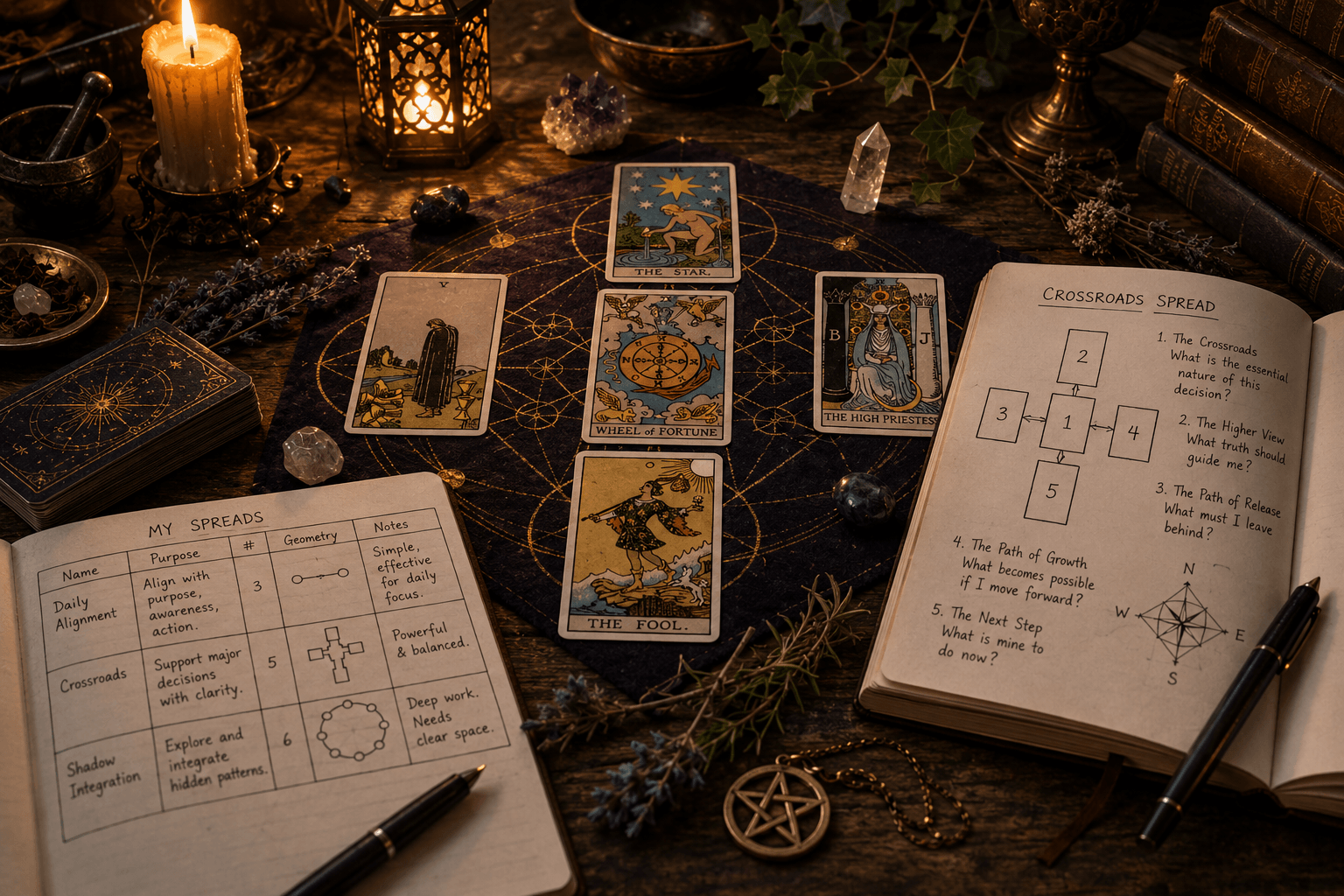
Example Two: The Crossroads Spread
Now imagine that you are facing an important decision.
Begin with a cross.
Center — The Crossroads
What is the essential nature of this decision?
Above — The Higher View
What truth should guide me?
Left — The Path of Release
What must I leave behind?
Right — The Path of Growth
What becomes possible if I move forward?
Below — The Next Step
What is mine to do now?
The geometry reinforces the symbolism.
The center represents the present intersection.
Above provides perspective.
The sides establish opposing or complementary directions.
Below brings the reading back into embodiment.
The final position is especially important.
Insight without action can become another form of avoidance.
Example Three: A Shadow Integration Spread
For deeper personal work, we might construct a circular spread.
1. The Mask
What am I consciously presenting?
2. The Shadow
What am I reluctant to acknowledge?
3. The Root
Where does this pattern originate within my experience?
4. The Teacher
What is this hidden aspect trying to teach me?
5. The Offering
What must I give up or transform?
6. The Integration
How can I bring this knowledge into conscious life?
The sixth position prevents the reading from becoming an exercise in endlessly excavating darkness.
Shadow work is not about discovering how broken you are.
It is about bringing what has been divided back toward consciousness.
The purpose of descent is return.
Keep a Grimoire of Your Spreads
If you regularly create custom Tarot spreads, give them their own section in your journal or magical record.
For each spread, record:
Name
Purpose
Date created
Geometry
Number of positions
Position meanings
Correspondences
First test
Subsequent results
Changes made
Final version
You might even record a small sketch of the geometry.
Over time, this becomes a personal library of ritual forms.
Some spreads will disappear.
Some will be used once and never again.
Others may become foundational tools that you return to for years.
That distinction is useful.
Do not force every creation to become permanent.
A practitioner learns not only how to build but also what deserves to remain built.
Common Mistakes in Creating Tarot Spreads
Making the Spread Too Complicated
Complexity can feel profound.
It is not necessarily profound.
If you cannot explain what the spread is doing in a few sentences, simplify it.
Using Vague Position Names
“Energy.”
“Message.”
“Guidance.”
These can mean almost anything.
Be more precise.
“What emotional pattern is influencing this situation?”
is much easier to work with.
Designing for Cleverness
A beautiful seven-pointed arrangement may look wonderfully occult.
But if you created it because it looked impressive rather than because the question required it, the geometry is ornamental rather than functional.
Form should serve intention.
Failing to Test
Never assume a spread works simply because it sounds good.
Use it.
Record it.
Change it.
Test it again.
Forgetting to Close the Work
A temporary temple should eventually be dismantled.
When the reading is complete, gather the cards.
Take a breath.
Thank whatever powers or spiritual realities you invoked according to your own practice.
Then consciously end the session.
You do not need to leave every ritual psychologically open.
Begin deliberately. End deliberately.
From Using Temples to Building Them
There is a subtle milestone in becoming an experienced Tarot practitioner.
At first, you learn the systems others created.
You memorize card meanings.
You learn established spreads.
You study correspondences.
You follow the paths already laid down.
This is necessary.
Tradition gives the apprentice a language.
But eventually, the apprentice becomes capable of composing.
You begin to recognize that the same symbolic principles can be rearranged to meet new circumstances.
You learn how to take a question and give it structure.
How to take an intention and give it geometry.
How to take an invisible concern and create a visible pattern through which it can be contemplated.
That is the deeper art of creating your own Tarot spreads.
You are no longer simply inhabiting temples built by others.
You are learning how to raise your own.
And every well-tested spread becomes a small piece of spiritual architecture — a repeatable structure through which you can enter into conversation with symbol, psyche, mystery, and the sacred.
The best custom Tarot spreads are not necessarily the largest.
They are the ones in which every position has a reason to exist.
Every card has a throne.
Every throne serves the temple.
And the temple exists to serve the work.
So take a real question from your life this week.
Do not search for a spread.
Build one.
Write down what you genuinely need to understand.
Reduce it to three, five, or seven essential questions.
Give those questions names.
Arrange them deliberately.
Draw the cards.
Then listen.
If the structure fails, rebuild it.
If it works, record it.
And if it proves itself repeatedly, you may have created something more valuable than a clever Tarot layout.
You may have created a ritual form that belongs to your own path.
The old temples teach us how to build.
The living practice asks us to build something of our own.