A Hermetic Pagan Journey Through the Tarot Lineage
Every living tradition is carried by human beings.
The teachings may speak of gods, spirits, archetypes, hidden laws, divine intelligence, or cosmic principles. The symbols may appear timeless. The mysteries may seem to exist beyond history.
But traditions are transmitted through people.
Someone discovers an idea.
Someone preserves it.
Someone transforms it.
Someone challenges it.
Someone writes it down.
And eventually, someone else receives what came before and carries it into another generation.
Tarot is no different.
The cards did not emerge fully formed from the ether, complete with the meanings modern practitioners now recognize. The Tarot we know today is the result of centuries of experimentation, interpretation, occult speculation, artistic creation, spiritual practice, and transmission.
Many hands shaped the tradition.
Some were historians.
Some were occultists.
Some were professional card readers.
Some were ceremonial magicians.
Some were artists.
Some were teachers who attempted to make an increasingly complicated body of symbolism accessible to ordinary practitioners.
In the Hermetic Pagan manner, we can regard these figures as links in what might be called a Golden Chain — a chain of transmission connecting one generation of seekers to another.
This does not mean that every person in the chain was correct.
Far from it.
Some promoted theories that modern scholarship has disproven. Others inherited ideas from their predecessors without questioning them. Some built elaborate systems upon assumptions that were historically inaccurate.
Yet their work may still have carried something valuable.
The task of the modern practitioner is therefore neither blind reverence nor arrogant dismissal.
It is discernment.
We study what they received.
We examine what they created.
We preserve what remains useful.
And where necessary, we allow old theories to fall away.
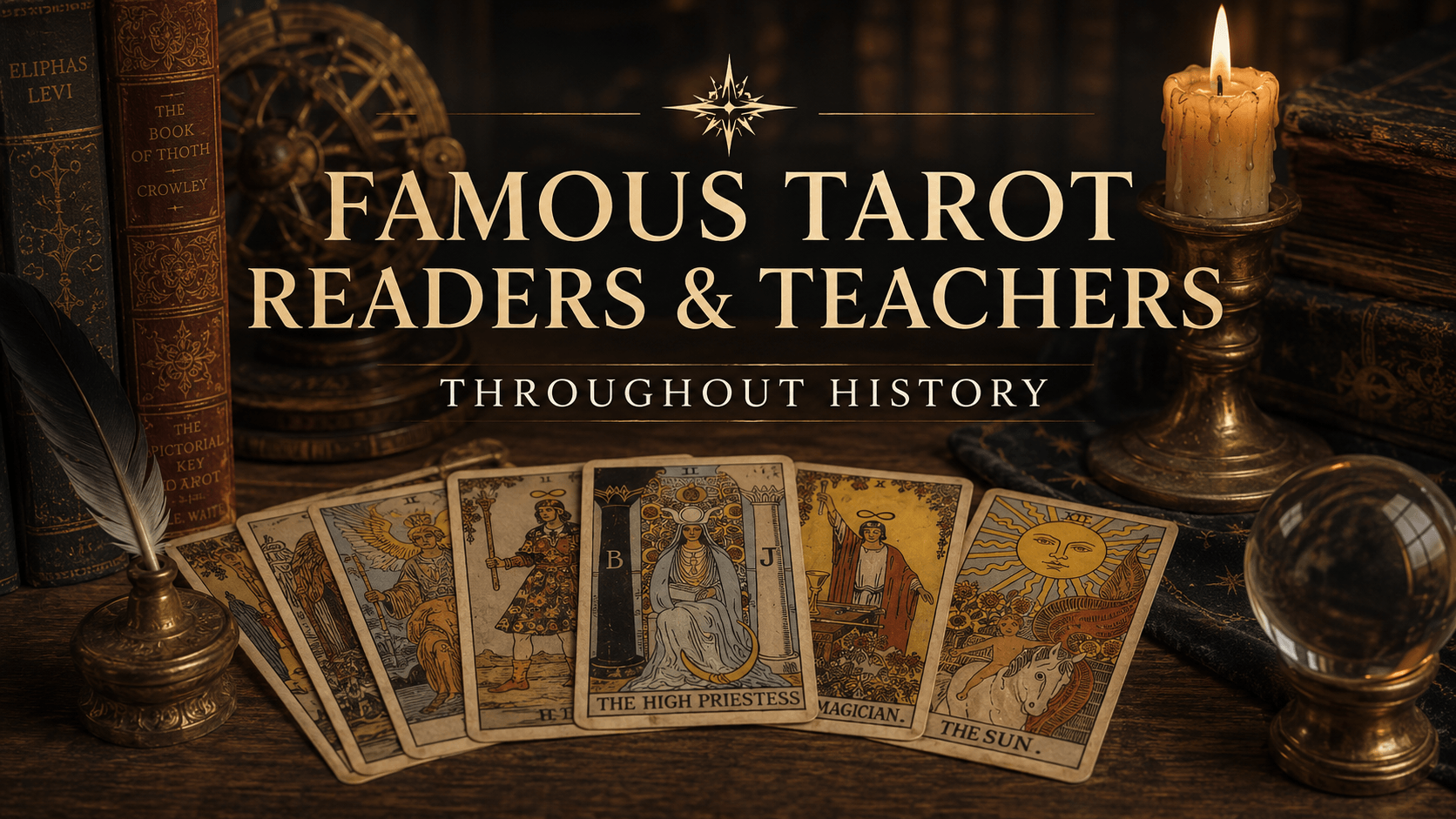
Let us therefore look at some of the most important figures in the history of Tarot readers and teachers.
A Brief Timeline of the Tarot Lineage
Before examining the individuals themselves, it is useful to see the broad movement:
18th century
Antoine Court de Gébelin → Etteilla
19th century
Marie Anne Lenormand → Éliphas Lévi → the developing occult Tarot tradition
Late 19th / early 20th century
Hermetic Order of the Golden Dawn → MacGregor Mathers → Waite → Pamela Colman Smith → Crowley
20th century
Oswald Wirth → Paul Foster Case → Eden Gray
Late 20th / 21st century
Rachel Pollack → Mary K. Greer → contemporary Tarot practitioners
This is not a perfectly straight line.
Tarot history is filled with parallel currents, disagreements, forgotten teachers, rediscoveries, and traditions that influenced one another indirectly.
But it gives us a useful map.
Antoine Court de Gébelin: The Myth-Maker
Antoine Court de Gébelin occupies an unusual position in Tarot history.
He was not a Tarot reader in the modern professional sense.
Instead, he was one of the earliest influential writers to claim that Tarot contained an ancient body of esoteric wisdom.
In the late eighteenth century, Court de Gébelin published his theories about Tarot in Le Monde Primitif.
He proposed that the cards originated in ancient Egypt and preserved fragments of an ancient sacred philosophy.
Historically, this theory does not hold up.
There is no evidence that Tarot originated in ancient Egypt, and the historical development of Tarot can be traced much more convincingly to Renaissance Europe.
Yet something important happened when Court de Gébelin made the claim.
He changed the question.
Instead of asking only:
“What game is this?”
occultists began asking:
“What wisdom might these images contain?”
That question would transform the future of Tarot.
From a historical perspective, Court de Gébelin’s Egyptian theory was mistaken.
From the perspective of the history of ideas, however, it was enormously influential.
He helped create the intellectual environment in which Tarot could become an occult system.
Sometimes a myth can be historically false while still becoming culturally powerful.
The Hermetic practitioner should be capable of holding both truths simultaneously.
Etteilla: The First Professional Tarot Occultist
If Court de Gébelin provided the mythic spark, Jean-Baptiste Alliette — better known by the reversed form of his name, Etteilla — turned Tarot into a practical occult profession.
Etteilla was born in 1738 and became one of the earliest known professional practitioners to make a living through card divination.
His importance cannot be overstated.
He developed his own theories concerning Tarot, produced an explicitly esoteric Tarot deck, and established methods for interpreting the cards.
This represented a major shift.
Tarot was no longer simply an old card game that someone had decided might contain hidden Egyptian wisdom.
It was becoming a system.
Etteilla organized meanings.
He assigned symbolic interpretations.
He developed spreads and methods of consultation.
He created a specialized deck designed around his occult theories.
In other words, he helped establish something fundamental to modern Tarot practice:
the idea that Tarot could be deliberately constructed as a divinatory and esoteric technology.
The modern reader who sits before a spread and interprets a sequence of cards is participating in a practice that owes something to this early development.
Etteilla was not merely interpreting Tarot.
He was helping invent the concept of the modern Tarot practitioner.
Marie Anne Lenormand: The Archetype of the Famous Seer
Marie Anne Lenormand occupies another fascinating place in the history of divination.
Born in 1772, she became famous in France as a professional fortune-teller and card reader.
Her reputation grew enormously, and stories connected her with powerful figures of her era.
The historical reality surrounding some of these stories is difficult to separate from the mythology that developed around her.
This itself is instructive.
The famous reader eventually becomes larger than the historical person.
Her name became attached to the Lenormand tradition of cartomancy, although the Lenormand deck commonly used today was developed after her death and should not simply be treated as a deck personally designed by Lenormand.
Nevertheless, her cultural importance remains substantial.
Lenormand helped establish the image of the professional female seer whose knowledge of cards could penetrate the hidden circumstances of ordinary and powerful people’s lives.
She represents another important current in the history of divination:
the practitioner as oracle.
Not merely someone who knows meanings from a book, but someone whose experience allows the symbolic language of cards to become living interpretation.
Éliphas Lévi: Tarot Enters the Mysteries
If Etteilla helped establish Tarot as an occult system, Éliphas Lévi helped elevate it into the architecture of Western ceremonial magic.
Born Alphonse Louis Constant in 1810, Lévi became one of the most influential occult thinkers of the nineteenth century.
His writings connected Tarot with systems of Hermetic and Qabalistic symbolism.
For Lévi, the Tarot was not simply a method for predicting events.
It could function as a symbolic map of spiritual reality.
This distinction is crucial.
The cards could represent principles.
They could encode relationships between numbers, letters, elements, planets, and spiritual forces.
They could become a visual language through which the practitioner contemplated the structure of the universe.
Lévi’s writings profoundly influenced later occultists, particularly those who would eventually form the intellectual environment surrounding the Hermetic Order of the Golden Dawn.
His exact Tarot attributions were not identical to those later used by the Golden Dawn, and his system should not be confused with the fully developed Golden Dawn correspondence system.
But the bridge had been built.
Tarot was increasingly being understood as part of the great symbolic machinery of Western esotericism.
The Hermetic Order of the Golden Dawn
By the late nineteenth century, the Western occult revival had reached a new level of organization.
The Hermetic Order of the Golden Dawn brought together ceremonial magic, astrology, Qabalah, alchemy, elemental symbolism, and Tarot into a remarkably elaborate initiatory framework.
Among its major figures was Samuel Liddell MacGregor Mathers.
The Golden Dawn’s importance to Tarot is enormous.
It established correspondences between the Major Arcana, Hebrew letters, astrology, the Tree of Life, elements, and other components of ceremonial magic.
These relationships would become foundational to many modern occult Tarot systems.
Much of what practitioners today consider “advanced Tarot” — planetary correspondences, elemental dignities, Qabalistic paths, Hebrew-letter associations, and ceremonial symbolism — exists in the shadow of this tradition.
But here again, discernment matters.
The Golden Dawn’s Tarot system was not an ancient Egyptian inheritance.
It was a modern occult synthesis.
That does not make it worthless.
Quite the opposite.
It makes it something more interesting:
a deliberate attempt to build a coherent symbolic universe from multiple esoteric traditions.
For the Hermetic Pagan practitioner, this is part of the beauty of the tradition.
We need not pretend that something is ancient in order to find it sacred.
Arthur Edward Waite and Pamela Colman Smith
Few names have shaped modern Tarot more profoundly than Arthur Edward Waite and Pamela Colman Smith.
Together they created what became known as the Rider-Waite-Smith Tarot, first published in 1909.
Waite was a scholar and occultist deeply influenced by Christian mysticism, Rosicrucianism, and the Golden Dawn tradition.
Pamela Colman Smith was an extraordinary artist whose illustrations transformed the deck.
Their contributions were different.
Waite provided the conceptual and symbolic direction.
Smith gave the system its visual language.
And her contribution cannot be reduced to simply “illustrating Waite’s ideas.”
Smith’s images gave the Minor Arcana something that would permanently change the way Tarot was read.
Instead of relying primarily on abstract arrangements of swords, cups, wands, and pentacles, the cards depicted scenes.
Characters acted.
People struggled.
People celebrated.
People mourned.
People traveled.
People worked.
People fought.
People loved.
Suddenly, the Minor Arcana could tell stories.
This made Tarot dramatically more accessible.
The Rider-Waite-Smith deck eventually became the most influential Tarot deck in the modern world, inspiring countless descendants.
When someone today looks at the Three of Swords, the Ten of Cups, the Eight of Pentacles, or the Six of Wands and immediately understands the card as a scene rather than merely a numerical pattern, they are benefiting from Smith’s artistic revolution.
The history of the Waite-Smith Tarot is therefore not simply the history of one deck.
It is the history of a transformation in how Tarot imagery communicates.
Aleister Crowley and Lady Frieda Harris
If Waite and Smith created one great modern visual language of Tarot, Aleister Crowley and Lady Frieda Harris created another.
Their Thoth Tarot emerged from Crowley’s Thelemic magical system and Harris’s visionary artwork.
Crowley brought an enormous body of occult correspondence into the project.
Astrology.
Qabalah.
Alchemy.
Numerology.
Thelemic philosophy.
Ceremonial magic.
The cards became intensely layered symbolic structures.
Harris translated those concepts into extraordinary paintings filled with geometry, color, movement, planetary imagery, and abstract symbolism.
The result was not intended merely to be an attractive deck.
It was a magical and philosophical system.
The Thoth Tarot can therefore feel demanding.
It asks the practitioner to study.
To compare symbols.
To understand correspondences.
To contemplate rather than merely memorize.
This is one reason the deck remains so influential among serious students of esoteric Tarot.
The Crowley Thoth Tarot represents one of the clearest expressions of the idea that Tarot can function as a complete symbolic universe.
Oswald Wirth: Tarot as Initiation
Oswald Wirth was a Swiss occultist whose work helped carry the symbolic tradition of Tarot further into the twentieth century.
Influenced by Lévi and other occult thinkers, Wirth developed his own Tarot deck and interpretations.
His approach emphasized the initiatory dimension of the Major Arcana.
The cards could be understood as stages, forces, principles, and lessons encountered along a spiritual path.
This approach is particularly compatible with a Hermetic understanding of Tarot.
The question is not simply:
“What will happen to me?”
It becomes:
“What is this experience asking me to become?”
The distinction changes the entire practice.
A card can represent an event.
But it can also represent an initiation.
It can reveal a psychological pattern, a spiritual challenge, a virtue requiring development, or a force that must be integrated.
Wirth’s contribution helped strengthen this initiatory interpretation.
Paul Foster Case: Building a School Around Tarot
Paul Foster Case took the esoteric Tarot tradition and turned it into a structured system of study.
A former member of the broader occult milieu influenced by the Golden Dawn tradition, Case eventually founded the Builders of the Adytum (B.O.T.A.).
His work refined many Tarot correspondences and emphasized meditation, symbolism, Qabalah, color, number, and spiritual development.
Case’s great contribution was pedagogical.
He did not merely produce interpretations.
He created a framework through which students could systematically study.
This matters because esoteric traditions can easily become collections of fascinating fragments.
A planet here.
A Hebrew letter there.
An alchemical symbol somewhere else.
A Tarot card connected to a Qabalistic path.
Case attempted to bring these relationships into an organized educational system.
For generations of students, Tarot became something one could practice as a discipline rather than merely admire as occult symbolism.
Eden Gray: Bringing Tarot to the Public
By the middle of the twentieth century, Tarot was beginning to move beyond specialist occult circles.
Eden Gray played an important role in this transition.
Her books presented Tarot in a manner that ordinary readers could approach.
Her work helped introduce large numbers of people to card meanings, spreads, and practical readings.
This may seem less glamorous than ceremonial magic.
But it was historically significant.
A tradition survives not only through initiates and scholars.
It survives through accessibility.
If Tarot had remained exclusively within small occult societies, its modern development might have looked very different.
Eden Gray helped make the cards approachable for the growing number of people who wanted to learn Tarot for themselves.
She helped create the bridge between the occult library and the beginner’s table.
Rachel Pollack: Tarot as a Living Symbolic Language
By the late twentieth century, Tarot scholarship and practice were entering another period of transformation.
Rachel Pollack became one of the most influential modern Tarot teachers.
Her writing demonstrated that Tarot could be approached through multiple lenses simultaneously.
Psychological.
Mythological.
Spiritual.
Symbolic.
Narrative.
Personal.
Rather than reducing a card to one fixed keyword, Pollack encouraged readers to engage with the living complexity of Tarot imagery.
This approach is particularly important for practitioners who want to move beyond memorization.
The meaning of a card is not necessarily a sentence printed in a guidebook.
The image participates in a conversation.
The surrounding cards matter.
The question matters.
The reader matters.
The circumstances matter.
The symbol may reveal something different when approached from another angle.
Pollack helped demonstrate that Tarot could remain spiritually meaningful without becoming intellectually rigid.
Mary K. Greer: The Practice of the Reader
Mary K. Greer has likewise been enormously influential in modern Tarot education.
Her work has explored Tarot through personal development, journaling, practical reading methods, historical study, and psychological approaches.
One of her important contributions has been demonstrating that becoming a better Tarot reader involves more than memorizing meanings.
It involves observation.
Reflection.
Experimentation.
Record keeping.
Self-questioning.
And practice.
This is an important lesson for anyone developing a relationship with the cards.
A Tarot book can give you a vocabulary.
But experience teaches you how that vocabulary behaves in actual readings.
A practitioner who records readings over years may begin noticing patterns that no introductory book could possibly provide.
The cards become less like flashcards and more like a language.
And languages are learned through use.
What These Teachers Actually Gave Us
When we look across this history, something remarkable appears.
Each generation emphasized something different.
Court de Gébelin gave Tarot an ancient mythic identity.
Etteilla developed systematic occult divination.
Lenormand helped establish the cultural archetype of the professional seer.
Lévi connected Tarot with the broader architecture of Western esotericism.
The Golden Dawn developed an intricate web of correspondences.
Waite and Pamela Colman Smith transformed the visual language of Tarot.
Crowley and Frieda Harris created a deeply integrated magical and astrological system.
Wirth emphasized initiation and symbolic development.
Paul Foster Case turned Tarot study into a structured discipline.
Eden Gray made Tarot accessible to a mass audience.
Rachel Pollack expanded the psychological and symbolic possibilities of interpretation.
Mary K. Greer emphasized practice, reflection, and the development of the reader.
None of these contributions completely replaced the others.
They accumulated.
That is what a living tradition does.
The Tarot Lineage Is Not a Straight Line
It is tempting to imagine Tarot history as a neat succession:
One master teaches another.
One system becomes another.
One deck leads naturally to the next.
Reality is much messier.
Different occultists disagreed.
Systems overlapped.
Ideas were borrowed.
Traditions were reinvented.
Historical claims were sometimes repeated simply because earlier writers had repeated them.
Some figures were influential without being accurate.
Others were accurate in one area and speculative in another.
And some of the most important contributors were artists, printers, publishers, anonymous practitioners, or ordinary readers whose names have disappeared from history.
This is why the phrase Tarot lineage should not be understood as a single unbroken institution.
It is better understood as a network.
A web of influence.
A series of conversations across centuries.
What Do We Inherit?
We inherit much.
We inherit the idea that Tarot can be more than entertainment.
We inherit systems of divination.
We inherit symbolic correspondences.
We inherit astrology.
We inherit Qabalah.
We inherit numerology.
We inherit elemental symbolism.
We inherit mythological interpretation.
We inherit psychological approaches.
We inherit spreads.
We inherit meditation practices.
We inherit countless images created by artists who attempted to give visual form to invisible principles.
But inheritance creates responsibility.
The fact that an idea came from an important occultist does not automatically make it true.
The fact that something appears in an old book does not make it ancient.
The fact that something is modern does not make it spiritually inferior.
This is where discernment becomes part of the Work.
The Hermetic Attitude: Reverence Without Blindness
There are two easy mistakes when studying occult history.
The first is ancestor worship.
We assume the old masters possessed secret knowledge that modern people have somehow lost.
Every statement becomes sacred because it came from a famous occultist.
The second mistake is the opposite.
We dismiss everything from the past because historical scholarship has disproven some of its assumptions.
Neither approach is sufficient.
The Hermetic attitude lies somewhere between them.
Study deeply.
Question carefully.
Test personally.
Research historically.
Keep what proves fruitful.
Discard what proves false.
And distinguish between historical truth and symbolic usefulness.
Court de Gébelin was wrong about Tarot being an ancient Egyptian book.
Yet his theory profoundly influenced Tarot’s occult development.
The Golden Dawn’s correspondences were modern constructions.
Yet they created an extraordinarily influential symbolic system.
Crowley’s occult philosophy was controversial.
Yet the Thoth Tarot remains one of the most sophisticated esoteric decks ever produced.
These things can all be true at once.
We do not have to choose between reverence and reason.
Becoming the Next Link
There is something humbling about studying the history of Tarot.
Every time you shuffle the cards, you participate in a practice that countless people have helped shape.
The reader before you may have lived in eighteenth-century Paris.
Another may have been studying ceremonial magic in Victorian London.
Another may have been painting visionary images in the twentieth century.
Another may have been sitting alone at a kitchen table with a newly purchased deck and a Tarot book.
The circumstances change.
The human questions remain remarkably similar.
What is happening?
What am I failing to see?
What force is moving through my life?
What must I learn?
What path should I take?
This is why the history of Tarot matters.
It reminds us that we are not beginning from nothing.
We are entering a conversation.
And eventually, whether we realize it or not, we contribute something to that conversation.
Perhaps it will be a new interpretation.
Perhaps a new spread.
Perhaps a new deck.
Perhaps a new book.
Perhaps simply the example of someone who approached the cards with unusual integrity.
The chain continues because someone chooses to carry it.
Final Thoughts: Honor the Tradition by Practicing It Well
To study famous Tarot readers and teachers throughout history is not merely to memorize names.
It is to discover the layers beneath the cards.
Etteilla reminds us that Tarot can become a structured divinatory system.
Lévi reminds us that symbols can form a map of invisible relationships.
The Golden Dawn demonstrates the power of correspondence.
Pamela Colman Smith demonstrates the extraordinary power of imagery.
Crowley and Harris demonstrate how Tarot can become an entire magical cosmos.
Case demonstrates disciplined study.
Gray demonstrates accessibility.
Pollack demonstrates symbolic depth.
Greer demonstrates the importance of practice.
And all of them, in different ways, remind us that Tarot is not finished.
The tradition remains alive because people continue to engage with it.
We do not honor the teachers of the past by pretending they were infallible.
We honor them by taking their work seriously enough to examine it.
We study.
We question.
We experiment.
We practice.
We preserve what deserves preservation.
And we create where creation is necessary.
The cards are still being interpreted.
The symbols are still speaking.
The questions are still being asked.
And the Golden Chain has not ended.
It has simply reached us.
Now it is our turn to carry it.
A Simple Tarot Study Timeline
1730s–1790s — Etteilla
Early professional Tarot occultism and systematic card divination.
1770s–1840s — Marie Anne Lenormand
Professional cartomancy and the archetype of the famous European seer.
1780s — Court de Gébelin
The Egyptian origin theory that helped launch the occult Tarot revival.
1810–1875 — Éliphas Lévi
Tarot, Qabalah, ceremonial magic, and Western esotericism.
Late 19th century — Golden Dawn
The development of an extensive Tarot correspondence system.
1909 — Rider-Waite-Smith Tarot
Arthur Edward Waite and Pamela Colman Smith transform Tarot imagery.
20th century — Thoth Tarot
Aleister Crowley and Lady Frieda Harris create another monumental esoteric Tarot system.
20th century — Wirth, Case, Gray
Tarot becomes increasingly initiatory, systematic, educational, and accessible.
Late 20th–21st century — Pollack, Greer, and others
Psychological, scholarly, experiential, and contemporary approaches expand the tradition.
Suggested Primary Texts for Further Study
For those who wish to go deeper, the writings and decks associated with these figures provide an excellent starting library.
- Antoine Court de Gébelin — Le Monde Primitif
- Etteilla — writings and decks associated with his Tarot system
- Éliphas Lévi — Transcendental Magic
- Arthur Edward Waite — The Pictorial Key to the Tarot
- Pamela Colman Smith — the Rider-Waite-Smith Tarot imagery
- Aleister Crowley — The Book of Thoth
- Oswald Wirth — writings on Tarot symbolism
- Paul Foster Case — The Tarot: A Key to the Wisdom of the Ages
- Eden Gray — The Tarot Revealed
- Rachel Pollack — Seventy-Eight Degrees of Wisdom
- Mary K. Greer — Tarot for Your Self
Read them not as unquestionable scripture.
Read them as conversations with predecessors.
That is the more fruitful way to approach any esoteric lineage.
Where Does Your Tarot Lineage Begin?
Every reader eventually develops a lineage of their own.
Perhaps your first teacher was a book.
Perhaps it was a grandmother.
Perhaps it was an occult tradition.
Perhaps it was a particular Tarot deck.
Perhaps it was a single card that refused to stop appearing until you finally listened.
The names discussed here form only one portion of a much larger history.
There are countless readers, artists, scholars, teachers, mystics, publishers, and anonymous practitioners who contributed to the tradition.
The question is not simply:
“Who taught Tarot?”
The deeper question is:
“What will we do with what they taught us?”
Because a tradition survives through transmission.
But it evolves through practice.
Study the ancestors.
Question them.
Learn from them.
Then sit down with the cards.
Shuffle.
Draw.
Listen.
And continue the Work