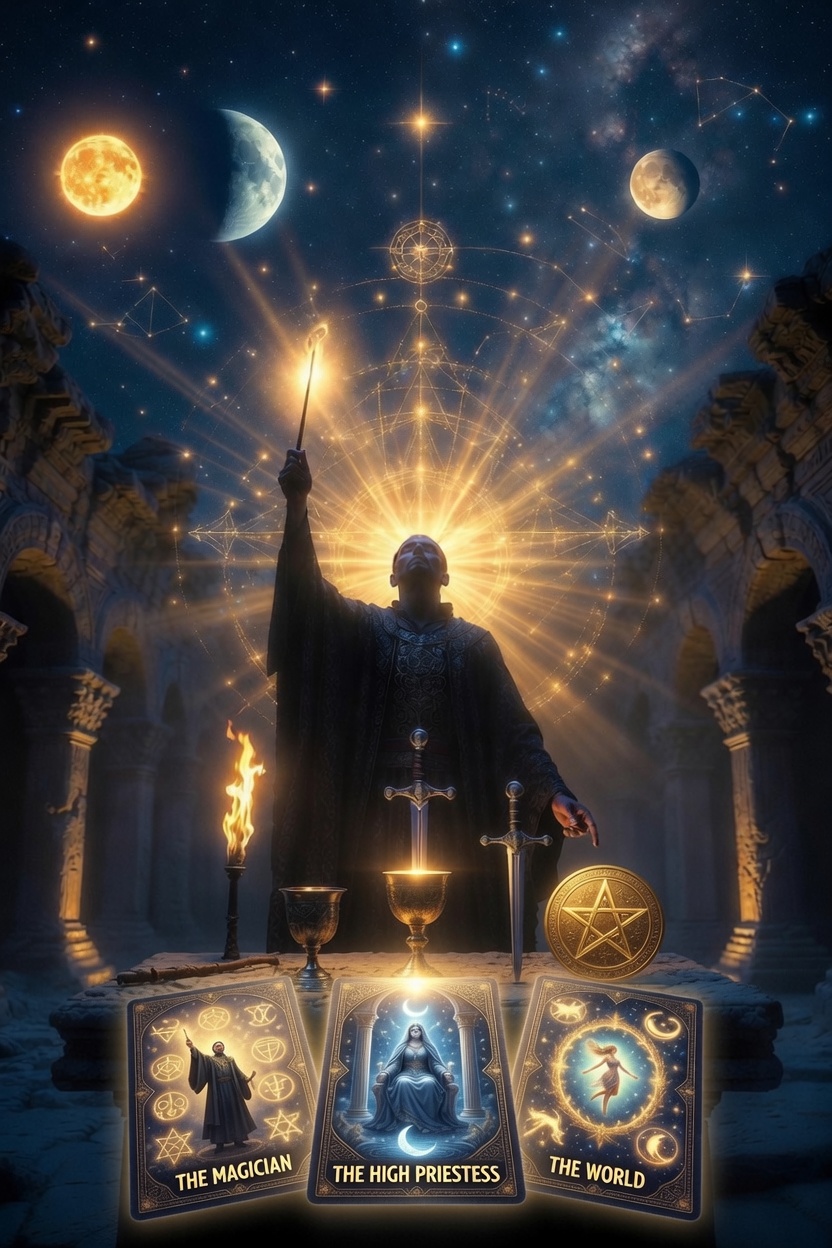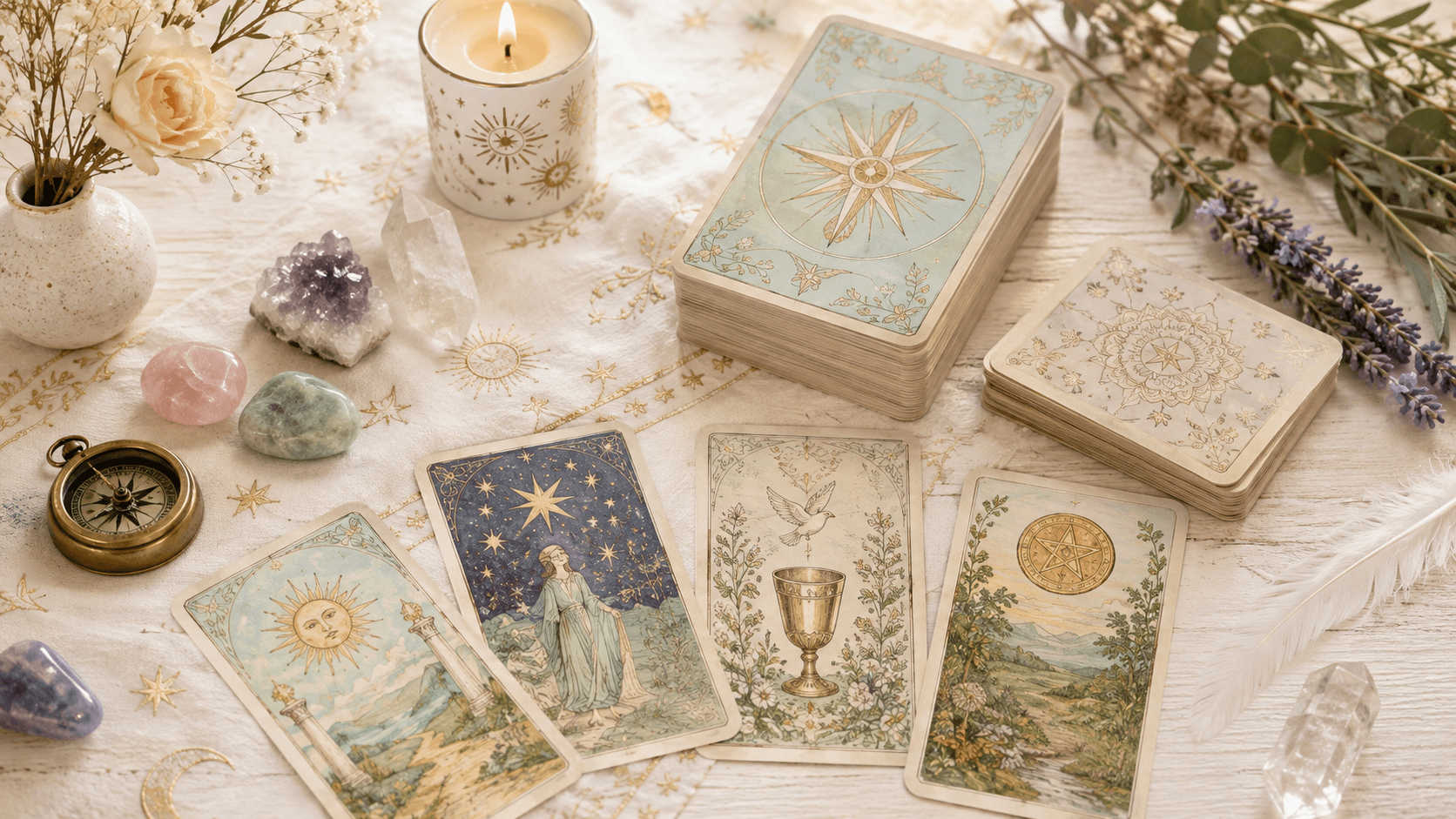
There is something fascinating about the cards.
A small collection of illustrated or marked pieces of paper can become, in the hands of a skilled practitioner, a language of symbols, patterns, possibilities, and hidden relationships.
Today, tarot is probably the first thing that comes to mind when most people hear the words card divination. Yet tarot is only one branch of a much larger family of cartomantic traditions.
Playing cards have been used for divination. Lenormand cards developed their own distinctive system of interpretation. Tarot itself passed through several cultural and intellectual transformations before becoming the esoteric system familiar to modern practitioners. And as cards traveled beyond Europe, they were adopted, reinterpreted, and sometimes blended with existing spiritual and divinatory traditions.
There is an important historical nuance here.
Card divination did not independently arise in every ancient culture. Playing cards originated in Asia and eventually traveled westward, while the major traditions of formal card cartomancy developed in Europe from the eighteenth century onward. Later, card reading became a global practice, taking on new meanings within different cultural and spiritual environments.
This history is worth knowing because it allows us to appreciate both what is genuinely shared and what is genuinely distinct.
From a Hermetic Pagan perspective, we can see these traditions as different dialects of a broader human impulse: the desire to bring hidden patterns into consciousness and enter into dialogue with what lies beyond ordinary awareness.
The cards change.
The cosmologies change.
The methods change.
But the question remains remarkably constant:
What is moving beneath the surface of things?
The Shared Impulse Behind Card Divination
Divination begins with a simple human experience.
We know that there is more happening than we can immediately perceive.
A relationship contains currents that have not yet been spoken.
A decision contains consequences that cannot yet be seen.
A period of transition contains possibilities that have not yet taken form.
The ordinary mind wants certainty.
The divinatory mind learns to look for patterns.
Cards provide an intermediary.
They externalize the question and produce a pattern that can then be contemplated.
Different traditions explain what happens differently.
One practitioner may understand the reading as communication with spirits or ancestors.
Another may see the cards as an instrument through which divine providence or fate becomes legible.
Another may understand them psychologically, as a means of bringing unconscious material into consciousness.
A Hermetic Pagan may allow several of these possibilities to remain open.
The important thing is that the cards create a meeting place between the known and the unknown.
But the cultural tradition surrounding the cards profoundly affects how that meeting takes place.
A tarot practitioner may look for archetypal patterns and elemental relationships.
A folk cartomancer may ask whether a particular card indicates a journey, a visitor, money, a romantic development, or an obstacle.
A Lenormand reader may examine how several concrete symbols modify one another.
The same physical concept — cards placed before a reader — can therefore produce very different forms of divination.
Tarot: The European Esoteric Tradition
The tarot tradition most familiar to modern occultists has its roots in Renaissance Italy.
Tarot cards first appeared in fifteenth-century Italy as an elaboration of existing playing-card forms. The earliest tarot decks were not created as occult systems. They were associated with games and, in some cases, elaborate courtly culture.
Their transformation into an explicitly divinatory and esoteric system came much later.
Eighteenth-century French occultists began assigning ancient Egyptian, mystical, and esoteric origins to the cards, although many of these historical claims are not supported by modern scholarship.
Later occultists developed increasingly elaborate systems of correspondence involving astrology, Hebrew letters, Kabbalah, the elements, ceremonial magic, and spiritual development.
The British occult revival, particularly the work associated with the Hermetic Order of the Golden Dawn, played an enormous role in shaping the tarot symbolism inherited by many contemporary Western practitioners.
This history is important.
The tarot used by a modern Hermetic practitioner is not simply an unchanged survival from Renaissance Italy.
It is the result of centuries of interpretation, reinterpretation, synthesis, and occult development.
And that is part of its genius.
Tarot became a remarkably comprehensive symbolic language.
The 22 Major Arcana can be contemplated as archetypal powers and stages of transformation.
The Minor Arcana introduce the four suits, numbers, court figures, and elemental structures.
The cards can be interpreted individually, relationally, numerologically, astrologically, psychologically, or ritually.
For the Hermetic Pagan practitioner, tarot can therefore become more than an instrument for predicting events.
It can become a map of consciousness.
A map of transformation.
A symbolic mirror of the soul.
This is the particular stream most directly ancestral to the tarot practice explored throughout this tradition.
Folk Cartomancy: The Divination of Playing Cards
Tarot is not the only European card tradition.
Ordinary playing cards became instruments of divination in numerous parts of Europe and eventually in the Americas.
This tradition is often called cartomancy.
Instead of using a specialized tarot deck, the practitioner works with an ordinary playing-card deck, usually containing 52 cards, although regional systems and historical practices vary.
This gives the practice a very different character.
There are no elaborate scenes like those found throughout the Rider-Waite-Smith tradition.
There is no Major Arcana.
There is no Fool’s Journey.
The symbolic vocabulary is more compact.
Yet that does not make it simplistic.
Folk cartomancy developed through numerous local traditions, and meanings could vary considerably from one reader to another.
Some systems developed associations for individual cards.
Others relied heavily upon combinations.
Some focused upon relationships, money, travel, family matters, or practical circumstances.
The tone can therefore feel remarkably different from esoteric tarot.
Tarot often invites the question:
What is happening within the deeper structure of this experience?
Folk cartomancy may be more inclined toward:
What is happening, who is involved, and what is likely to happen next?
This practical character is one of its strengths.
Cartomancy was often transmitted through families, communities, and individual practitioners rather than through formal occult organizations.
The cards belonged to ordinary life.
They could be shuffled at a kitchen table.
No ceremonial temple was required.
No elaborate altar was necessary.
In this sense, folk cartomancy represents a fascinating meeting between the mundane and the sacred.
The ordinary deck becomes an oracle.
Lenormand: Precision Through Combination
The Lenormand tradition occupies another distinct position.
The name is associated with Marie Anne Lenormand, the famous French fortune-teller who lived during the late eighteenth and early nineteenth centuries. However, the 36-card Lenormand deck commonly used today developed in its recognizable form after her death and should not simply be treated as the personal deck of Lenormand herself.
Unlike tarot, Lenormand generally uses relatively simple images.
A ship.
A house.
A tree.
A ring.
A key.
A mountain.
A heart.
A fox.
A cross.
The individual symbols are comparatively straightforward.
The real complexity emerges through combination.
A single Lenormand card may be broad.
Several cards placed beside one another can become remarkably specific.
The House and Ring might suggest commitment within the domestic sphere.
The Ship and Anchor might suggest a journey connected with work or stability.
The Heart and Fox might raise questions about sincerity, affection, or deception.
The exact interpretation depends upon context and the surrounding cards.
This makes Lenormand particularly different from tarot.
Tarot often excels at symbolic depth and psychological exploration.
Lenormand frequently excels at concrete relationships between circumstances.
It can feel almost grammatical.
One card modifies another.
A third adds another layer.
The reader learns to construct meaning through combinations.
For practical questions, this can be extraordinarily effective.
It also teaches an important lesson:
A divination system does not need hundreds of symbols to be complex.
Sometimes complexity emerges from the relationship between a small number of simple signs.
Card Divination Beyond Europe
As cards traveled across the world, they did not remain culturally isolated.
They entered societies with existing spiritual traditions, religious frameworks, folk practices, and systems of divination.
The resulting practices can be highly diverse.
This is where we should resist making overly broad claims.
There is no single “Latin American tarot tradition,” just as there is no single Asian approach to tarot.
Different countries, communities, practitioners, and religious environments have developed different relationships with cards.
In parts of Latin America and the Caribbean, card reading may exist alongside Catholic devotional practices, spirit work, folk healing, ancestor traditions, and other forms of popular spirituality.
Sometimes the cards function primarily as a practical divinatory tool.
In other settings, a card reading may be incorporated into a broader consultation involving spiritual or ritual practices.
These combinations should be understood on their own terms rather than automatically interpreted through European occult categories.
Similarly, tarot has been adopted extensively in countries such as Japan, South Korea, China, and India.
Modern practitioners in these cultures may work with Western tarot structures while interpreting them through local aesthetic, philosophical, religious, or spiritual perspectives.
Some practitioners maintain a largely Western esoteric framework.
Others adapt the cards to local symbolic environments.
Still others combine tarot with astrology, numerology, meditation, traditional divination, or contemporary spiritual practices.
The important point is that adoption is not necessarily imitation.
When a symbolic technology enters a new culture, people reinterpret it.
The cards become part of a new conversation.
The Difference Between Borrowing and Syncretism
This raises an important responsibility for modern practitioners.
There is a difference between learning from another tradition and casually borrowing pieces from it without understanding their meaning.
The modern occult world has often been guilty of collapsing distinct cultures into a single generalized category called “ancient wisdom.”
This does no justice to the traditions involved.
A Japanese practitioner incorporating tarot into a contemporary spiritual practice is not necessarily doing the same thing as a European ceremonial magician.
A Caribbean spiritual practitioner who uses cards within a broader religious context is not necessarily practicing the same form of cartomancy as a French fortune-teller.
A South Asian tarot reader may bring cultural assumptions and symbolic associations to the cards that differ substantially from those of a British occultist.
These differences are valuable.
They demonstrate that symbols are not interpreted in a vacuum.
Culture teaches us how to see.
Tradition gives symbols their surrounding grammar.
Personal experience adds another layer.
The mature practitioner therefore approaches unfamiliar traditions with curiosity rather than entitlement.
Study first.
Attribute sources.
Distinguish historical practice from modern reconstruction.
And when a tradition belongs to a living religious or cultural community, treat it as something more than a collection of techniques available for extraction.
Different Traditions, Different Reading Philosophies
The differences between card-divination systems become especially clear when we compare what they ask the reader to notice.
| Tradition | Typical Character | Primary Strength |
|---|---|---|
| Tarot | Archetypal, symbolic, layered | Psychological and spiritual exploration |
| Playing-card cartomancy | Practical, direct, folkloric | Everyday questions and concrete circumstances |
| Lenormand | Literal, combinatorial, concise | Relationships between people and events |
| Modern oracle decks | Thematic, intuitive | Focused spiritual or reflective messages |
| Culturally adapted tarot | Syncretic, locally interpreted | Integrating tarot with another worldview |
These are tendencies rather than rigid rules.
A tarot reader can perform an extremely practical reading.
A cartomancer can conduct profound spiritual work.
A Lenormand reader can develop extraordinary intuition.
The system establishes possibilities.
The practitioner determines how deeply those possibilities are explored.
What Changes From Culture to Culture?
Several elements tend to change when card divination moves between traditions.
1. The Meaning of the Symbols
A symbol rarely has one universal meaning.
The meaning of a house, bird, tree, sun, snake, or cross can shift depending upon cultural context.
2. The Purpose of the Reading
One practitioner may seek spiritual guidance.
Another may want practical information.
Another may use cards for counseling or reflection.
Another may regard the consultation as communication with spirits.
3. The Authority of the Reader
Historically, readers could occupy very different social roles.
A card reader might be an entertainer.
A fortune-teller.
A village wise person.
A professional consultant.
A spiritual practitioner.
A folk healer.
A ceremonial magician.
Modern tarot has expanded these possibilities even further.
4. The Relationship Between Fixed Meaning and Intuition
Some traditions place considerable weight upon established meanings.
Others emphasize combinations.
Others encourage free association and visionary perception.
There is no universal balance.
Every system teaches the practitioner a different relationship between structure and intuition.
5. The Method of Interpretation
Some readers work with elaborate spreads.
Others lay cards in lines.
Others use small groups.
Some systems emphasize neighboring cards.
Others emphasize positions.
Others barely use predetermined layouts at all.
The physical act of arranging cards therefore becomes part of the language.
What the Modern Tarot Practitioner Can Learn
Studying other traditions does not diminish tarot.
Quite the opposite.
It can make you appreciate tarot more deeply.
A Lenormand reader’s precision can teach you to notice combinations in your own spreads.
A cartomancer’s practical directness can remind you not to bury a simple answer beneath layers of occult speculation.
A folk tradition can demonstrate the value of developing meanings through lived experience rather than relying exclusively upon books.
A culturally adapted system can remind you that symbols are always interpreted through a worldview.
And the study of other traditions can expose one of the great dangers of esoteric practice:
parochialism.
It is easy to assume that the system we inherited is the system itself.
It is not.
Tarot has a history.
Its meanings developed.
Its correspondences were constructed and modified.
Its modern forms emerged from particular historical circumstances.
Understanding this does not make tarot less sacred.
It makes our relationship with it more conscious.
Depth Before Collection
There is also a practical lesson here.
The modern occult marketplace offers endless systems.
Tarot.
Lenormand.
Oracle cards.
Runes.
I Ching.
Astrology.
Pendulums.
Scrying.
And countless specialized decks.
It is tempting to collect them all.
But possession is not mastery.
You can own twenty decks and understand none of them deeply.
The better approach is to choose a system and enter into it seriously.
Learn its history.
Study its symbols.
Practice consistently.
Keep records of readings.
Observe where your interpretations succeed and where they fail.
Learn the difference between intuition and projection.
Develop your ability to ask good questions.
Then, when another system calls to you, approach it with the same discipline.
The goal is not to accumulate tools.
The goal is to cultivate perception.
The Hermetic Pagan View: Many Languages, One Mystery
From a Hermetic Pagan perspective, diversity in divination should not be threatening.
The Divine Mind is not limited by human preference.
The gods do not require every culture to speak the same symbolic language.
Human beings create languages because we need forms through which mystery can become intelligible.
One culture develops one vocabulary.
Another develops another.
One tradition sees patterns in the heavens.
Another in coins.
Another in cards.
Another in dreams.
Another in natural phenomena.
The forms differ.
The encounter remains.
This does not mean that every divination system is secretly identical.
They are not.
Tarot is not simply Lenormand with different pictures.
Lenormand is not playing-card cartomancy with fewer cards.
A folk cartomancy tradition cannot automatically be translated into Golden Dawn correspondences.
Respecting the mystery requires respecting the differences.
The rivers should remain rivers.
We do not need to destroy their individuality in order to recognize that they ultimately participate in the same great mystery of human beings seeking knowledge beyond ordinary certainty.
For the Hermetic practitioner, this is particularly significant.
Hermeticism teaches us to look for correspondence.
But correspondence does not mean sameness.
It means relationship.
The cards can correspond to the elements.
The elements correspond to the planets.
The planets correspond to qualities of consciousness.
Those qualities correspond to patterns in nature.
And the practitioner learns to move between levels without confusing them.
This is the deeper art of symbolic perception.
Tarot as One Constellation Among Many
Tarot remains one of the most sophisticated and versatile card-divination systems available to the modern practitioner.
Its combination of Major and Minor Arcana, elemental symbolism, numerology, archetypal imagery, court figures, and later esoteric correspondences gives it remarkable depth.
But its greatness becomes clearer when we stop treating it as though it exists in isolation.
Playing-card cartomancy reveals the practical and folkloric side of card reading.
Lenormand demonstrates the power of concise symbols and combinations.
Modern adaptations show how a symbolic system can enter new cultural environments and acquire new meanings.
Together, these traditions remind us that cards are not inherently confined to one method of interpretation.
They are instruments.
What they become depends partly upon the tradition, worldview, and consciousness brought to them.
The wise practitioner therefore learns to honor both the particular and the universal.
Honor the tradition you practice.
Learn its history.
Understand its symbols.
Do not casually rewrite its origins to make them more mystical.
And at the same time, remain open to the possibility that other traditions may illuminate something your own practice has overlooked.
The cards speak in many accents.
The mature reader does not demand that every accent sound the same.
Instead, they listen.
They study.
They compare.
They practice.
And slowly, beneath the differences of decks, cultures, symbols, and methods, they begin to recognize the deeper art:
learning how to see.