If you have ever studied a tarot card and immediately looked at its image, suit, or symbolism, you are not alone.
Most readers begin there. We see the overflowing cups, the crossed swords, the burning wands, or the abundant harvest of Pentacles. We study the figures, colors, landscapes, and symbols. These visual languages are essential.
But beneath them is another language that is easy to overlook.
Number.
In tarot, number is not merely a convenient way of organizing the Minor Arcana. The number of a card tells us something about where its energy is within the process of manifestation. It gives us another layer through which to understand what the card is doing.
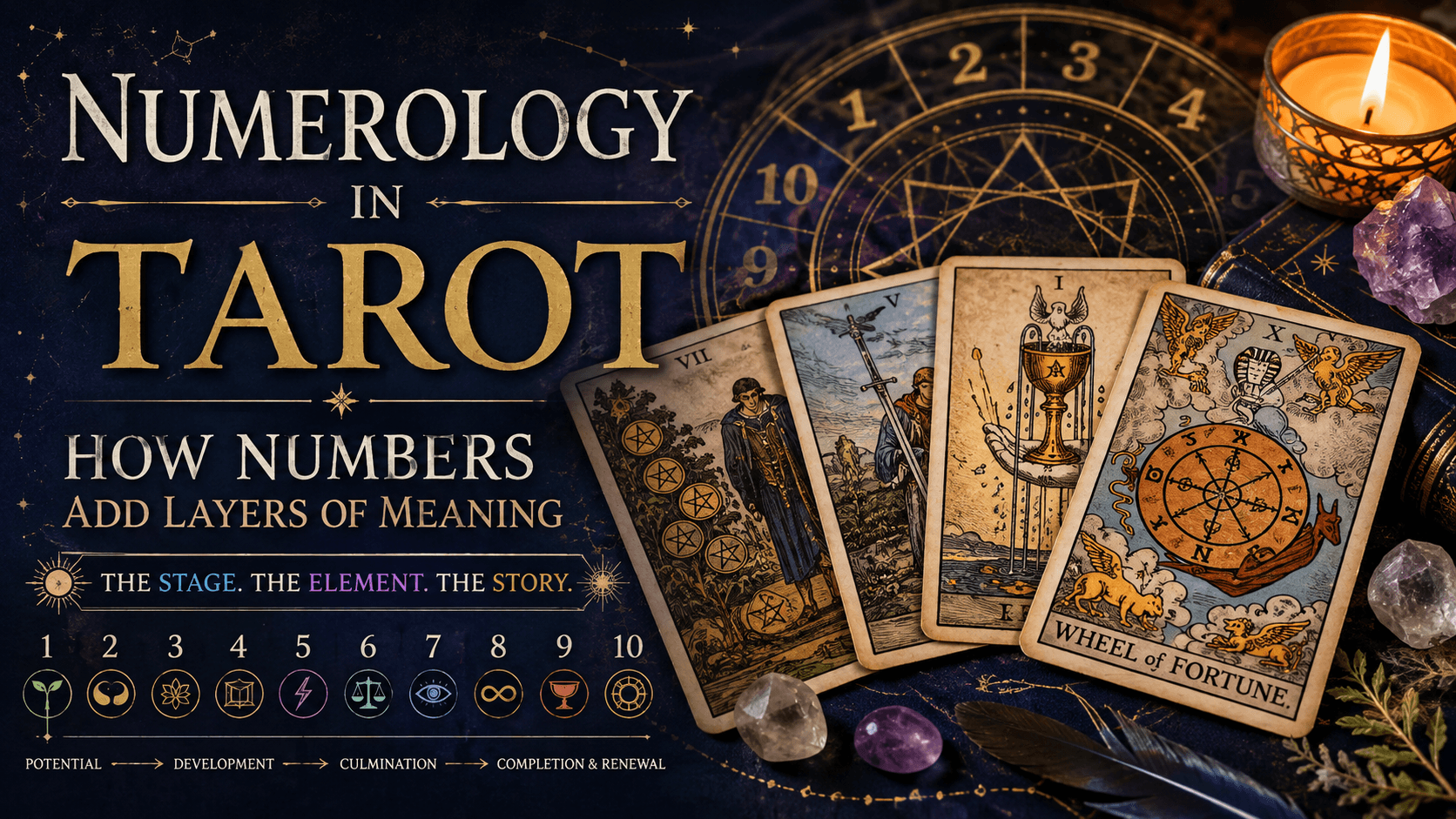
From the Ace to the Ten, the Minor Arcana can be understood as a journey: potential becomes polarity, polarity becomes creation, creation becomes structure, structure is tested, balance returns, mystery deepens, power develops, experience reaches culmination, and finally the cycle completes.
This is the sacred architecture of the Decad.
From a Hermetic Pagan perspective, numbers are not dead abstractions. They are expressions of cosmic order—patterns through which the powers of existence become intelligible.
Learning numerology in tarot therefore does not mean memorizing another list of keywords.
It means learning to recognize the stage of a process.
The Hermetic View of Number
To modern eyes, a number usually means quantity.
Three apples. Seven days. Ten coins.
But many ancient philosophical and magical traditions understood number differently. Number could express quality as well as quantity.
One represents unity.
Two introduces polarity.
Three allows relationship to produce something new.
Four establishes structure.
Five disturbs that structure.
And so the sequence continues.
In this view, numbers are not simply labels attached to objects. They describe relationships, movements, and principles.
This becomes extremely useful when reading tarot.
Every Minor Arcana card contains at least two fundamental layers:
The number tells you the stage.
The suit tells you the element or field in which that stage is occurring.
The Five of Cups, for example, is not simply “a card about disappointment.”
It is the Five power operating through Water.
The Five brings disruption, testing, and instability.
Water governs emotion, relationship, receptivity, memory, and the inner life.
Put these together and the meaning becomes much richer: emotional structures are being tested. Something has been disturbed within the realm of feeling. The experience may involve loss, disappointment, or grief—but the number tells us why the energy has taken this particular form.
This is the beginning of tarot numerology.
The Journey from Ace to Ten
The simplest way to begin developing your understanding of tarot number meanings is to study the progression from Ace through Ten.
Think of these not as rigid definitions but as living stages in a cycle.
| Number | Core Power | Essential Movement |
|---|---|---|
| 1 — Ace | Potential | The seed awakens |
| 2 | Polarity | Unity divides into relationship |
| 3 | Creation | Relationship produces expression |
| 4 | Stability | Expression becomes established |
| 5 | Challenge | Structure is tested |
| 6 | Harmony | Balance returns |
| 7 | Assessment | The path turns inward |
| 8 | Power | Energy becomes disciplined |
| 9 | Culmination | Experience reaches fullness |
| 10 | Completion | The cycle ends and renews |
Let’s examine each stage more closely.
One: The Undivided Seed
The Ace is pure potential.
It is the elemental force in its concentrated form, before it has developed into a complicated story.
The Ace of Cups is not yet a relationship.
The Ace of Wands is not yet a completed project.
The Ace of Pentacles is not yet wealth.
The Ace of Swords is not yet an entire philosophy.
Each contains the seed of its element.
One represents unity, beginning, identity, and concentrated force.
When an Ace appears, ask:
What is beginning?
What potential is present but not yet fully developed?
The Ace is the spark before the fire becomes a flame.
Two: Polarity and Relationship
With Two, unity becomes polarity.
There is now something to compare, choose between, join with, oppose, or balance.
Two introduces relationship.
This is why Twos often contain themes of choice, partnership, tension, balance, or duality.
The Two of Swords may present a difficult choice.
The Two of Cups may present relationship and mutual exchange.
The Two of Pentacles can show the balancing of competing demands.
The Two of Wands can suggest standing between the present reality and a possible future.
The essential question of Two is:
What happens when one becomes two?
Three: Creation and Expression
Three is the first great flowering.
Two forces interact, and something new emerges from their relationship.
Three therefore carries the principle of creation, synthesis, expression, and expansion.
The Three of Wands can show the expansion of an intention into the world.
The Three of Cups expresses emotional connection becoming celebration and community.
The Three of Pentacles brings different abilities together to create something tangible.
The Three of Swords demonstrates that the principle of division can also become painfully expressed through the mental and emotional realms.
Three is not automatically pleasant.
It simply means that something is coming into form.
Ask:
What is being created from what has already begun?
Four: Stability and Structure
Four establishes.
The energy that was only potential in One has now passed through relationship and creation and is given structure.
Four is foundation, stability, order, containment, and establishment.
This is why the Fours can feel solid—but sometimes too solid.
The Four of Wands can represent celebration, stability, and a foundation worth honoring.
The Four of Pentacles may show material security becoming attachment or possessiveness.
The Four of Swords establishes stillness and withdrawal.
The Four of Cups creates a stable emotional state that may become stagnation.
The lesson of Four is therefore twofold:
Structure gives energy a place to live.
But structure can also become a prison.
Five: Challenge and Disruption
Five disturbs the Four.
What has been established is tested.
This is one reason Fives can feel uncomfortable in tarot.
The Five introduces friction, conflict, instability, loss, competition, or disruption.
But challenge is not necessarily failure.
Without Five, there is no testing of the structure.
The Five asks whether what has been built is strong enough to continue.
The Five of Wands tests will through competition.
The Five of Cups tests emotional attachment through disappointment.
The Five of Pentacles tests material security through hardship.
The Five of Swords tests the mind through conflict.
When a Five appears, ask:
What structure is being tested?
Sometimes the disruption is not punishment.
It is initiation.
Six: Harmony and Restoration
After the friction of Five comes the possibility of restoration.
Six introduces harmony, balance, beauty, reciprocity, generosity, and integration.
The Six does not erase what happened during Five.
It incorporates the experience.
The Six of Cups can restore connection with memory and affection.
The Six of Pentacles explores balance in giving and receiving.
The Six of Wands can represent recognition following struggle.
The Six of Swords can indicate movement toward calmer mental waters.
Six asks:
What is returning to balance?
It is the breath after the struggle.
Seven: Mystery and Assessment
Seven turns the journey inward.
The energy is no longer simply expanding outward. It begins asking deeper questions.
Have we chosen correctly?
What lies beneath appearances?
What is actually being tested?
Seven therefore carries themes of assessment, mystery, introspection, faith, strategy, and spiritual testing.
The Seven of Cups confronts the imagination with many possibilities.
The Seven of Pentacles asks whether one’s investment will bear fruit.
The Seven of Wands demands courage and continued commitment.
The Seven of Swords brings strategy, concealment, and complicated mental movement.
Seven asks:
What must I understand before I proceed?
This is the number of the threshold.
Eight: Power and Mastery
Eight brings energy into sustained movement.
Where Seven asks questions, Eight demands engagement.
The number can therefore suggest power, discipline, mastery, movement, repetition, limitation, or the consequences of sustained action.
The Eight of Wands is rapid movement.
The Eight of Pentacles is disciplined repetition and craftsmanship.
The Eight of Cups is sustained movement away from what no longer satisfies.
The Eight of Swords demonstrates what happens when the mind’s structures become restrictive.
Eight asks:
How is power being directed?
And perhaps more importantly:
What have I become capable of through repeated action?
Nine: Culmination and Intensity
Nine stands near the end of the cycle.
The energy has developed considerably. What began as a seed is now approaching fullness.
This makes Nines cards of culmination, intensity, refinement, endurance, and near-completion.
The Nine of Cups can represent emotional satisfaction.
The Nine of Pentacles shows material independence and cultivated abundance.
The Nine of Wands speaks of endurance after repeated trials.
The Nine of Swords can show the mind reaching an extreme of anxiety or mental intensity.
Nine asks:
What has this process become?
The answer can be beautiful—or overwhelming.
Ten: Completion and Renewal
Ten completes the cycle.
But completion does not mean annihilation.
It means that the current form has reached its limit.
The Ten contains the fullness of the previous sequence and therefore also contains the beginning of another.
The Ten of Cups brings emotional fulfillment and family harmony.
The Ten of Pentacles shows accumulated material and ancestral abundance.
The Ten of Wands can show the burden created by carrying too much to completion.
The Ten of Swords can represent the finality of a mental or circumstantial cycle.
This is why it is a mistake to treat every Ten as simply “bad.”
Ten says:
This cycle has reached its full expression. What comes next?
The end contains the seed of the beginning.
Number and Element: Reading Both Layers Together
This is where tarot numerology explained becomes genuinely useful.
Do not read the number separately from the suit.
Read them together.
Imagine the Four appearing.
You know Four represents stability, structure, and foundation.
Now look at the suit.
Four of Wands
Four + Fire
Structure is being established through inspiration, will, creativity, celebration, and action.
Four of Cups
Four + Water
Emotional energy has become established. Depending on context, this may be stability—or emotional stagnation.
Four of Swords
Four + Air
The mind enters stillness, retreat, contemplation, and recovery.
Four of Pentacles
Four + Earth
Material stability becomes the central concern. This may be security, preservation, or attachment.
The number gives you the verb.
The element gives you the realm.
Together they produce the card’s living expression.
You can practice this with any Minor Arcana card:
This is the [number] power acting through the [element].
For the Eight of Pentacles:
This is the power of disciplined development acting through Earth.
Suddenly the card becomes more than a picture.
It becomes a process.
The Major Arcana: Numbers on a Higher Octave
The numerical architecture does not stop with the Minor Arcana.
The numbered Major Arcana echo many of these same principles, but they operate on a larger archetypal level.
The Magician is numbered I.
Here we encounter the principle of beginning, concentrated will, potential, and the ability to bring something from possibility into manifestation.
This creates a beautiful correspondence with the Aces.
The Ace is elemental potential.
The Magician represents that principle at a greater archetypal level.
Likewise, the Wheel of Fortune is numbered X.
Ten signifies completion, culmination, and the closing of a cycle—but also the turning toward another.
The Wheel embodies this movement dramatically.
The wheel turns.
Cycles complete.
Fortune changes.
The old arrangement becomes the beginning of another.
These numerical echoes allow the tarot deck to be experienced as a unified symbolic system.
The same divine idea appears again and again, but at different levels.
How to Use Numerology in a Tarot Reading
You do not need an elaborate system to begin.
Start with observation.
1. Look for Repeated Numbers
Suppose a reading contains three different Sevens.
That is unlikely to be something you should completely ignore.
The specific suits tell you where the issue is occurring, while the repeated Seven tells you that assessment, testing, uncertainty, or inward examination is a major theme.
The number becomes a chorus running underneath the individual cards.
2. Look for Numerical Progressions
Imagine a spread containing:
Three → Five → Nine
You can read this as a developmental story.
Something was created or expressed.
It encountered disruption or testing.
It eventually moved toward culmination.
The individual cards will tell you what happened, but the numbers reveal the trajectory.
3. Look for Regression
The reverse can also be meaningful.
A reading that moves from Eight back toward Four may suggest a return from intense activity toward stabilization.
The cards may be describing a process of consolidation rather than expansion.
4. Ask What Stage the Situation Is In
A useful question is:
“What stage of development is this energy currently occupying?”
A relationship may be in Two: learning how two people relate.
A project may be in Three: taking shape.
A career may be in Five: being tested.
A spiritual practice may be in Seven: demanding deeper examination.
The number gives you a developmental map.
Developing Numerical Literacy
Like any symbolic language, number becomes easier when practiced repeatedly.
Try these exercises.
Study One Number Across All Four Suits
Choose Four.
Lay out:
- Four of Wands
- Four of Cups
- Four of Swords
- Four of Pentacles
Ignore the conventional meanings for a moment.
Ask:
What does Four look like through Fire?
What does Four look like through Water?
What does Four look like through Air?
What does Four look like through Earth?
You will begin to feel the number rather than merely memorize it.
Track Your Numbers
For one lunar cycle, record the numbers appearing in your readings.
Do certain numbers repeatedly emerge?
Are you surrounded by Twos?
Are Fives appearing everywhere?
Are you repeatedly reaching the Nines and Tens?
Do not immediately assume this predicts an external event.
Instead, use it as a mirror.
What process in my life currently resembles this number?
Meditate on a Number
Before sleep or ritual, choose a single number.
Do not immediately consult a book.
Sit quietly with the number.
Write it.
Visualize it.
Speak its name.
Ask what it represents to you.
Then record whatever impressions arise.
Over time, this develops an intuitive relationship with numerical symbolism.
Common Mistakes When Learning Tarot Numerology
There are several traps worth avoiding.
Turning Numbers Into Rigid Keywords
“Five means conflict.”
“Ten means ending.”
“Seven means deception.”
This approach becomes another form of memorization.
Numbers are dynamic.
Five can be conflict, but it can also be necessary testing.
Ten can be an ending, but it can also be fulfillment and renewal.
Ignoring the Number Entirely
Some readers rely exclusively on intuition or imagery.
Intuition is valuable, but structure gives intuition something to work with.
Number provides a framework within which intuitive impressions can become more precise.
Starting With Too Much Complexity
The tarot has many sophisticated systems of correspondence.
Tree of Life attributions, planetary associations, decans, elemental dignities, and other Hermetic frameworks can deepen one’s practice considerably.
But there is no need to master everything at once.
Begin with the Decad.
Learn One through Ten until you can recognize their movement naturally.
Then add complexity.
Treating Ten as Purely Negative
Completion is not inherently negative.
A harvest is a completion.
A fulfilled promise is a completion.
A completed apprenticeship is a completion.
Even painful endings can create the space in which something new begins.
The Ten closes a door—but it also turns the key toward another.
A Short Meditation on the Decad
Take a moment to contemplate the sequence:
One.
The seed.
Two.
The division.
Three.
The creation.
Four.
The foundation.
Five.
The trial.
Six.
The restoration.
Seven.
The mystery.
Eight.
The mastery.
Nine.
The culmination.
Ten.
The completion.
Then return to One.
The cycle begins again.
This is one of the most beautiful insights offered by Hermetic tarot numbers.
Life rarely moves in a straight line.
It moves through cycles.
We begin.
We encounter others.
We create.
We establish.
We struggle.
We restore.
We question.
We develop mastery.
We approach fullness.
We complete.
And then, from within the completion, another beginning appears.
The tarot’s numbers teach us to recognize this movement.
The Hidden Architecture of the Minor Arcana
When number is restored to its proper place, the Minor Arcana cease to look like a collection of unrelated pictures.
The cards begin speaking to one another.
The Four of Wands and Four of Swords become relatives.
The Five of Cups and Five of Pentacles reveal a shared numerical tension expressed through different elements.
The Nine of Cups and Nine of Pentacles become two expressions of culmination in different realms.
And the Tens reveal themselves not merely as endings, but as thresholds.
This is the deeper gift of pagan tarot numerology.
Number gives us a way to see order within apparent chaos.
It reminds us that the experiences represented by the cards are not isolated accidents. They belong to cycles of growth, manifestation, testing, integration, and renewal.
The next time you draw a Minor Arcana card, resist the temptation to immediately search for its traditional meaning.
Look first at the number.
Ask what stage it represents.
Then look at the suit.
Ask through which element that stage is expressing itself.
Finally, look at the image.
Let the symbol reveal how that numerical and elemental power has taken form.
You may discover that the number was speaking before the picture ever caught your attention.
A Simple Practice
This week, pull the four Aces or the four Fours from your deck.
Place them together.
Spend several minutes observing them without interpreting them.
If you choose the Aces, contemplate pure potential.
If you choose the Fours, contemplate stability and structure.
Then ask yourself:
Where is this power appearing in my life?
What is beginning to take form?
Or:
What needs to become more stable?
Let the cards answer slowly.
Because once you begin to recognize the numerical current running beneath the tarot, every reading gains another dimension.
The images tell the story.
The elements tell you the realm.
But the numbers tell you where you are in the journey.