
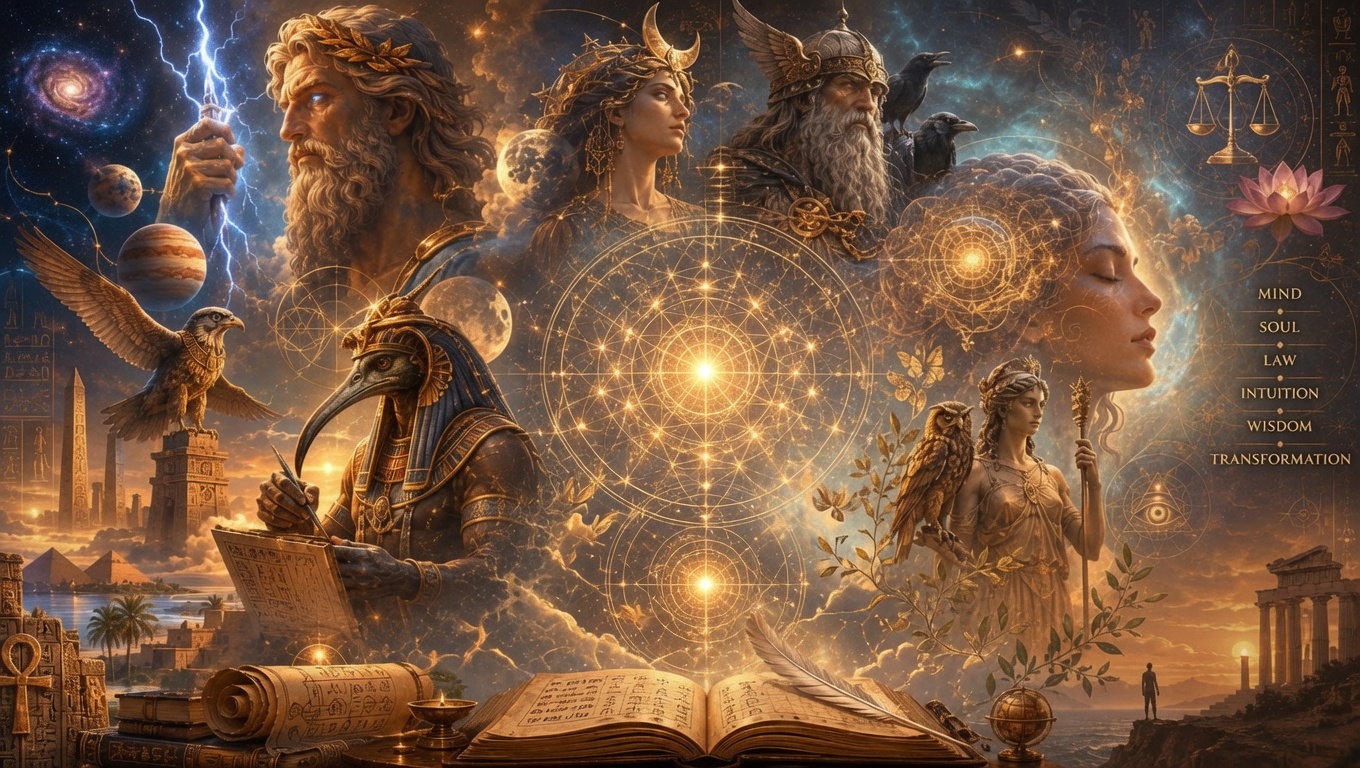
The Many Faces of the Gods: Understanding the True Nature of the Divine
One of the greatest obstacles to understanding the ancient Gods is assuming they can be reduced to a single definition.
Modern people often ask questions like, “Were the Gods real beings?” “Were they archetypes?” “Were they forces of nature?” “Were they planets?”
The answer, according to the ancient initiatory traditions, is yes.
The Gods were never understood as existing on only one level. They are living realities that encompass multiple dimensions of existence simultaneously. This is precisely what makes them Gods. They are not simple personalities or mythological characters—they are vast intelligences whose nature spans the cosmos, humanity, and the deepest laws governing existence.
To understand a God fully is to understand that every aspect of reality reflects every other.
The Gods as Cosmic Realities
On the external level, the Gods are the great powers that shape the Universe itself.
They embody the elemental forces of creation—Fire, Water, Earth, Air, and Aether. They govern universal principles such as light, darkness, attraction, gravity, harmony, and order. They personify the deeper laws that sustain existence, including Justice, Karma, and the hidden laws of Magick.
At the same time, the Gods are real, independent Beings who exist beyond humanity. They are creators, rulers, teachers, and guardians of the cosmic order.
Each God possesses many layers of reality. The more one studies, meditates upon, and works with a deity, the deeper these layers become.
The Gods Within Humanity
The ancients also taught that everything existing in the Universe has its reflection within man.
The Gods therefore exist internally as well as externally.
Within us, the Gods are:
- Faculties of the conscious and unconscious mind.
- Archetypal patterns of consciousness.
- Living aspects of the soul.
- Centers and functions of the human brain.
- Expressions of the universal laws operating within body, mind, and spirit.
Ultimately, humanity itself is a reflection of the Divine.
Many ancient traditions go even further, referring to the Gods as the literal progenitors of humanity—the Ones who seeded mankind and guided civilization during its earliest ages.
Understanding the Gods therefore means understanding ourselves.
Symbols: The Language Connecting Heaven and Earth
How do these external and internal realities connect?
Through symbols.
Symbols are the bridge between cosmic truth and human understanding. They allow one reality to express itself across many different levels at once.
This is why ancient texts can seem confusing to modern readers.
When the ancients referred to a God, they were often speaking about several realities simultaneously.
Without initiatory knowledge, many of these writings appear contradictory. With initiation, they reveal an astonishing consistency.
One Name, Many Meanings
Take Zeus as an example.
Depending upon the text, Zeus may refer to:
- The living God Himself.
- The Aether that permeates all existence.
- The source of cosmic creation.
- The leader of the Gods.
- The totality of divine powers.
- The Father from whom the other Gods proceed.
None of these descriptions contradict one another.
They simply describe different layers of Zeus’s being.
Because Zeus encompasses such immense reality, many ancient philosophers referred to Him as the “One God”—not to deny the existence of the other Gods, but to emphasize the all-encompassing magnitude of His divine nature.
Similar ideas appear throughout the ancient world.
Marduk in Babylon, Amun in Egypt, and Odin among the Norse all embody the concept of the All-Father—supreme expressions of Divine Intelligence whose nature extends beyond simple mythology.
The highest spirituality is never simplistic. It is layered, symbolic, and multidimensional.
Thoth: A Perfect Example
No God better illustrates this principle than Thoth.
Most people know Thoth simply as the Egyptian God of wisdom.
Yet this is only one layer of His reality.
Thoth is first and foremost a living Divine Being.
He is simultaneously the ruler of the Third Eye, representing the awakening of higher perception and spiritual vision within humanity.
Psychologically, He governs learning, memory, intuition, understanding, and the endless pursuit of wisdom.
Archetypally, He represents the perfected seeker—the one who devotes himself completely to knowledge.
Cosmically, He rules over Mercury and the Moon, embodying communication, intelligence, measurement, writing, and the transmission of knowledge.
Throughout history, He appears under many different names.
The Greeks knew Him as Hermes.
In Mesopotamia He appears as Nebo and Ninghizzidha.
Different civilizations used different names because names are linguistic vessels designed to express the same Divine Essence.
According to ancient traditions, Thoth was among the great civilizing beings who descended in humanity’s earliest ages to teach writing, mathematics, language, science, and sacred knowledge.
Although cultures describe Him differently, the Being behind the names remains the same.
Reading the Ancient Texts
Understanding this framework transforms how we interpret ancient writings.
When an initiate wrote:
“The Art of Thoth”
they were referring to writing and sacred knowledge.
When they wrote:
“The Domain of Thoth”
they could be speaking about the Moon or Mercury.
When they instructed students to:
“Awaken Thoth”
they referred to activating the Third Eye and expanding consciousness.
If a text declared:
“Thoth sleeps,”
it indicated that this inner faculty had become dormant.
If it said:
“Feed Thoth,”
it meant to nourish and strengthen that center through spiritual practice.
Without initiatory understanding, these passages are interpreted literally and lose nearly all of their intended meaning.
Many modern readers—including academics approaching ancient texts solely through historical or materialistic methods—often miss these deeper layers because they are looking only at the surface.
The mystery traditions always expected the reader to recognize symbolism and multiple levels of meaning simultaneously.
The Gods Are Living Wholeness
Every God is an anchor point that unites countless realities into one Divine Being.
A God is not merely an individual personality.
Nor is a God simply a psychological archetype.
Nor merely a planet.
Nor merely a force of nature.
Nor merely an idea.
Each God is all of these together.
If Thoth were only the planet Mercury, He would not be a God.
If He were only an archetype, He would not be a God.
If He were only an extraterrestrial teacher, He would not be a God.
His divinity lies in His ability to encompass every one of these realities simultaneously.
This is true of all the Gods.
Beyond Worship
The ancient religions never encouraged blind worship.
The purpose of honoring the Gods was never to become their slave.
Instead, they established cultures of initiation, discipline, self-transformation, and spiritual ascent.
Worship serves an important purpose because it focuses the mind upon Divine realities.
As consciousness becomes attuned to the Gods, the divine potential already present within the soul begins to awaken.
To glorify the Gods is also to glorify the divine spark They have placed within humanity.
The ultimate goal is not passive devotion, but conscious participation in the process of becoming more divine.
The Journey Toward the Godhead
To understand the Gods completely is to recognize their reflection within ourselves.
Every act of study, contemplation, ritual, meditation, and self-development becomes a step toward realizing the Divine Nature latent within the human soul.
This journey is neither simple nor quick.
It demands knowledge, discipline, experience, and transformation.
The Gods cannot be understood through a single lens—not as mythological superheroes, not merely as cosmic visitors, not merely as psychological symbols, nor solely as invisible spiritual beings.
Each of these perspectives contains part of the truth.
Only when all the layers are brought together does the true nature of the Divine begin to emerge.
The Gods are living, multidimensional realities. They are the powers that shaped the cosmos, the intelligences behind creation, the archetypes of the soul, the hidden laws of existence, and the highest potential within humanity itself.
To know the Gods is, ultimately, to begin the journey of becoming like Them.