Few tarot cards capture the emotional weight of a breakup as vividly as the Five of Cups. It is the card of loss, regret, disappointment, and the painful realization that something you once cherished may no longer exist in the form you hoped it would.
When the Five of Cups appears in a breakup reading, it often points to a heart still occupied by the past. Someone may be mourning the relationship, replaying old conversations, regretting decisions, or struggling to accept that the future they imagined with another person has been taken away.
But this card carries a deeper message than heartbreak alone. It reveals the strange power the past can hold over the present—and how grief can prevent us from recognizing what remains possible.
To understand the Five of Cups in a breakup reading, we must look beyond its surface meaning and examine what it reveals about emotional attachment, reconciliation, regret, and the difficult process of reclaiming our power after love has been lost.
The Five of Cups Tarot Card: Understanding Its Symbolism
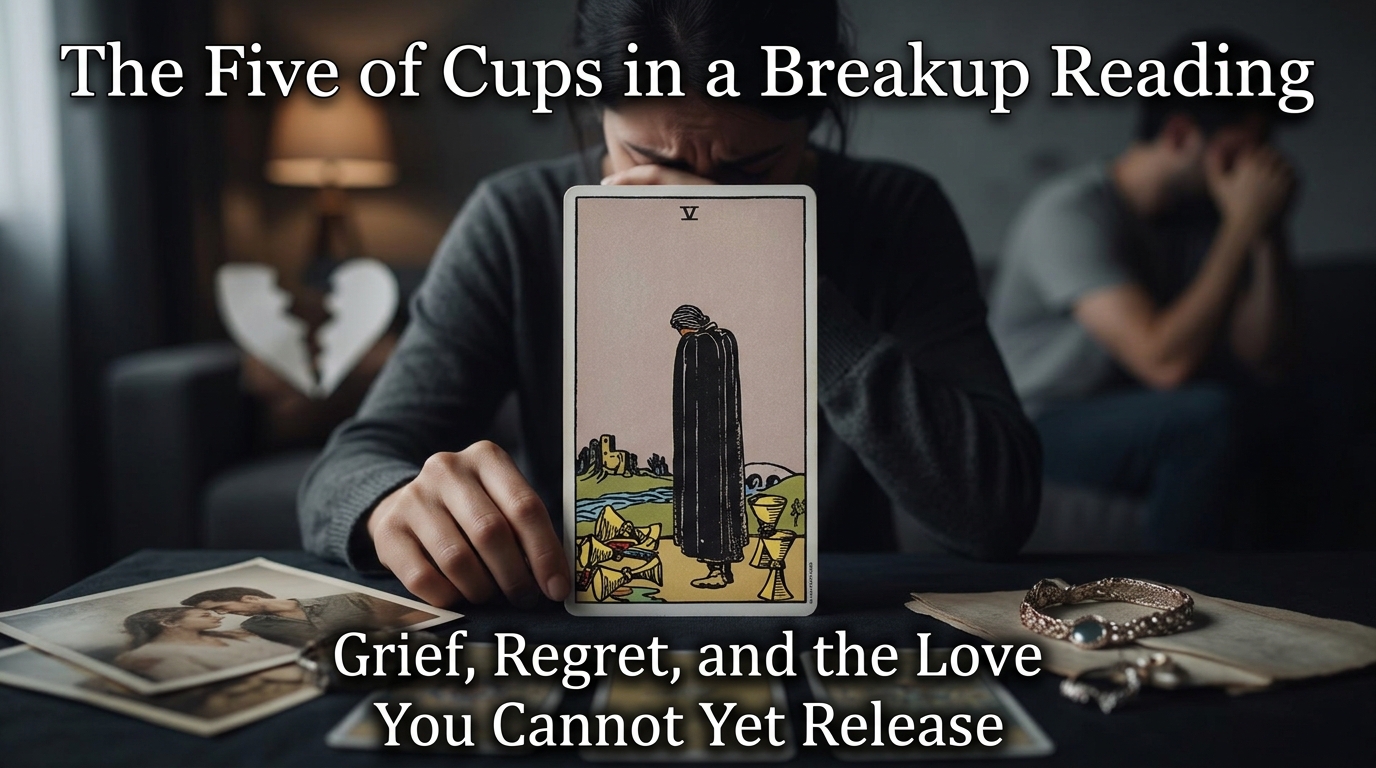
In the traditional Rider-Waite-Smith tarot deck, the Five of Cups depicts a cloaked figure standing before three spilled cups. The figure’s head hangs downward, seemingly absorbed in the loss. Behind them stand two upright cups, while a river, bridge, and distant structure occupy the surrounding landscape.
Every element contributes to the card’s meaning.
The Three Spilled Cups: What Has Been Lost
The spilled cups represent emotional disappointment and the painful consequences of an experience that did not unfold as desired.
In a breakup reading, they may symbolize the relationship itself, broken promises, lost intimacy, or the future two people once imagined together. They can also represent trust that has been damaged or words that cannot be taken back.
The figure does not appear to be grieving an abstract possibility. Their attention is fixed on something that once held value and is now gone.
This is the emotional reality of a breakup: sometimes, what hurts most is not simply losing a person, but losing the life you believed you were going to build with them.
The Two Upright Cups: What Remains
Behind the grieving figure stand two cups that have not been spilled.
These cups are central to the card’s deeper message. They represent what has survived the loss, whether that means remaining affection, personal dignity, emotional wisdom, future romantic possibilities, or the capacity to love again.
In certain readings, the two upright cups may even suggest that a connection between former partners has not entirely disappeared. Feelings may remain, and reconciliation may still be possible under the right circumstances.
However, the presence of these cups does not guarantee a reunion. Their meaning depends on the surrounding cards, the question being asked, and the actual circumstances of the relationship.
The essential message is that loss does not necessarily mean everything of value has been destroyed.
The Cloaked Figure: Emotional Withdrawal
The figure’s posture suggests sorrow, isolation, and an inability to look beyond the immediate pain.
This is particularly significant in breakup readings because emotional suffering often narrows our perception. We remember the beautiful moments, obsess over the mistakes, and imagine alternative endings in which everything might have worked out differently.
The mind repeatedly returns to what was lost because accepting the loss means confronting a future that looks unfamiliar.
The Five of Cups reveals this state of emotional withdrawal. Someone may be so consumed by regret or longing that they cannot yet recognize what life is offering them now.
The Bridge: A Path Beyond Heartbreak
The bridge in the background symbolizes a possible passage from one state of being to another.
After a breakup, that passage may involve accepting the end of the relationship, rebuilding a sense of identity, establishing healthier boundaries, or eventually approaching love with greater wisdom.
The bridge does not promise that the past can be restored. Instead, it suggests that the present emotional landscape is not the final destination.
There is a way forward, even when the grieving figure cannot yet see it.
The Five of Cups as Feelings After a Breakup
When you ask the tarot how someone feels about you after a breakup and the Five of Cups appears, it often suggests sadness, disappointment, regret, or an unresolved emotional attachment.
The person may be thinking about what went wrong and feeling the absence of the relationship more strongly than they expected.
They might miss your presence, remember shared experiences, or wish that certain arguments and decisions had unfolded differently.
However, the Five of Cups does not necessarily indicate that someone wants to return.
Missing someone and being willing to rebuild a relationship are two different things.
A former partner may genuinely regret losing you while still believing that the breakup was necessary. They may miss the comfort of the relationship without being prepared to address the problems that caused it to fail.
Alternatively, they may be struggling with the realization that their own actions contributed to the separation.
The surrounding cards help distinguish these possibilities. The Six of Cups may emphasize nostalgia, the Judgement card may point toward reflection and a possible reckoning, and the Eight of Cups may suggest that emotional pain exists alongside a decision to move on.
The Five of Cups, by itself, describes an emotional condition more reliably than it predicts what someone will do about it.
Does the Five of Cups Mean Your Ex Regrets Losing You?
Regret is one of the most important themes associated with the Five of Cups.
When this card appears in response to a question about an ex-partner’s feelings, it can suggest that the person is reflecting on the relationship through the lens of loss. They may recognize that something meaningful has ended and feel sorrow about the outcome.
But the nature of that regret matters.
There are several ways it can manifest.
1. Regret Over Losing the Relationship
Your ex may be mourning the companionship, affection, intimacy, and shared experiences that are no longer available.
They may have underestimated the emotional significance of the relationship until they experienced its absence.
This is especially plausible when the Five of Cups appears alongside cards associated with emotional connection, such as the Two of Cups or the Six of Cups.
2. Regret Over Their Own Actions
Sometimes the pain comes from recognizing that one’s choices contributed to the loss.
A person may wish they had communicated more honestly, treated their partner with greater consideration, or handled conflict differently.
In this interpretation, the Five of Cups points toward the emotional consequences of past behavior.
Yet remorse alone does not establish that someone has genuinely changed. A person can feel terrible about losing a relationship without developing the maturity necessary to sustain one.
3. Regret Over an Unfulfilled Future
A breakup can destroy an imagined future as effectively as it ends a present relationship.
The couple may have discussed marriage, children, travel, a shared home, or other plans that will now never unfold in the same way.
The Five of Cups can represent grief over these unrealized possibilities.
Sometimes, what a person misses most is not simply their former partner, but the life they believed the two of them would share.
4. Regret Without Reconciliation
This is an important distinction.
Someone can regret a breakup and still choose not to return. They may recognize the value of what they lost while understanding that the relationship was unhealthy, incompatible, or impossible to maintain.
The Five of Cups encourages us to acknowledge emotional complexity rather than reduce every sign of sadness to a prediction of reunion.
If you are asking whether your ex regrets losing you, consider the card an invitation to examine that possibility—not proof of another person’s private thoughts.
Does the Five of Cups Mean Reconciliation?
The Five of Cups is not an automatic reconciliation card. Its primary emphasis is on loss, sorrow, and the emotional consequences of disappointment.
Nevertheless, it can appear in readings where reconciliation remains a possibility.
The two upright cups provide a symbolic opening for what has survived the breakup. They can suggest that affection remains, that the connection has not been entirely forgotten, or that something valuable could still be recovered.
But there is an important condition: someone must eventually turn away from the spilled cups and recognize what remains.
In practical terms, reconciliation requires more than missing each other. It requires both people to confront the reasons the relationship ended.
If dishonesty destroyed trust, trust must be rebuilt. If emotional neglect caused resentment, the pattern must change. If incompatible life goals led to separation, those differences must be addressed honestly.
Without that work, a reunion may simply recreate the circumstances that produced the original breakup.
What Other Cards Can Reveal
The surrounding cards can help clarify the Five of Cups in a reconciliation reading.
- Five of Cups + Six of Cups: Nostalgia, memories, and emotional attachment to the past may be prominent.
- Five of Cups + Judgement: Reflection, accountability, and the possibility of revisiting a significant decision become important themes.
- Five of Cups + Two of Cups: The reading may emphasize a meaningful emotional bond that deserves closer examination.
- Five of Cups + Eight of Cups: Grief may coexist with a decision to leave the relationship behind.
- Five of Cups + The Tower: The breakup may have involved a painful disruption that fundamentally changed how the relationship was understood.
- Five of Cups + The Star: Healing, renewed hope, and the gradual recovery of emotional perspective become central themes.
- Five of Cups + Death: The emphasis shifts toward transformation, the ending of an old chapter, and the necessity of allowing something to change fundamentally.
These combinations are interpretive possibilities, not fixed predictions. Their significance depends on the question, positions in the spread, and the broader reading.
The Five of Cups When You Are the One Who Was Left
When you draw the Five of Cups to describe your own feelings after a breakup, the card may be reflecting the emotional reality you already know but have not fully processed.
You may be grieving the person, the relationship, or the version of yourself that existed when you were together.
Perhaps you keep returning to the final conversation, wondering whether a different choice would have produced a different outcome. Perhaps you are searching for hidden meanings in their last message or hoping that the tarot will reveal that they still love you.
The Five of Cups asks you to look honestly at what you are mourning.
Are you grieving the person as they actually were, or the person you hoped they would become?
Are you longing for the relationship you experienced, or the relationship you believed was always just within reach?
Are you holding on because the connection was genuinely nourishing, or because accepting its end feels like admitting that your investment did not produce the future you wanted?
These questions are not intended to diminish your feelings. They help distinguish love from idealization, attachment from compatibility, and genuine possibility from the desire to undo pain.
You do not have to pretend that the relationship meant nothing. Nor must you convince yourself that the breakup was a blessing before you are ready to believe it.
The Five of Cups allows grief to be real while reminding you that grief is not the whole story.
The Five of Cups as a Warning Against Living in the Past
One of the card’s most challenging interpretations is its association with fixation.
Grief is a natural response to loss, but it can become a prison when every aspect of the present is measured against what once existed.
You may compare every potential partner to your ex. You may revisit old photographs, reread conversations, or construct elaborate explanations for why the relationship ended. You may repeatedly consult tarot cards in search of reassurance that the story is not finished.
Over time, the search for certainty can become another way of remaining attached to the past.
The Five of Cups asks whether your attention is serving you or keeping you emotionally suspended.
There is a difference between learning from a relationship and endlessly reliving it. Reflection helps you understand what happened. Rumination repeatedly returns you to the same pain without producing new insight.
In the language of Hermetic philosophy, attention is a powerful force in shaping your experience. What occupies the mind influences how you interpret the world, what possibilities you recognize, and which actions you consider available.
When attention remains fixed on what has been lost, the possibilities that remain may become increasingly difficult to perceive.
The lesson is not to deny your sorrow. It is to recognize that sorrow need not govern every decision you make.
The Five of Cups and the Hermetic Meaning of Heartbreak
From a Hermetic perspective, a breakup can be understood as a confrontation with the difference between reality and the inner image we have constructed of it.
We rarely love another person in complete isolation from our own expectations. We also love the meanings we attach to them: the security they represent, the future they promise, the recognition they provide, or the version of ourselves we become in their presence.
When the relationship ends, these inner structures are shaken.
The Five of Cups illustrates the moment when consciousness becomes absorbed in the discrepancy between what was imagined and what has occurred.
The spilled cups symbolize the collapse of an emotional arrangement. The two upright cups represent the possibility that value, meaning, and creative power still exist beyond that collapse.
The principle of Mentalism, commonly expressed in Hermetic traditions as the idea that reality and experience are profoundly connected with mind, offers a useful lens for examining this process. It does not mean that heartbreak is imaginary or that thoughts alone control external events. Rather, it invites us to investigate how our interpretations shape our experience of loss.
If you believe that one particular relationship was your only opportunity for profound love, its ending may feel like the destruction of your entire romantic future.
If you recognize that the relationship was one meaningful expression of your capacity to love, its ending can be devastating without becoming a verdict on everything that lies ahead.
The external event may be the same. The meaning you assign to it changes how you respond.
The Alchemical Dimension: Nigredo
In alchemical symbolism, the stage of nigredo is associated with darkness, dissolution, and the breakdown of an existing form.
The Five of Cups resonates with this symbolism because heartbreak can dismantle assumptions that once seemed unquestionable.
You may discover that you ignored incompatibilities, confused intensity with intimacy, sacrificed too much of yourself, or expected another person to resolve an insecurity you had never fully examined.
These discoveries can be painful. Yet they can also become the raw material of transformation.
The purpose of this process is not to become cold, distrustful, or incapable of vulnerability. It is to emerge with a more integrated understanding of yourself and your relationships.
A person who has confronted their patterns honestly may become better able to recognize reciprocity, communicate their needs, and distinguish genuine commitment from temporary emotional intensity.
The Five of Cups, viewed through this lens, is not simply a card of suffering. It is an image of the interval between the collapse of an old emotional reality and the formation of a wiser one.
What Should You Do When the Five of Cups Appears in a Breakup Reading?
The practical advice of this card is to acknowledge the loss without allowing it to define the entirety of your future.
First, identify what you have actually lost.
Write down what you miss about the relationship. Then distinguish between the qualities that genuinely existed and the possibilities you hoped would eventually materialize.
This exercise can reveal whether you are grieving a relationship that fulfilled your needs or one that kept you waiting for fulfillment.
Second, examine your regrets without turning them into self-punishment.
Perhaps you made mistakes. Perhaps your former partner did. Perhaps both of you contributed to the breakdown in different ways.
Take responsibility for what belongs to you, learn from it, and resist the temptation to assume that you could have controlled every outcome.
Regret becomes useful when it produces understanding and changed behavior. Without that movement, it merely repeats the past.
Third, stop treating another person’s return as the only possible resolution.
You may want reconciliation, and that desire is not inherently wrong. But your emotional recovery should not depend entirely on a decision made by someone else.
If reconciliation becomes possible, evaluate it through honest communication, consistent behavior, mutual accountability, and compatibility—not simply the intensity of your longing.
If reconciliation does not happen, your life can still develop in meaningful and fulfilling directions.
Fourth, turn your attention toward what remains.
The two upright cups offer a symbolic prompt: what has survived this experience?
Perhaps you still possess friendships, ambitions, creative interests, spiritual practices, or a sense of purpose that became neglected during the relationship.
Perhaps you have gained a clearer understanding of your boundaries and the kind of love you want to experience.
These things do not erase the loss. They remind you that the loss has not erased everything else.
A Five of Cups Tarot Spread for Breakup Healing
If you want to explore the card’s message more deeply, try this five-card tarot spread.
- What am I truly grieving? — Identify the central emotional loss beneath the surface.
- What am I struggling to accept? — Reveal the truth, change, or uncertainty you are resisting.
- What lesson does this relationship hold for me? — Examine the pattern or insight you can carry forward.
- What remains in my life that I am overlooking? — Recognize existing sources of strength, connection, and possibility.
- What is the next step toward emotional integration? — Identify a practical action that supports your recovery.
You can use this spread whether you hope to reconcile or want to move on.
The purpose is not to force yourself into a particular outcome. It is to understand the emotional forces influencing your decisions so you can approach the future with greater awareness.
Final Thoughts: The Five of Cups Is Not the End of Your Love Story
The Five of Cups is one of the tarot’s clearest images of heartbreak. It speaks to the sorrow of losing someone, the regret of choices that cannot be undone, and the longing to return to a moment when the future still appeared certain.
In a breakup reading, it may suggest that you or your former partner are struggling with the emotional consequences of separation. It can point toward unresolved feelings, remorse, and the difficulty of releasing a relationship that once mattered deeply.
But the card also contains a quiet challenge.
Will you allow what has been lost to become the only thing you can see?
The two upright cups remain behind the grieving figure. They do not demand immediate optimism, nor do they guarantee that the relationship can be restored. They simply represent the possibility that something of value still exists beyond the present sorrow.
Perhaps that value is a connection that can be rebuilt through genuine change. Perhaps it is the wisdom you gained, the boundaries you learned to establish, or the capacity to love that remains yours regardless of who stays or leaves.
The Five of Cups does not ask you to forget the past. It asks you to stop confusing the past with the entirety of your future.
Sometimes, the most important revelation in a breakup reading is not whether someone will come back.
It is discovering what you can reclaim within yourself, even if they never do.