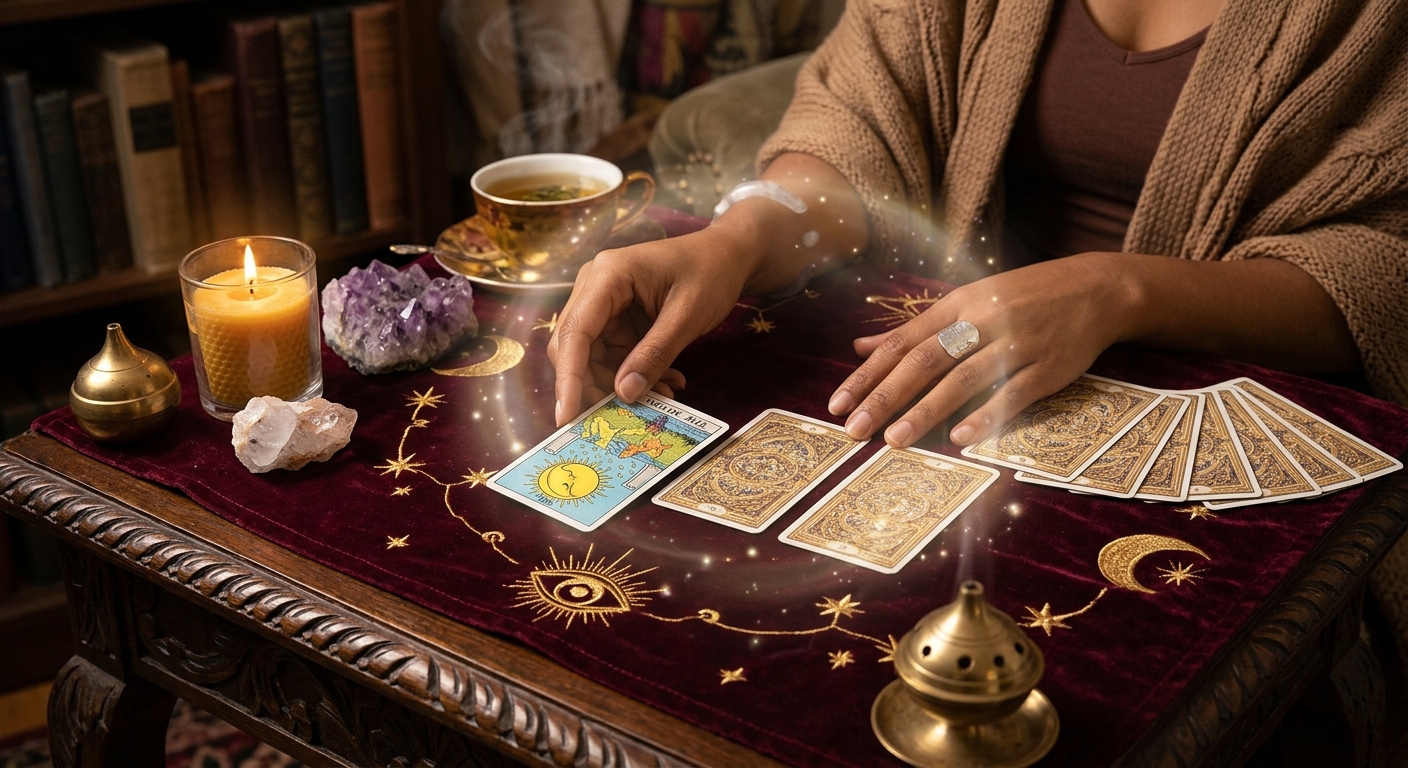
Have you ever met someone and wondered what they thought of you the moment they saw you? Perhaps you noticed a lingering glance, an unexpected smile, a sudden change in their behavior, or a subtle tension you could not quite explain. Maybe the encounter seemed ordinary on the surface, yet something about it stayed with you long after you parted ways.
First impressions are fascinating because they often form before two people have exchanged more than a few words. Physical appearance, body language, emotional atmosphere, and unconscious expectations can all influence how one person perceives another. In romantic encounters, these first moments may establish the initial conditions for attraction, curiosity, or even hesitation.
But what if you could use tarot to explore the impression you may have made?
In a Hermetic-Pagan approach to tarot, the cards are more than illustrations of familiar human experiences. They form a symbolic language through which we can investigate attraction, projection, emotional responses, and the subtle dynamics that emerge when two people meet.
A tarot reading cannot establish with certainty what another person thought or felt. However, it can help you examine the possible dynamics of an encounter, consider different interpretations of their behavior, and recognize what you may be bringing to the situation yourself.
In this guide, we will explore the tarot cards that may reveal how someone initially perceives you, which cards suggest romantic curiosity, which indicate intimidation or uncertainty, and how to perform a tarot spread designed specifically for first impressions.
Why First Impressions Matter in Love
The first encounter between two people establishes an initial framework through which later interactions may be interpreted.
Someone might perceive you as confident before discovering that you are naturally shy. Another person might mistake your quietness for mystery, your directness for authority, or your warmth for romantic interest. These impressions can change as familiarity develops, but they may influence whether someone feels encouraged to approach you or chooses to keep their distance.
In romantic situations, first impressions often involve several overlapping questions:
- Does this person find me physically attractive?
- Do I seem approachable, confident, or intimidating?
- Have I awakened their curiosity?
- Do they perceive me as someone they would like to know more intimately?
- Did something about our encounter leave a lasting impression?
Tarot offers a way to explore these questions symbolically.
The important distinction is between examining a possible impression and treating the cards as direct access to another person’s private thoughts. The former encourages reflection; the latter can lead you to mistake your hopes or anxieties for evidence.
When you approach a reading with curiosity rather than a demand for certainty, the cards become much more useful.
The Tarot Cards That Reveal How Someone May See You
Certain tarot cards are especially useful when exploring the image you project, the attraction you may inspire, and the emotional atmosphere surrounding a first encounter.
Their meanings depend on the question, the position in the spread, and the cards surrounding them. Nevertheless, the following interpretations provide a useful starting point.
1. The Empress: You Appeared Attractive, Warm, and Magnetic
The Empress is one of the most intriguing cards to receive when asking about a romantic first impression.
Associated with Venus, beauty, sensuality, fertility, abundance, and creative power, The Empress represents an energy that attracts through presence rather than force.
If this card appears in a position representing how someone initially perceived you, it may suggest that your appearance, warmth, confidence, or natural ease stood out to them.
They may have experienced you as someone who seems comfortable in their own skin. Your mannerisms, smile, voice, personal style, or ability to make others feel welcome may have contributed to that impression.
In a romantic reading, The Empress can symbolize physical attraction, admiration, and the desire to become closer.
However, its meaning is not limited to conventional beauty or femininity. The card can also represent abundance of spirit, creativity, generosity, and a grounded sense of self-worth.
The deeper message: You do not need to pursue every person’s attention. The Empress invites you to recognize the qualities you naturally bring into a room.
2. The High Priestess: You Seemed Mysterious and Difficult to Read
The High Priestess represents intuition, hidden knowledge, silence, and the mysteries that exist beneath the visible surface.
When this card appears in a reading about a first impression, it may suggest that someone perceived you as reserved, enigmatic, perceptive, or emotionally difficult to decipher.
Perhaps you did not reveal much about yourself during the encounter. Perhaps you listened more than you spoke, maintained a composed expression, or gave the impression that you were observing everything around you.
Such qualities can inspire curiosity. Someone may want to know what lies beneath your quiet exterior.
Yet mystery can also create uncertainty. A person who cannot easily interpret your reactions may not know whether you are interested, indifferent, shy, or simply thoughtful.
The deeper message: Privacy can be compelling, but genuine connection eventually requires communication. You can maintain your depth without making yourself impossible to approach.
3. The Queen of Wands: You Appeared Confident and Charismatic
The Queen of Wands is associated with confidence, vitality, independence, passion, and personal magnetism.
If this card represents someone’s first impression of you, it may suggest that you appeared self-assured, expressive, energetic, or socially comfortable.
You might have entered the room with a strong presence, spoken with conviction, or demonstrated an ease that attracted attention without requiring constant validation.
In a romantic context, the Queen of Wands can symbolize a person who inspires admiration and curiosity. Someone may find your independence particularly attractive because you seem to possess interests, ambitions, and a life of your own.
However, confidence can be interpreted differently depending on the observer. One person may find it inspiring, while another may feel intimidated or uncertain about approaching you.
The deeper message: Your strongest attraction may come from expressing your genuine personality rather than performing a version of yourself designed to please someone else.
4. The Lovers: There May Have Been an Immediate Sense of Attraction
The Lovers is one of the most recognizable cards in romantic tarot readings.
When it appears in a first-impression spread, it can symbolize attraction, a sense of recognition, shared values, or the possibility of a meaningful connection.
You may have experienced an encounter in which conversation felt unusually natural or in which mutual interest seemed possible from the beginning.
The Lovers can also represent a moment when attraction creates a choice: whether to approach, continue the conversation, exchange contact information, or explore the possibility of something more.
However, the card does not prove that another person experienced love at first sight or believes you are their soulmate.
It may instead invite you to consider whether the encounter revealed genuine compatibility or simply awakened your imagination about what could happen.
The deeper message: Attraction may open the door, but mutual effort and conscious choice determine what happens next.
5. The Star: You Appeared Refreshing, Inspiring, or Unusually Genuine
The Star represents hope, renewal, authenticity, openness, and the restoration of trust.
In a reading about someone’s first impression, it may suggest that you came across as approachable, sincere, peaceful, or quietly inspiring.
Perhaps your presence felt different from what the person had experienced recently. You may have seemed easy to talk to, emotionally open, or comfortable expressing yourself without excessive self-consciousness.
In romantic contexts, The Star can symbolize admiration that develops through a sense of authenticity rather than immediate physical intensity.
Someone may be intrigued by the impression that you are comfortable being yourself.
The Star also cautions against idealization. When we encounter someone who seems extraordinary, we sometimes project our hopes onto them before learning who they really are.
The deeper message: Allow yourself to be seen honestly, and give the other person time to reveal who they are as well.
6. The Sun: You Made a Positive and Memorable Impression
The Sun represents vitality, warmth, confidence, joy, and clarity.
When it appears in this type of reading, it may suggest that you came across as friendly, expressive, cheerful, or easy to be around.
You might have made someone laugh, helped them feel comfortable, or brought a welcome sense of energy to the encounter.
In a romantic reading, The Sun can symbolize openness and the possibility of a connection that develops without excessive games or ambiguity.
Rather than suggesting secret obsession or hidden longing, this card often emphasizes the value of straightforward interaction.
The deeper message: Sometimes the most attractive impression is the one created when two people feel free to relax and enjoy one another’s company.
7. The Emperor: You Appeared Powerful, Mature, or Intimidating
The Emperor represents authority, stability, structure, self-control, and personal boundaries.
If this card appears in a first-impression reading, someone may have perceived you as confident, disciplined, serious, or difficult to impress.
You might project a sense of independence that makes it clear you know what you want. In a romantic context, this can inspire respect and attraction, particularly in someone who values stability.
However, The Emperor can also suggest that your composure makes you seem emotionally guarded.
Someone may admire you without knowing whether you would welcome their attention.
The deeper message: Strength and warmth are not opposites. You can maintain your standards while allowing others to see your approachable side.
8. The Moon: They Found You Intriguing but Were Unsure What to Think
The Moon represents uncertainty, imagination, intuition, hidden fears, and the difficulty of distinguishing appearances from reality.
When this card appears in a first-impression reading, it may suggest that the encounter left someone uncertain or that the situation contains details you do not yet understand.
They may have found you difficult to read, experienced mixed feelings, or formed an impression influenced by their own expectations.
The Moon is particularly important when you find yourself repeatedly analyzing small gestures, glances, or changes in tone.
A mysterious encounter can inspire powerful speculation, but uncertainty is not evidence of hidden romantic feelings.
The deeper message: Do not confuse the absence of information with proof of a deeper connection. Let reality become clearer before deciding what the encounter means.
9. The Devil: Strong Chemistry, Temptation, or Intense Curiosity
The Devil is associated with desire, attachment, temptation, compulsion, and the forces that can draw us toward experiences we find difficult to resist.
In a first-impression reading, it may symbolize strong physical attraction, fascination, or an encounter that brings desire to the forefront.
You might have noticed intense eye contact, heightened awareness of the other person’s presence, or an atmosphere that felt charged.
Yet The Devil can also point toward projection, unhealthy attachment, or the tendency to interpret intensity as proof of compatibility.
It does not automatically mean that someone is obsessed with you or secretly desires you.
The deeper message: Chemistry is worth acknowledging, but it should not be confused with emotional availability, compatibility, or genuine commitment.
10. The Hermit: They Saw You as Reserved, Independent, or Thoughtful
The Hermit represents introspection, wisdom, solitude, and the search for deeper understanding.
If this card appears in a first-impression spread, you may have seemed quiet, reflective, independent, or more interested in observing than attracting attention.
Someone might perceive you as mature or thoughtful. They may also be uncertain about whether you want company.
In a romantic context, The Hermit can indicate that the initial impression was one of distance rather than immediate flirtation.
That distance is not necessarily negative. It may reflect a preference for meaningful interaction over superficial conversation.
The deeper message: You do not need to become the loudest person in the room to attract a compatible partner. But if you want someone to approach you, small signals of openness can help.
What If the Cards Suggest That You Intimidated Them?
Not every first impression is immediately warm or romantic.
Sometimes the cards suggest that someone perceived you as serious, independent, guarded, or difficult to approach. If you receive The Emperor, Queen of Swords, King of Swords, or Nine of Pentacles, it may be useful to explore themes of self-possession and boundaries.
The Queen of Swords, for example, can symbolize intelligence, discernment, directness, and emotional independence. Someone may have perceived you as sharp-minded or unwilling to tolerate superficial behavior.
The Nine of Pentacles can suggest that you appeared self-sufficient, composed, or content with your own company.
These qualities are not flaws that need to be corrected. However, they can influence how others interpret your availability.
If you are interested in someone, consider whether your natural reserve might be mistaken for disinterest. A smile, an engaging question, or a willingness to continue the conversation can communicate openness without requiring you to abandon your standards.
At the same time, do not assume that someone who seems nervous around you must be attracted to you. Nervousness can have many causes, and the cards cannot establish which explanation is correct.
The most useful question is not whether you intimidated someone, but whether you are expressing yourself in a way that reflects both your boundaries and your intentions.
What If You Drew the Page of Cups or Knight of Cups?
The court cards can provide additional symbolic insight into the emotional tone of a first encounter.
The Page of Cups: Curiosity and Tentative Interest
The Page of Cups represents emotional openness, imagination, sensitivity, and the beginnings of affection.
In a first-impression reading, it may suggest a gentle curiosity or the possibility of a budding romantic interest.
The encounter may have felt sweet, playful, or unexpectedly touching. Alternatively, the card may reflect your own hope that something meaningful could develop.
The Page encourages you to remain open to possibilities without deciding too early what they mean.
The Knight of Cups: Romantic Appeal and Idealization
The Knight of Cups is associated with romance, charm, emotional expression, and the pursuit of an ideal.
As a first-impression card, it can suggest that the encounter carried a romantic atmosphere or that someone was drawn to qualities they perceived as attractive and emotionally appealing.
It can also highlight idealization. You may have formed a beautiful picture of the person before discovering whether their character and intentions support that impression.
The Knight reminds you that romance is most rewarding when imagination is balanced with genuine knowledge of the person.
The Queen of Cups: Emotional Warmth and Sensitivity
The Queen of Cups represents compassion, receptivity, emotional depth, and intuitive understanding.
This card may suggest that you came across as caring, gentle, empathetic, or emotionally perceptive.
Someone may have felt comfortable speaking with you because you seemed willing to listen without immediately judging them.
The card can also invite you to consider whether you are reading the encounter through your own emotional hopes. Sensitivity is valuable, but it does not make every intuitive impression infallible.
The King of Wands: Confidence and Strong Presence
The King of Wands symbolizes leadership, ambition, charisma, and purposeful action.
In a first-impression reading, it may suggest that you appeared driven, bold, energetic, or naturally influential.
Someone might have noticed your confidence or been drawn to the way you expressed your interests and ambitions.
The King of Wands can also encourage you to take the initiative if you genuinely want to get to know the person. You do not have to wait indefinitely for someone else to make the first move.
A Seven-Card Tarot Spread: What Was Their First Impression of Me?
If you want to explore a particular encounter, this seven-card spread can help you examine its possible dynamics from several angles.
Before drawing the cards, take a moment to settle your thoughts. If you practice tarot devotionally, you may choose to light a candle or offer a brief prayer for clarity.
Rather than asking the cards to reveal another person’s private thoughts with absolute certainty, use the question:
What can I understand about the first impression created during my encounter with this person, and how should I approach the connection?
Lay out seven cards in a row or in a horseshoe pattern.
Card 1 — The Energy I Projected
What qualities might I have communicated through my appearance, body language, words, or general manner?
Card 2 — The Initial Dynamic Between Us
What was the apparent atmosphere of the encounter? Consider whether it seemed relaxed, awkward, curious, formal, playful, or emotionally charged.
Card 3 — What May Have Attracted Their Attention
Which qualities or aspects of the encounter deserve consideration? Interpret this card as a possibility, not proof of another person’s attraction.
Card 4 — What May Have Created Uncertainty
Was there a potential source of hesitation, misunderstanding, guardedness, or ambiguity?
Card 5 — The Possibility of Romantic Interest
What does the reading suggest about the potential for attraction or further connection, given the available context?
Card 6 — What I May Be Projecting Onto Them
What assumptions, fears, or desires might be influencing my interpretation of their behavior?
Card 7 — The Wisest Next Step
How can I approach this person, or reflect on the encounter, in a way that respects both my desires and the other person’s autonomy?
Once the cards are laid out, look for recurring suits, repeated numbers, and Major Arcana cards. A concentration of Cups may invite reflection on emotional themes, while Wands may emphasize passion, confidence, and enthusiasm. Swords can bring attention to communication, assumptions, or uncertainty, while Pentacles may highlight practical circumstances and the gradual development of trust.
Do not force every card into a romantic interpretation. Sometimes the most useful reading is one that reveals that you simply need more information.
How to Avoid Misreading the Cards When You Have a Crush
When you are attracted to someone, it is easy to search for evidence that the feeling is mutual.
A glance becomes a declaration of interest. A delayed message becomes a test. An awkward conversation becomes proof of overwhelming chemistry.
Tarot can intensify this tendency if every card is interpreted according to the outcome you want.
The Hermetic principle of Mentalism offers a useful reminder: our perception is influenced by the mind through which we interpret experience. The meanings we assign to events can shape how we respond to them, even when those meanings are incomplete.
This does not mean that your intuition is always wrong. It means that intuition benefits from examination.
To read more clearly, consider these practices.
First, separate observation from interpretation. Write down what actually happened before deciding what it meant. For example, “They looked at me several times” is an observation. “They were secretly fascinated by me” is an interpretation.
Second, acknowledge your desired outcome. If you want someone to like you, admit that preference before drawing the cards. You do not need to eliminate your feelings to read responsibly; you need to recognize how they might influence you.
Third, avoid repeatedly asking the same question. Drawing card after card until you receive a favorable answer can increase confusion rather than clarity.
Fourth, consider alternative explanations. Someone may appear distant because they are shy, distracted, tired, uncertain, or simply not interested. A tarot reading cannot distinguish these explanations with certainty.
Finally, look at what happens next. Genuine interest becomes easier to evaluate through consistent communication, reciprocal effort, and a willingness to spend time together.
The purpose of tarot is not to make uncertainty disappear through forced interpretation. It is to help you approach uncertainty with greater awareness.
Can Tarot Reveal Whether Someone Was Attracted to You at First Sight?
This is one of the most common questions people ask when exploring romantic tarot readings.
Cards such as The Lovers, The Empress, the Ace of Wands, the Two of Cups, and the Knight of Cups can symbolically represent attraction, romantic curiosity, desire, or the potential for emotional connection.
When these cards appear in a spread focused on a first encounter, they may provide a useful framework for considering whether attraction is one possible interpretation of the situation.
However, no card can independently confirm that someone experienced love at first sight or felt a particular emotion the moment they saw you.
The Ace of Wands, for example, can represent a spark of enthusiasm or desire, but it can also symbolize your own excitement about a new possibility. The Two of Cups can represent reciprocity, but its presence in a reading does not prove that another person shares your feelings.
Context matters.
Ask yourself whether the card’s interpretation fits the actual encounter, whether the surrounding cards support the same theme, and whether subsequent behavior provides any reason to believe that interest is mutual.
If you want to discover whether attraction exists, the most reliable path is to create an opportunity for genuine interaction. Start a conversation, suggest meeting again, or express your interest in an appropriate way.
A symbolic reading can help you reflect on the situation, but a real relationship develops through communication between real people.
The Hermetic-Pagan Perspective: The Impression You Leave Is Also a Mirror
From a Hermetic-Pagan perspective, the first impression you make on another person can be explored through the relationship between inner qualities and outward expression.
The Hermetic principle of Correspondence is often summarized by the phrase, “As above, so below.” In personal reflection, this principle can encourage us to examine the relationship between our internal state and the way we move through the external world.
When you feel comfortable with yourself, that confidence may influence your posture, voice, facial expression, and willingness to engage with others. When you feel guarded, that reserve may also become visible, even when you intend to appear approachable.
This does not mean that other people perceive your inner nature perfectly. First impressions are inevitably incomplete, shaped by the observer’s own experiences, assumptions, and preferences.
Nevertheless, tarot can help you investigate the qualities you are expressing.
The Empress may invite you to cultivate self-worth and receptivity. The Queen of Wands may encourage you to express your confidence without apology. The High Priestess may remind you to protect your privacy while remaining open to genuine connection. The Queen of Swords may call attention to the balance between discernment and emotional accessibility.
You can use these archetypes as guides for self-understanding rather than costumes to wear in pursuit of another person’s approval.
If you wish to incorporate a spiritual practice, choose a tarot card that represents a quality you want to embody. Spend a few minutes contemplating its imagery and write down one practical way to express that quality in your daily interactions.
If you work with a deity associated with love, beauty, or social harmony, you may also incorporate an appropriate devotional practice into your routine. Keep the focus on cultivating your own qualities and intentions rather than attempting to control another person’s feelings.
The aim is to become more conscious of the impression you make while accepting that you cannot determine how every person will perceive you.
Final Thoughts: What Does Their First Impression of You Reveal?
A first impression can mark the beginning of a romantic connection, but it rarely tells the whole story.
The Empress may symbolize attraction and warmth. The High Priestess may point toward mystery. The Queen of Wands can represent confidence, while The Lovers may invite reflection on compatibility and romantic possibility. The Moon reminds you that uncertainty remains, and The Devil warns against confusing intensity with genuine intimacy.
Together, these archetypes offer a rich language for exploring the many ways two people might experience an initial encounter.
But the most valuable insight may not be whether someone found you beautiful, intimidating, mysterious, or irresistible. It may be what the encounter reveals about your own desires, expectations, and willingness to connect with another person.
You do not need to know exactly what someone thought of you to decide how you want to move forward.
If the encounter interested you, give the connection an opportunity to develop. If you sensed mutual curiosity, make room for another conversation. If the situation remains ambiguous, allow time and real interaction to provide the information you need.
Tarot can illuminate possibilities, challenge assumptions, and help you approach love with greater self-awareness. The rest unfolds through the choices both people make.
Sometimes a first impression is the beginning of something extraordinary. Sometimes it is simply a brief encounter that teaches you something about yourself.
The wisdom lies in remaining open to either possibility without confusing hope with certainty.