Of all the cards in the tarot deck, few cause as much hesitation as the Court Cards.
You turn over a Major Arcana card and recognize the archetype.
You draw a numbered Minor Arcana card and can usually identify its elemental and numerical structure.
Then you turn over a Queen, Knight, King, or Page—and suddenly the certainty disappears.
Is this a person? A personality? An event? Advice? Me? Someone else?
The confusion is understandable.
The Court Cards occupy a strange and fascinating place within the tarot. They are neither purely archetypal forces like the Major Arcana nor simply numbered stages of development like the Minor Arcana.
They are personified powers.
They give faces, bodies, voices, and movement to the elemental forces of the suits.
From a Hermetic Pagan perspective, the Court Cards are not an afterthought or a collection of difficult personalities to memorize. They are living expressions of elemental intelligence.
They may appear as people.
They may appear as aspects of ourselves.
They may describe a way of acting.
And, for the practitioner who approaches tarot as a spiritual language, they may even be encountered as personified powers with whom one develops a relationship.
The key to understanding them is surprisingly simple:
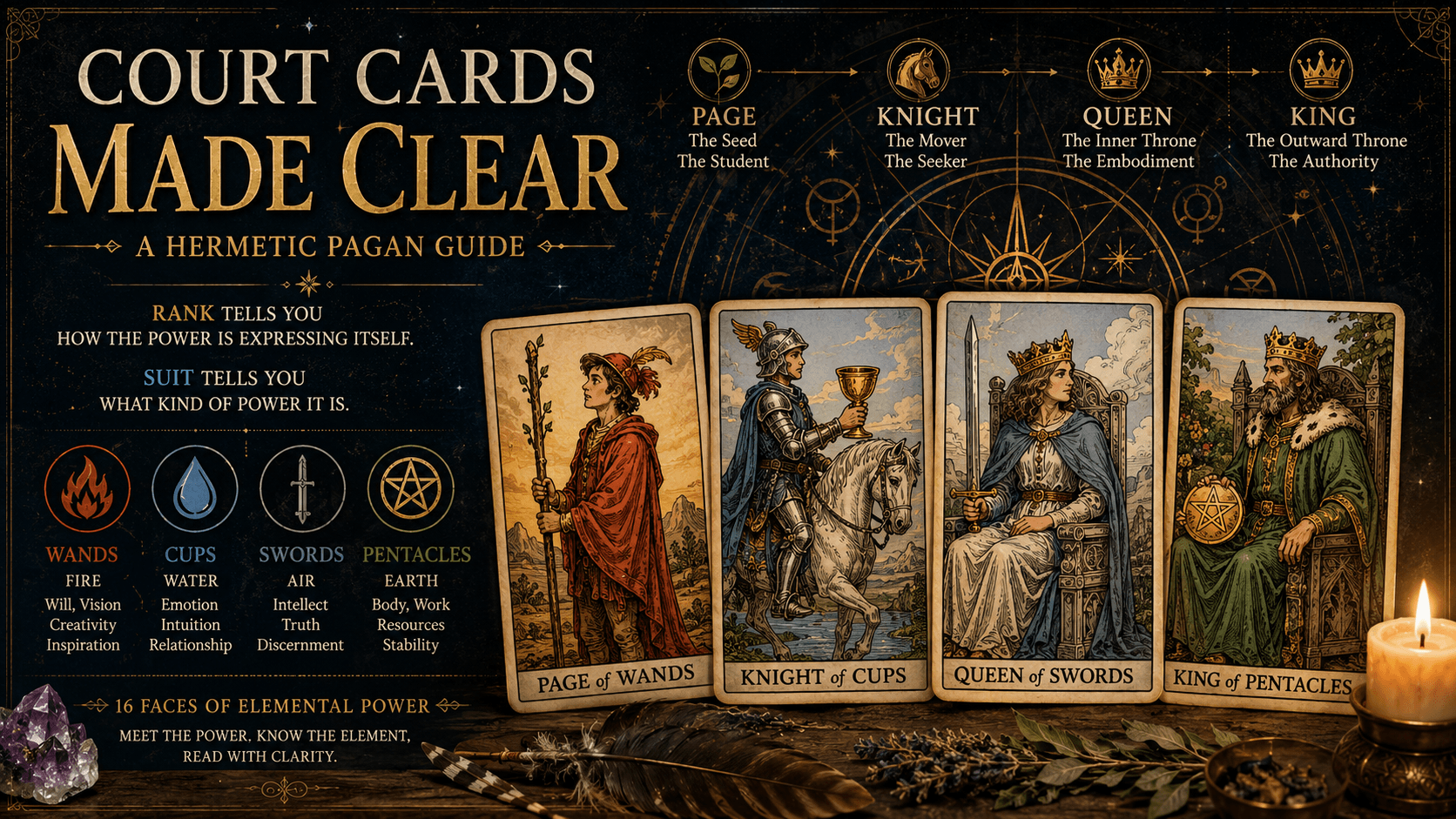
Rank tells you how the power is expressing itself.
Suit tells you what kind of power it is.
Once you understand those two layers, the sixteen Court Cards become much less mysterious.
The Architecture of the Court
There are sixteen traditional Court Cards:
- Four Pages
- Four Knights
- Four Queens
- Four Kings
And each rank appears in all four elemental suits.
| Rank | Wands | Cups | Swords | Pentacles |
|---|---|---|---|---|
| Page | Page of Wands | Page of Cups | Page of Swords | Page of Pentacles |
| Knight | Knight of Wands | Knight of Cups | Knight of Swords | Knight of Pentacles |
| Queen | Queen of Wands | Queen of Cups | Queen of Swords | Queen of Pentacles |
| King | King of Wands | King of Cups | King of Swords | King of Pentacles |
This gives us the fundamental equation:
Rank + Element = Court Card
The rank describes the mode of expression.
The suit describes the elemental field.
So rather than memorizing sixteen unrelated personalities, you can construct their meanings from a relatively small set of principles.
Consider the Page.
A Page represents youthful, emerging, receptive, or developing energy.
Now place that energy within Fire.
You have the Page of Wands: emerging Fire, curiosity, inspiration, enthusiasm, and the first stirrings of creative will.
Place the same rank within Water.
You have the Page of Cups: emerging Water, emotional sensitivity, imagination, receptivity, and the opening of the heart.
The architecture becomes visible.
And once you see the architecture, you no longer have to rely entirely on memorization.
The Four Ranks as Modes of Power
The titles vary between tarot traditions.
Some decks use Page, Knight, Queen, and King.
Others use Princess, Prince, Queen, and Knight.
Some systems arrange the hierarchy differently.
Do not allow the names to become an obstacle.
The important thing is to understand the function of each station.
The Page: The Seed and the Student
The Page is the element in a youthful or emerging state.
Pages are curious.
They learn.
They receive messages.
They experiment.
They approach the elemental force without necessarily possessing mastery over it.
This makes Pages particularly associated with:
- Beginnings
- Learning
- Messages
- Curiosity
- Invitations
- Discovery
- Potential
- First encounters
The Page of Wands may arrive as a sudden spark of inspiration.
The Page of Cups may bring an emotional opening or intuitive impression.
The Page of Swords may represent curiosity, investigation, or the pursuit of information.
The Page of Pentacles may indicate the beginning of practical study or the first tangible opportunity to develop something.
The Page asks:
What am I beginning to learn?
And sometimes:
What is arriving that deserves my attention?
Pages are not necessarily immature in a negative sense.
They are new.
There is a difference.
The Knight: The Moving Force
If the Page receives the elemental current, the Knight carries it forward.
The Knight is movement.
Quest.
Pursuit.
Action.
The energy has developed enough to leave the threshold and enter the world.
Knights can therefore be exhilarating.
They can also be reckless.
Their strength is momentum.
Their weakness is momentum without sufficient wisdom.
The Knight of Wands charges forward with Fire.
The Knight of Cups pursues through Water, often following feeling, beauty, romance, or imagination.
The Knight of Swords moves through Air with speed, intellect, conviction, and sometimes aggression.
The Knight of Pentacles advances through Earth slowly, deliberately, and persistently.
Notice how different they become.
The rank remains the same.
The elemental current changes.
The Knight asks:
Where is this energy going?
What am I pursuing?
What happens when this force is set into motion?
The Queen: The Inner Throne
The Queen represents mature elemental power that has become deeply embodied.
She does not necessarily need to chase the element.
She inhabits it.
The Queen therefore has a strongly receptive, generative, interior, and embodied quality.
She knows the element from within.
The Queen of Wands embodies Fire through confidence, creativity, charisma, and presence.
The Queen of Cups embodies Water through emotional intelligence, compassion, intuition, and receptivity.
The Queen of Swords embodies Air through discernment, clarity, independence, and truth.
The Queen of Pentacles embodies Earth through nourishment, material wisdom, practical care, and grounded sovereignty.
The Queen asks:
What happens when this element is fully embodied?
She may also represent the inner realm of the suit.
This makes Queens particularly valuable when a reading concerns one’s internal relationship with an elemental force.
The King: The Outward Throne
The King represents established elemental authority.
Where the Queen embodies the element deeply, the King directs it outward.
He establishes.
Commands.
Organizes.
Governs.
The King of Wands directs Fire toward vision and leadership.
The King of Cups directs Water through emotional mastery and mature relationship.
The King of Swords directs Air through reason, law, judgment, and intellectual authority.
The King of Pentacles directs Earth through resources, stability, stewardship, and material mastery.
The King asks:
How is this power being directed into the world?
The distinction between Queen and King is therefore not simply “female versus male.”
It is more useful to think in terms of inner embodiment versus outward direction.
Both can possess enormous power.
Both can lead.
Both can nurture.
Both can command.
They simply express elemental authority differently.
The Four Elemental Courts
Now we add the suits.
The four suits can be understood as four great elemental kingdoms.
Wands — Fire
Fire concerns:
- Will
- Vision
- Creativity
- Passion
- Courage
- Inspiration
- Charisma
The Court of Wands is therefore concerned with the development and expression of will.
Cups — Water
Water concerns:
- Emotion
- Relationship
- Intuition
- Imagination
- Receptivity
- Psychic depth
The Court of Cups explores the development of feeling and inner perception.
Swords — Air
Air concerns:
- Intellect
- Communication
- Truth
- Discernment
- Conflict
- Ideas
The Court of Swords governs the development of mind and discrimination.
Pentacles — Earth
Earth concerns:
- Body
- Resources
- Work
- Material reality
- Stability
- Manifestation
The Court of Pentacles explores embodied and practical sovereignty.
Now the sixteen cards become combinations of elemental force and developmental station.
Why the Knight of Cups Is Not the Knight of Swords
This is one of the easiest ways to see why the system works.
Both are Knights.
Both represent movement.
But they move through completely different elements.
The Knight of Cups follows Water.
His movement may be motivated by emotion, beauty, relationship, imagination, or longing.
The Knight of Swords follows Air.
His movement may be motivated by ideas, arguments, truth, information, or intellectual conviction.
One asks:
What does the heart desire?
The other asks:
What must be understood or confronted?
Neither is inherently better.
Their elemental weather is simply different.
This is why memorizing a single keyword such as “romantic” for the Knight of Cups or “aggressive” for the Knight of Swords can actually make readings harder.
Learn the architecture instead.
Knight = movement.
Cups = Water.
Therefore:
Movement through Water.
Then let the surrounding cards tell you how that movement is actually manifesting.
How to Read Court Cards in Practice
The great advantage of Court Cards is their flexibility.
There is no universal rule saying that a Court Card must represent another person.
Instead, approach the card through several possible layers.
1. As an Aspect of Yourself
A Court Card may describe a quality currently active within you.
Suppose you ask:
“What do I need to embody in this situation?”
And receive the Queen of Swords.
The card may not be telling you that a mysterious woman is about to enter your life.
It may be saying:
Become clear. Become discerning. Speak the truth. Establish boundaries.
The Queen becomes a mode of being.
2. As Another Person
Sometimes the simplest interpretation is correct.
A Court Card can describe someone involved in the situation.
But avoid becoming overly literal.
The Queen of Cups does not necessarily mean “a woman.”
The King of Pentacles does not necessarily mean “an older man.”
The card may describe the person’s mode of power.
Someone of any gender can embody the qualities of the Queen of Cups.
Someone of any age can express the King of Pentacles.
The image provides a symbolic vocabulary—not a biological requirement.
3. As a Spiritual Presence
For readers who approach tarot as a sacred or devotional practice, Court Cards can sometimes be encountered as personified elemental powers.
This should be approached with discernment rather than fantasy.
Instead of immediately declaring:
“This card is definitely a spirit.”
Try asking:
“What quality of consciousness is presenting itself through this figure?”
Sit with the image.
Notice the posture.
The clothing.
The landscape.
The objects being held.
The direction of the gaze.
The elemental atmosphere surrounding the figure.
Allow the card to become a presence before forcing it into a category.
4. As Counsel
A Court Card can also tell you how to approach a situation.
The Queen of Pentacles may advise:
Approach this practically. Ground yourself. Tend to what is tangible.
The King of Swords may advise:
Make the decision according to principle rather than emotional pressure.
The Knight of Wands may say:
Act boldly. Move. Take the initiative.
The Page of Cups may suggest:
Remain receptive to the unexpected emotional or intuitive message.
In this mode, the Court Card becomes a teacher.
Let the Figure Speak Before You Label It
One of the most useful practices with Court Cards is to delay interpretation.
Before asking:
“What does the Queen of Cups mean?”
Look at her.
What is her posture?
Is she relaxed?
Guarded?
Attentive?
What does she hold?
What is the landscape doing around her?
Does the elemental environment feel calm or turbulent?
Does the figure appear to welcome you or challenge you?
This is particularly important in a Hermetic Pagan approach because symbolism is not merely decorative.
The figure is a concentration of forces.
You are learning to perceive the force before assigning it a dictionary definition.
When Court Cards Appear Reversed
Reversals can add another dimension.
A reversed Court Card does not automatically mean that the person represented is “bad.”
Instead, ask whether the elemental power is:
- Blocked
- Immature
- Excessive
- Internalized
- Distorted
- Misapplied
- Unconsciously expressed
A reversed King of Swords might represent intellectual authority becoming domination.
A reversed Queen of Cups might suggest emotional sensitivity without adequate boundaries.
A reversed Knight of Wands might show Fire becoming impulsiveness.
A reversed Page of Pentacles might indicate difficulty committing to learning or practical development.
The question is not simply:
“Is this card positive or negative?”
Ask:
“What has happened to this elemental power?”
What If Several Court Cards Appear?
Do not panic.
A reading filled with Court Cards is not necessarily a sign that you need to identify five different people.
Sometimes the cards are showing you an internal council.
Imagine drawing:
- Page of Swords
- Knight of Wands
- Queen of Cups
- King of Pentacles
You might be looking at four different people.
But you might also be looking at four different faculties within yourself.
The Page investigates.
The Knight acts.
The Queen feels.
The King establishes.
The reading may therefore be showing an entire process of inner development.
Ask:
How are these figures relating to one another?
Is one supporting another?
Is one dominating?
Is one immature while another is mature?
Does the Knight need the wisdom of the Queen?
Does the Page need the authority of the King?
Now the Courts become a living drama rather than a collection of confusing faces.
Developing a Relationship With the Court
Court Cards become much easier when you stop treating them as vocabulary and start treating them as figures of practice.
Try studying one family at a time.
Take all four Wands Courts.
Place them together.
Observe the progression:
Page → Knight → Queen → King
Watch Fire develop from curiosity and emergence into movement, embodiment, and authority.
Then do the same with Cups.
Then Swords.
Then Pentacles.
You will begin to notice that the ranks are not isolated personalities.
They are stages.
Choose a Daily Court Ally
For a week, draw one Court Card each morning.
Instead of asking:
“What will happen today?”
ask:
“How might I embody this Court today?”
If you draw the King of Pentacles, perhaps your practice is to become more deliberate with money, work, time, or physical surroundings.
If you draw the Page of Cups, perhaps your practice is to remain receptive to beauty, intuition, and emotional experience.
At night, record what happened.
Over time, the cards will become familiar in a way that memorization alone cannot accomplish.
Three Ways to Read the Same Court Card
Imagine the Queen of Wands appears in a reading about a creative project.
As Yourself
She may represent the part of you that already possesses confidence, charisma, creative authority, and willingness to be seen.
As Another Person
She may describe someone whose presence influences the project—a charismatic, creative, encouraging, or commanding individual.
As Counsel
She may be saying:
Step into your authority. Stop hiding your creative fire. Let yourself be seen.
All three interpretations can be valid.
The question is which layer best fits the position, question, surrounding cards, and intuitive atmosphere of the reading.
This is why there is no need to force every Court Card into a single category.
The tarot is more fluid than that.
Common Court Card Mistakes
“It Must Represent a Person”
Not necessarily.
A Court Card can describe a person, but it can also describe an aspect of yourself, a mode of behavior, an influence, or counsel.
“Queens Are Women and Kings Are Men”
The symbolism is more useful when understood energetically rather than biologically.
The Court Cards describe modes of elemental expression.
Any person can embody any Court.
“Knights Are Always Reckless”
No.
Knights represent movement.
The quality of that movement depends upon the element and the surrounding cards.
The Knight of Pentacles can be extraordinarily deliberate.
“Pages Are Children”
Not necessarily.
Pages represent youthful or emerging energy.
A mature adult can be in a Page state when learning something entirely new.
“I Need to Memorize Sixteen Personalities”
You don’t.
Learn the four ranks.
Learn the four elements.
Then combine them.
This is far more powerful than memorizing sixteen isolated descriptions.
The Court as an Elemental Temple
There is another way to contemplate the Court Cards.
Imagine each suit as a kingdom.
The Page stands at the threshold.
The Knight rides outward.
The Queen sits upon the inner throne.
The King governs the established realm.
Each figure expresses the same elemental kingdom differently.
In Wands, they become four expressions of Fire.
In Cups, four expressions of Water.
In Swords, four expressions of Air.
In Pentacles, four expressions of Earth.
The Court therefore becomes a kind of elemental temple populated by living archetypal stations.
And you can enter that temple from either direction.
You can begin with the rank:
What does a Queen do?
Then ask:
How does she do it through Water? Through Fire? Through Air? Through Earth?
Or you can begin with the element:
What does Fire look like when it is young? When it is moving? When it is embodied? When it rules?
Both approaches reveal something different.
A Simple Month-Long Court Study
If you want to develop real fluency, spend one week with each rank.
Week One — Pages
Study beginnings, learning, receptivity, curiosity, and messages.
Week Two — Knights
Study movement, pursuit, momentum, and directed force.
Week Three — Queens
Study embodiment, depth, receptivity, and inner mastery.
Week Four — Kings
Study authority, direction, sovereignty, and outward mastery.
Each day, pull one card from the relevant rank.
Write three things:
What element is present?
How is that element expressing itself through this rank?
Where could I embody this quality today?
At the end of the month, you will likely find that the Court Cards feel less like sixteen strangers and more like familiar teachers.
The Court Cards Are Not the Difficult Cards
The Court Cards often seem difficult because we approach them as if they require sixteen separate definitions.
They do not.
They ask us to understand a simple symbolic grammar.
Page: the element awakens.
Knight: the element moves.
Queen: the element becomes embodied.
King: the element becomes directed and established.
Then we place those stations inside the four elemental kingdoms.
Fire. Water. Air. Earth.
Suddenly the Court becomes intelligible.
And then something more interesting happens.
The cards stop feeling like descriptions of strangers.
They begin revealing ways of being.
You may meet the Page within yourself when you are learning.
The Knight when you are pursuing.
The Queen when you are deeply embodying a power.
The King when you are ready to direct it with authority.
You may recognize these figures in other people.
You may encounter them as counsel.
And in a sacred practice, you may even come to experience them as personified expressions of the elemental intelligences themselves.
The mystery has not disappeared.
It has become organized.
And that is the real gift of understanding the Court.
The sixteen figures are not sixteen puzzles.
They are sixteen faces of elemental power.
The next time a Court Card appears in your reading, do not immediately ask:
“Who is this person?”
Ask something deeper:
“What power is standing before me?”
Then ask:
“What element does it carry?”
And finally:
“How is that element expressing itself through this particular station of the Court?”
The answer may describe a person.
It may describe you.
It may describe what you must become.
Or it may simply invite you to sit quietly before the figure and listen.
Because once you learn how to meet the Court, the most confusing chamber of the tarot can become one of its most intimate.
The faces begin to become familiar.
And eventually, when one appears, you may no longer need to ask who they are.
You will recognize the power they carry.