There is a particular feeling that can arise when certain tarot cards appear.
The image is turned over.
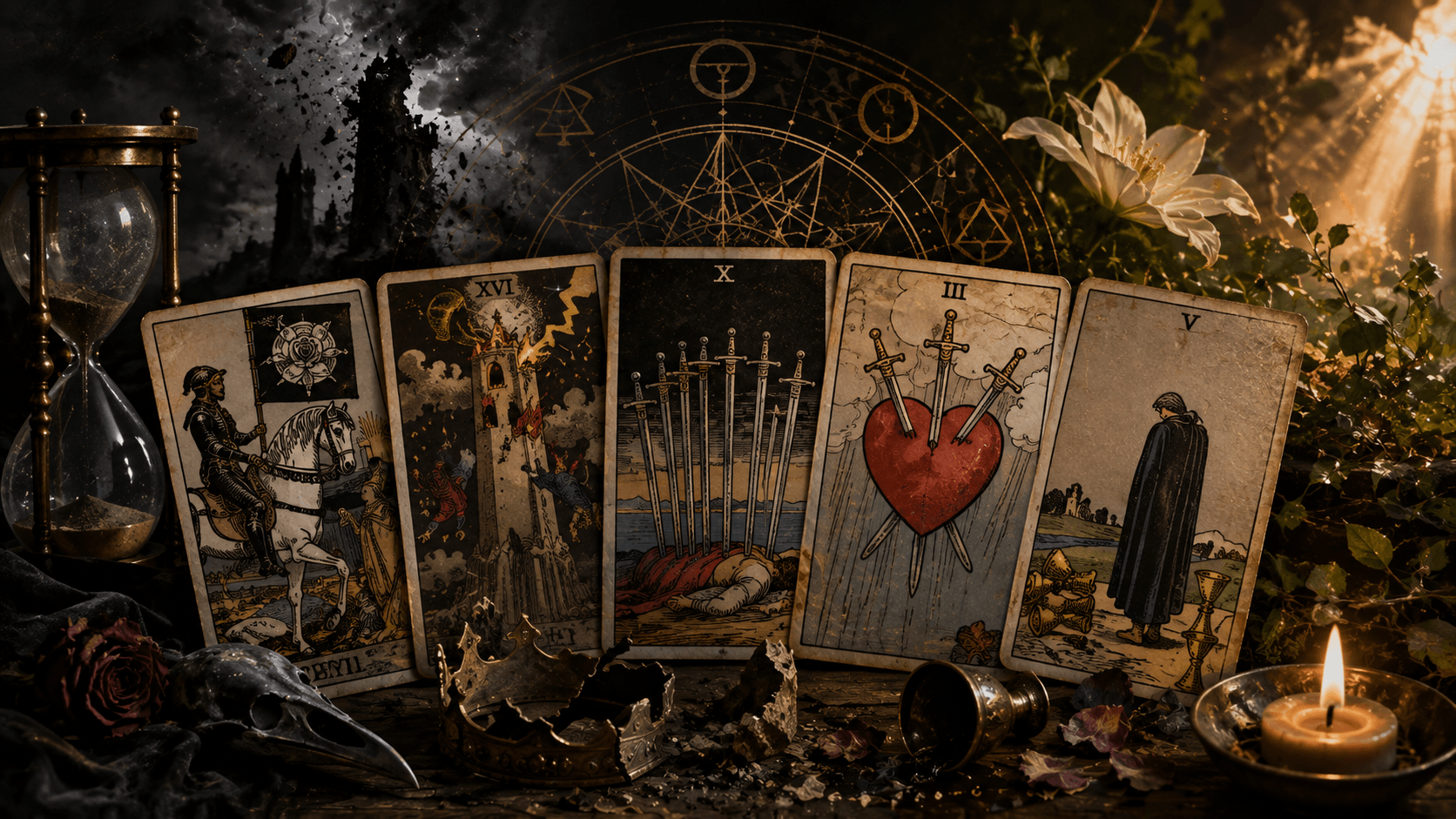
You see the skeletal rider of Death.
The burning crown of the Tower.
The terrible row of swords piercing a fallen figure.
And for a moment, the body reacts before the mind has even begun to interpret.
The breath becomes shallow.
The stomach tightens.
A question appears almost immediately:
“Is something terrible going to happen?”
This reaction is understandable.
Tarot contains images of destruction, grief, bondage, conflict, collapse, and endings. But the mistake is to assume that because an image is frightening, its presence must signify catastrophe.
From a Hermetic Pagan perspective, the so-called difficult tarot cards are not punishments.
They are threshold powers.
They represent the forces that dissolve what can no longer continue, expose what has been hidden, sever what has become binding, and make room for another form of life.
Death does not exist outside the sacred order.
Neither does destruction.
The forest floor must receive what has fallen before it can become soil.
The seed must break before the plant can emerge.
The old form must sometimes surrender before the new form can take its place.
The cards that frighten us most often reveal precisely this mystery.
They teach us that transformation is not always gentle.
But difficult does not mean evil.
And an unsettling card is not a sentence.
It is an invitation to look more honestly at the process already unfolding.
The Alchemical Context: Solve et Coagula
Hermetic and alchemical traditions give us a powerful image for understanding difficult cards:
Solve et coagula.
Dissolve and coagulate.
Break down the old form.
Then allow something new to take shape.
The alchemical Work cannot proceed if everything remains permanently fixed.
Something must be dissolved.
Something must be separated.
Something must be purified.
Something must be transformed.
In the language of alchemy, this breaking-down process is associated with the nigredo, the blackening.
It is the stage in which familiar forms lose their certainty.
The old structure may no longer function.
The identity that once seemed secure begins to crack.
The story we told ourselves can no longer contain what we are becoming.
This can feel like darkness.
But darkness is not necessarily the absence of the sacred.
Sometimes it is the chamber in which transformation occurs.
The difficult cards belong to this territory.
Death dissolves.
The Tower breaks open.
The Ten of Swords brings a cycle to its absolute conclusion.
The Devil reveals bondage.
The Three of Swords opens the wound of grief.
The Nine of Swords brings us face-to-face with the imagination of fear.
The Five of Cups asks us to mourn honestly without becoming blind to what remains.
These are not enemies of the Great Work.
They are participants in it.
The First Principle: Separate the Card From Catastrophe
When a difficult card appears, the first thing to do is separate symbolic meaning from catastrophic fantasy.
The Death card does not mean someone will die.
The Tower does not guarantee disaster.
The Ten of Swords does not promise that your life is about to collapse.
Tarot is a symbolic language.
Its images describe patterns, processes, psychological states, relationships, and possibilities.
The moment you translate a symbolic image directly into a literal prediction, fear takes control of the reading.
Instead, ask:
What is this card actually describing?
If Death appears in a reading about a career, perhaps an old professional identity is ending.
If it appears in a reading about a relationship, perhaps the existing form of the relationship is undergoing an irreversible transition.
If it appears in a reading about personal growth, perhaps an old way of understanding yourself is being shed.
The card becomes much less frightening when we stop asking:
“What terrible thing will happen?”
and start asking:
“What is changing?”
Death — The Sacred Power of Transformation
Few cards are more misunderstood than Death.
The image is dramatic for a reason.
Death represents irreversible transition.
Something has reached the end of its natural life.
A form that once served a purpose can no longer continue unchanged.
This is not necessarily physical death. In ordinary tarot readings, Death is far more often concerned with symbolic endings, transformation, release, and profound transition.
Think of a forest.
Leaves fall.
The fallen material decomposes.
What appears to be decay becomes nourishment.
The old form is not simply destroyed.
It is returned to the larger cycle.
This is why Death can be understood as a card of sacred composting.
An identity can be composted.
A habit can be composted.
A relationship pattern can be composted.
An outdated ambition can be composted.
A belief can be composted.
What remains becomes the material from which something more essential may grow.
The gift of Death is therefore release.
It says:
You do not have to carry this form forever.
Ask:
What is ready to be composted so that something more essential may live?
The Tower — When False Structures Meet Lightning
The Tower is different from Death.
Death describes transformation and the ending of an old form.
The Tower describes sudden revelation and structural collapse.
The image shows a structure struck by lightning.
The crown is thrown from its position.
The walls are breached.
The inhabitants fall.
The Tower asks what happens when something has been built upon unstable foundations.
Sometimes the Tower appears when a belief can no longer survive contact with reality.
Sometimes it reveals a defense mechanism.
Sometimes it represents the collapse of an identity.
Sometimes it describes a sudden truth that changes everything.
And sometimes life simply brings an unexpected event that forces adaptation.
The important point is that the Tower is not merely destruction.
It is destruction of structure.
What has been false, fragile, or unsustainable can no longer remain concealed.
This is why the Tower can ultimately be liberating.
A prison can look like a fortress from the inside.
A false belief can feel like security.
An identity built around fear can feel safer than uncertainty.
Then lightning comes.
The structure breaks.
And suddenly there is sky.
Ask:
What false tower is ready to be struck so that I may stand on real ground?
The Tower can be painful.
But pain and liberation are not always opposites.
Sometimes the truth hurts precisely because we have spent so long protecting ourselves from it.
Ten of Swords — The End of the Old Story
The Ten of Swords is one of the most visually severe cards in the deck.
Yet its numerical structure contains an important clue.
Ten is completion.
In the Minor Arcana, the sequence has reached its limit.
The Swords have moved through the stages of thought, conflict, perception, and mental development until the cycle reaches its final expression.
The Ten of Swords can therefore represent:
- Finality
- Mental exhaustion
- The end of a painful narrative
- Acceptance
- The collapse of an old way of thinking
- The conclusion of a struggle
The important phrase is:
The cycle is finished.
The card may describe something that has already reached its natural conclusion rather than predicting something terrible that is about to begin.
Imagine carrying an old story about yourself for years:
“I always fail.”
“I can never trust anyone.”
“This is just who I am.”
“Nothing will ever change.”
Eventually, the story becomes so exhausted that it can no longer sustain itself.
The Ten of Swords can mark that moment.
The old narrative has reached its limit.
And once the old story ends, another story becomes possible.
Ask:
What old tale or way of thinking am I finally allowed to stop carrying?
Three of Swords — The Honesty of Grief
The Three of Swords is often reduced to heartbreak.
But its deeper symbolism is broader.
Three is expression and manifestation.
Swords belong to Air.
Here, thought and perception encounter pain.
The card asks us not to bypass grief.
Some losses hurt.
Some truths wound.
Some endings deserve to be mourned.
The Hermetic Pagan approach does not require pretending that everything is secretly wonderful.
There is wisdom in saying:
This hurts.
Grief is not spiritual failure.
It is one of the ways the heart recognizes that something mattered.
The medicine of the Three of Swords is therefore not denial.
It is honest feeling.
Ask:
What grief needs to be acknowledged rather than avoided?
The Devil — Seeing the Chains
The Devil is another card that is frequently interpreted through fear.
Yet the traditional imagery contains an important clue: the chains can often be removed.
The Devil represents binding patterns.
Attachment.
Compulsion.
Shame.
Dependency.
Unconscious repetition.
The card asks:
What has power over me because I have not yet looked at it clearly?
This is shadow work.
And shadow work is not about declaring yourself evil.
It is about becoming conscious of what has been operating unconsciously.
The Devil can therefore be an extraordinarily empowering card.
What is seen can be examined.
What is examined can be understood.
What is understood can sometimes be changed.
Ask:
Where have I surrendered my power without realizing it?
Nine of Swords — The Dark Night of the Mind
The Nine of Swords brings us into the realm of mental suffering.
Fear.
Rumination.
Guilt.
Regret.
Insomnia.
The imagination running endlessly through possible disasters.
Because Swords belong to Air, this card can remind us that the mind is capable of creating entire worlds from thought alone.
But the appearance of the Nine of Swords does not mean every feared outcome is destined to occur.
Sometimes the card is describing the experience of fear itself.
That distinction matters.
A fearful thought is not automatically a prophecy.
The medicine of this card is compassion.
Ask:
Which fears are facts, and which are stories my mind is producing?
Then ask:
What would happen if I met my fear with tenderness instead of punishment?
Five of Cups — The Sacred Work of Mourning
The Five of Cups is a beautiful example of how a difficult card can contain its own medicine.
Five brings disruption.
Cups bring Water.
Something has been emotionally disturbed.
The figure looks toward what has been lost.
But not everything is gone.
Two cups remain.
The card does not tell us:
“You shouldn’t be sad.”
It says something more honest:
“Mourn what was lost—but do not become blind to what remains.”
There is dignity in grief.
There is also danger in allowing grief to become the only reality we can see.
The Five of Cups teaches both.
Ask:
What deserves to be mourned?
Then:
What remains available to me, even now?
A Practical Method for Reading Difficult Cards
When one of these cards appears, try the following six-step process.
1. Pause
Do not immediately interpret.
Take a breath.
Let the nervous system settle before the symbolic mind begins working.
2. Name the Power
Say internally:
Death.
Tower.
Ten of Swords.
Do not soften the card.
Do not exaggerate it either.
Meet it directly.
3. Identify What It Is Acting Upon
Ask:
What form, belief, attachment, relationship, or structure is under this card’s influence?
This turns an abstract fear into a concrete inquiry.
4. Look for the Opening
Every dissolution creates space.
Ask:
What becomes possible because this form is changing?
5. Read the Surrounding Cards
A difficult card rarely tells the whole story.
The cards around it may show:
- What caused the disruption
- What is being released
- What remains
- What comes afterward
- How the querent can respond
Read the entire sentence, not one frightening word.
6. Restore Agency
The reading should not leave someone feeling helpless.
Ask:
How can I cooperate consciously with this process?
This transforms tarot from fatalism into participation.
Reading Difficult Cards for Yourself
When reading for yourself, notice your immediate reaction.
If you draw Death and think:
“Oh no.”
write that down.
Then ask:
What exactly am I afraid of losing?
Often the resistance tells you as much as the card itself.
The card may be touching an attachment.
Perhaps you already know something is changing but do not want to acknowledge it.
Perhaps the card is challenging an identity you have built around continuity.
Journal both sides:
What I fear this card means.
What this card may actually be asking me to release.
This simple practice can reveal the difference between intuition and anxiety.
Reading Difficult Cards for Others
When reading for another person, these cards require particular care.
Do not dramatize them.
Do not announce that Death means someone will physically die.
Do not use the Tower to frighten someone into believing catastrophe is inevitable.
And do not sugar-coat the cards so aggressively that their actual message disappears.
Instead, hold the card steadily.
If Death appears, speak about transition.
If the Tower appears, discuss unstable structures and revelation.
If the Ten of Swords appears, explore completion and release.
The goal is neither fear nor false reassurance.
It is clarity with dignity.
A good reader does not remove every difficult truth.
They help the querent meet difficult truth without surrendering their agency.
The Difficult Card as Teacher
One of the most powerful shifts you can make is to stop thinking of these cards as enemies.
Imagine them instead as stern teachers.
Death teaches release.
The Tower teaches truth.
The Ten of Swords teaches completion.
The Three of Swords teaches honest grief.
The Devil teaches awareness of bondage.
The Nine of Swords teaches compassion toward the frightened mind.
The Five of Cups teaches honorable mourning.
None of these teachers are particularly gentle.
But gentleness is not the only form wisdom can take.
Fire can purify.
A storm can clear the air.
Winter can prepare the soil.
A blade can cut away what is diseased.
The sacred does not always arrive wearing a comforting face.
A Fearless Relationship With the Cards
You can develop familiarity with difficult cards without waiting for them to appear in a frightening reading.
Take the cards out of your deck.
Study them.
Look carefully at their imagery.
Ask what each figure is doing.
What is falling?
What remains?
Where is the light?
Where is the movement?
What comes after the apparent ending?
You can even meditate with one card at a time.
Place the card before you.
Take several slow breaths.
Then say:
I see you. I will not turn away. Teach me what I need to know.
Do not demand an answer.
Simply observe.
Over time, the image becomes familiar.
And familiarity dissolves superstition.
Keep a Record of What Actually Happens
One of the best antidotes to tarot fear is evidence.
When a difficult card appears, record:
- The card
- The question
- Your initial fear
- Your interpretation
- What actually happened afterward
- What you learned
After months of readings, review the journal.
You may discover that Death repeatedly coincided with symbolic endings rather than literal catastrophe.
You may find that the Tower often appeared when a false assumption was exposed.
You may discover that the Ten of Swords frequently marked the end of a stressful period.
Experience teaches what fear cannot.
The cards become less frightening because you begin to know them.
The Sacred Cycle
The deeper lesson of difficult tarot cards is not that everything ends.
It is that everything changes.
Forms arise.
Forms stabilize.
Forms are tested.
Forms decay.
Forms dissolve.
New forms emerge.
The cycle continues.
This is true in nature.
It is true in relationships.
It is true in identity.
It is true in spiritual practice.
And it is reflected throughout the tarot.
The Death card belongs to this cycle.
So does the Tower.
So does the Ten of Swords.
They are not interruptions of the sacred process.
They are part of it.
When the Cards Bring Fire and Bone
Perhaps the most important thing to remember is this:
A difficult card is not necessarily a difficult fate.
Sometimes it is a difficult truth.
Sometimes it is a difficult transition.
Sometimes it is simply an invitation to stop carrying what has already reached its end.
The fearful mind sees Death and thinks catastrophe.
The contemplative mind asks:
What is ready to change?
The fearful mind sees the Tower and thinks disaster.
The contemplative mind asks:
What structure was never built on solid ground?
The fearful mind sees the Ten of Swords and thinks suffering.
The contemplative mind asks:
What story has finally reached its conclusion?
This does not make the cards harmless.
It makes them intelligible.
And intelligibility is one of the great antidotes to fear.
The Initiating Cards
The so-called difficult cards are among the most honest teachers in the tarot.
They do not flatter us.
They do not always reassure us.
They ask us to release, confront, mourn, awaken, or begin again.
That is why they can become sacred companions.
The practitioner who learns to sit calmly before Death eventually discovers that Death is not only about endings.
The practitioner who studies the Tower discovers that destruction can reveal foundations.
The practitioner who learns the Ten of Swords discovers that completion can be merciful.
Fear diminishes as relationship grows.
The card that once seemed like an omen becomes a familiar teacher.
And eventually, when one of these images appears in a reading, you may find yourself doing something very different from what you did before.
You do not flinch.
You do not catastrophize.
You do not immediately search for the worst possible interpretation.
You simply breathe.
You look.
And you ask:
What is this power here to teach me?
That question changes everything.
Because the tarot does not promise that the path will always be comfortable.
It offers something more valuable:
the ability to meet the path consciously.
And sometimes the cards that frighten us most are the ones that teach us how to walk through transformation without turning away.
A Simple Practice for This Week
Choose one difficult card from your deck.
Do not ask it to predict anything.
Place it before you and spend five quiet minutes observing it.
Then write:
What about this image frightens me?
What is actually being destroyed or transformed?
What might be released through this process?
What remains after the change?
What new possibility could emerge?
Finish by saying:
I see you. I will not turn away. Teach me what I need.
Then close your journal.
You do not need to solve the card immediately.
Some powers reveal their meaning only after we have sat with them long enough to stop being afraid of their face.