Many people come to Tarot looking for reassurance.
They want to know that everything will work out. They want confirmation that they are on the right path. They want to see the happy ending waiting somewhere beyond the uncertainty of the present.
There is nothing wrong with seeking comfort.
But Tarot has another office.
It reveals.
Sometimes what it reveals is beautiful. Sometimes it is uncomfortable. Sometimes it points toward something within us that we have avoided seeing because seeing it would require us to change.
This is where shadow work with Tarot begins.
In the Hermetic Pagan current, personal growth is not merely the acquisition of positive habits or the construction of a more attractive self-image. The deeper work is the gradual reunification of what has become divided within us.
There are parts of ourselves we celebrate.
There are parts we hide.
There are desires we permit ourselves to acknowledge and others we exile.
There are instincts we call unacceptable, emotions we refuse to feel, abilities we suppress, and wounds that quietly shape our behavior from beneath conscious awareness.
These hidden regions constitute part of what we may call the shadow.
Shadow work is therefore not a project of destroying the darkness.
It is a descent into it.
The alchemists called the first stage of the Great Work nigredo — the blackening, the dissolution, the descent into the material that must be confronted before transformation can occur.
The darkness is not the destination.
It is the chamber in which something forgotten can be recovered.
And Tarot can serve as a remarkable companion on that journey.
What Does “Shadow” Actually Mean?
The shadow is often described as the collection of our negative traits.
That definition is too narrow.
The shadow can contain anger, jealousy, fear, selfishness, resentment, compulsive behavior, or destructive tendencies.
But it can also contain power.
Perhaps you were taught that being assertive was selfish.
You may have pushed your natural authority into the unconscious.
Perhaps expressing anger was forbidden.
You may have buried your capacity for healthy boundaries along with the anger.
Perhaps you learned that ambition was morally suspect.
You may have exiled your desire to create, lead, compete, or succeed.
The shadow therefore contains not only what we consider unacceptable.
It can contain what we were never permitted to become.
This is why shadow work can sometimes feel strangely liberating.
You are not merely discovering what is wrong with you.
You may be recovering something that belongs to you.
This makes shadow work an underworld journey — a conscious katabasis, or descent.
The descent has a purpose.
We enter the darkness not to become fascinated with darkness, but to retrieve what has been lost within it.
Tarot as Mirror and Psychopomp
Tarot can play two symbolic roles in this process.
First, it is a mirror.
The cards reflect patterns that may already exist within our experience.
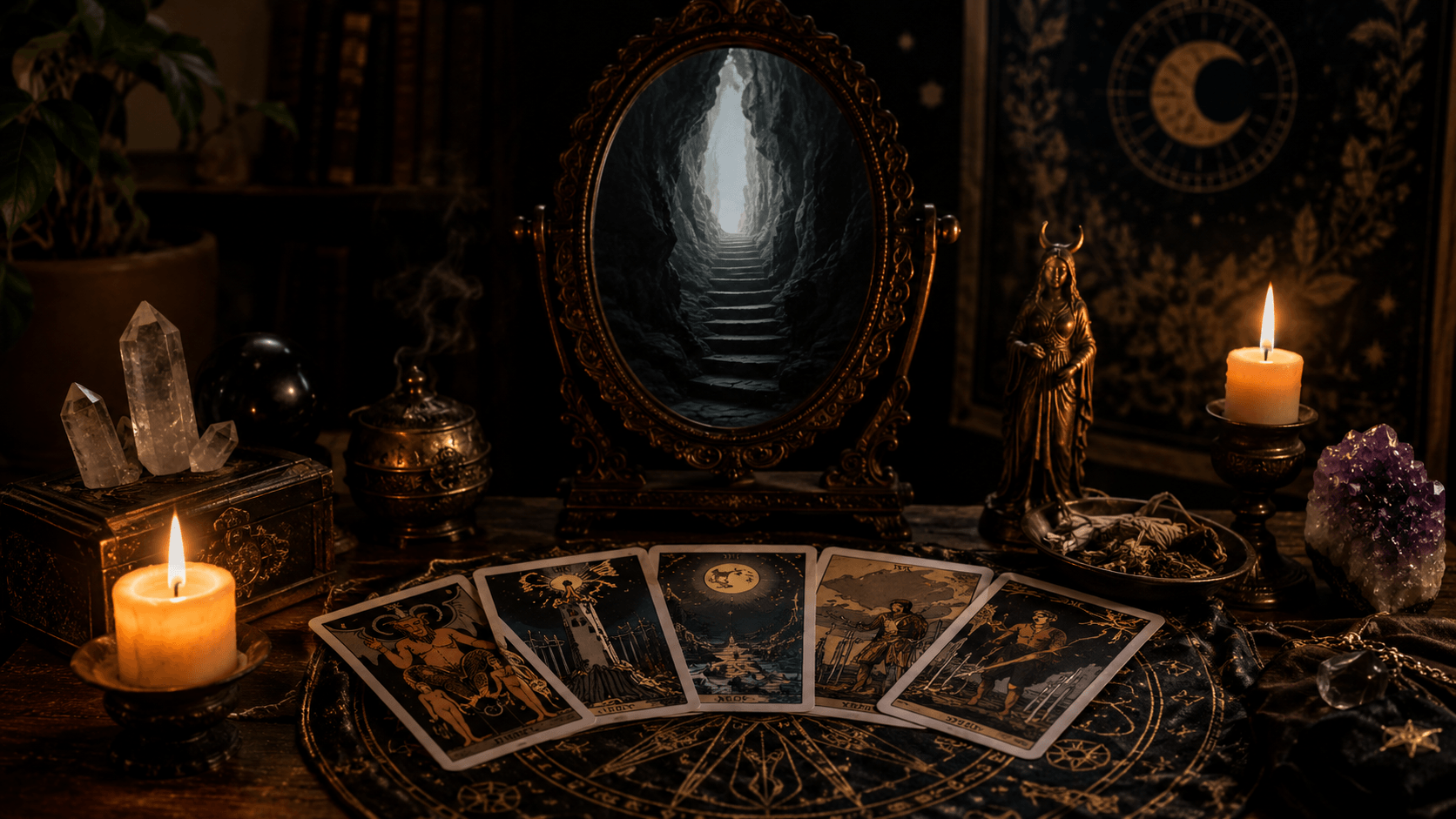
The Devil may reveal attachment.
The Tower may reveal the collapse of an unstable structure.
The Moon may expose uncertainty, projection, fear, or unconscious material.
Five of Swords may reveal conflict, ego, resentment, or destructive patterns of thought.
But Tarot can also function symbolically as a psychopomp — a guide into unfamiliar territory.
The cards provide images through which we can approach difficult material without reducing everything to a simplistic label.
Instead of saying:
“I am a bad person because I drew The Devil.”
we can ask:
“Where am I bound?”
“What desire or fear has acquired too much power over me?”
“What energy have I surrendered?”
The second set of questions creates space for responsibility without self-condemnation.
That distinction is essential.
Shadow work is not supposed to become an elaborate ritual of hating yourself.
It is supposed to make you more whole and more free.
The Ethical Foundations of Shadow Work
Shadow work deserves more respect than casual Tarot entertainment.
You do not need to force yourself into psychological territory that you are not prepared to meet.
Sometimes a card touches something much deeper than expected.
If a reading produces overwhelming distress, destabilization, or an inability to function normally, stop the reading.
Ground yourself.
Speak with someone you trust.
And when appropriate, seek professional therapeutic support.
Tarot can be a powerful reflective and spiritual tool, but it is not a replacement for qualified mental-health care.
This is especially important when working with severe trauma, self-harm, abuse, addiction, or other circumstances requiring specialized support.
There is no spiritual virtue in overwhelming yourself.
The Work must be undertaken at the depth you are actually resourced to meet.
Before beginning a shadow-oriented reading, establish a clear container.
Clean your space.
Light a candle if that is part of your practice.
Ground yourself.
State your intention.
You might simply say:
“May what is ready to be seen be revealed with clarity, compassion, and strength. May I meet what arises without fear and without cruelty toward myself.”
Then begin.
And when the reading is finished, close it.
Do not leave yourself psychologically and spiritually suspended in the middle of an underworld journey.
Principles for Shadow-Oriented Tarot Readings
A few principles make this work considerably more useful.
Ask questions that create agency
Instead of:
“What is wrong with me?”
ask:
“What pattern am I being invited to understand?”
Instead of:
“Why am I so broken?”
ask:
“What part of myself have I rejected, and what does it need from me?”
The wording of the question changes the relationship you establish with the cards.
Difficult cards are teachers, not verdicts
Death does not mean you are doomed.
The Tower does not mean your life is destined for disaster.
The Devil does not mean you are evil.
The Ten of Swords does not mean everything is hopeless.
Within shadow work, difficult cards often represent necessary powers of transformation.
The question is not:
“How do I get rid of this card?”
It is:
“What is this card asking me to see?”
Look for the gift
Every shadow pattern contains energy.
The person who suppresses anger may also have suppressed the ability to establish boundaries.
The person who fears their ambition may also possess tremendous creative drive.
The person who constantly seeks approval may have a deep capacity for connection that needs to be redirected toward healthier relationships.
Ask:
What energy is trapped inside this pattern?
That question moves the work from condemnation toward reclamation.
Insight is not integration
Seeing a pattern is only the beginning.
You can understand your behavior perfectly and still continue repeating it.
Integration requires action.
Ask:
“What is the next right step?”
Then make it small enough to actually do.
Four Shadow Work Tarot Spreads
These spreads are designed to approach shadow material gradually rather than attempting to expose everything at once.
Before each reading, establish your sacred space and grounding practice. When finished, close the work, record your insights, and return to ordinary activity.
1. The Descent — Six Cards
This spread approaches shadow work as an initiatory descent.
Lay six cards in a descending line or staircase.
Card 1 — What Stands in the Light
What part of myself am I consciously identifying with?
This represents the aspect of yourself you readily acknowledge.
Card 2 — What Has Been Cast into Shadow
What have I rejected, hidden, or refused to recognize?
This is the central shadow material.
Card 3 — The Root of the Split
Where did this division originate?
The card may point toward an old belief, learned behavior, fear, or adaptation.
It does not necessarily provide a literal historical explanation. Treat it symbolically.
Card 4 — The Guardian at the Threshold
What resistance appears when I approach this material?
This card can be especially revealing.
Perhaps the guardian is fear.
Perhaps pride.
Perhaps shame.
Perhaps perfectionism.
The guardian does not necessarily exist to stop you.
It may be protecting something that requires a more careful approach.
Card 5 — The Gift in the Darkness
What power or quality waits to be reclaimed?
This is the heart of the descent.
Card 6 — The First Step of Integration
What can I actually do with this understanding?
Keep this practical.
The answer might be a conversation, a boundary, a journal practice, an apology, a creative act, or simply permission to acknowledge a previously rejected emotion.
2. The Mirror of the Rejected — Five Cards
This spread is useful when a particular behavior or emotional pattern keeps repeating.
Card 1 — The Face of the Shadow
What shadow pattern is currently active?
Card 2 — How It Has Protected Me
What purpose has this pattern served?
Even destructive patterns often began as attempts at protection.
Card 3 — How It Limits Me
What does the pattern cost me now?
Card 4 — What It Needs from Me
What would allow this part of myself to transform?
Card 5 — The Strength to Reclaim
What quality or power can I retrieve from this shadow?
This final position is crucial.
Do not end the reading by staring endlessly into the wound.
End by asking what can be reclaimed.
3. The Nigredo Process — Four Cards
This spread is particularly appropriate during periods of profound transition.
Arrange four cards in a circle.
Card 1 — What Is Dissolving?
What identity, attachment, belief, or structure is losing its former form?
Card 2 — What Must Be Felt or Acknowledged?
What experience have I been avoiding?
This position asks for honesty.
Card 3 — The Alchemical Fire
What transformative force is currently working upon me?
This might appear as destruction, discipline, truth, grief, purification, or confrontation.
Card 4 — The Emerging Seed
What new possibility is forming beneath the dissolution?
The seed may be small.
Do not demand that the reading reveal the final form of your future.
The seed is enough.
4. The Daily or Weekly Shadow Check — Three Cards
Not every shadow reading needs to become an elaborate ritual.
For ordinary practice, use three cards:
Card 1
What shadow material is closest to the surface?
Card 2
How is it influencing my current life?
Card 3
What is the most constructive way to meet it right now?
This is an excellent weekly practice because it keeps shadow work connected to ordinary life.
The goal is not to spend every day excavating yourself.
The goal is to become increasingly conscious of the patterns influencing your choices.
Reading Difficult Cards in Shadow Work
Shadow work gives difficult Tarot cards an especially rich context.
Consider The Devil.
In a conventional reading, you might immediately think of temptation, addiction, obsession, bondage, or unhealthy attachment.
In shadow work, ask:
Where have I surrendered my freedom?
But then go further.
What desire am I afraid to acknowledge?
The Devil may reveal not only bondage but the energy trapped inside the bondage.
Likewise, The Tower may represent the collapse of a psychological structure that could no longer contain truth.
Ask:
What belief about myself is no longer sustainable?
What am I defending that reality is already dismantling?
And Death can become a profound symbol of psychological transformation.
Ask:
What identity has completed its purpose?
What am I continuing to carry after its season has ended?
These interpretations do not make difficult cards artificially pleasant.
They take them seriously.
The Tower still destroys.
Death still ends.
The Devil still binds.
But destruction, death, and bondage can become part of a larger process of liberation.
Shadow Work Beyond the Cards
The reading itself is not the entire practice.
In fact, the most important part may happen after the cards are put away.
Journal
Write down what appeared.
Do not edit yourself excessively.
Allow contradictory thoughts to exist.
Work with dreams
Shadow material frequently appears symbolically in dreams.
Record recurring figures, places, emotions, conflicts, and images.
You may begin noticing that the same archetypal themes appear in both dreams and Tarot.
Work with the body
Shadow patterns are not merely intellectual.
Notice where you feel tension, contraction, heat, heaviness, or agitation.
A realization becomes much more meaningful when it changes how you actually inhabit your body and behavior.
Watch for repetition
If the same card appears repeatedly across several months, pay attention.
Perhaps The Emperor keeps appearing whenever authority becomes an issue.
Perhaps Five of Pentacles appears whenever feelings of exclusion emerge.
Perhaps Queen of Wands repeatedly appears when you are suppressing confidence or creative power.
Recurring cards can become signposts on the deeper curriculum of your life.
Working with Archetypal Powers
For those practicing Tarot within a Hermetic Pagan framework, the archetypal nature of the cards can be approached consciously.
Death may become an image of initiation and transformation.
The Moon may become an image of descent into the unconscious and the uncertain.
The Devil may become an encounter with desire, attachment, instinct, and embodied power.
The Tower may become the lightning that destroys false structures.
You may also work with deities or other spiritual powers appropriate to your own tradition.
But maintain discernment.
Do not assume that every difficult psychological experience is a supernatural attack or that every Tarot card represents a literal external being.
The spiritual and psychological dimensions of the Work can coexist without collapsing one into the other.
The purpose is greater clarity.
Common Pitfalls in Shadow Work
Turning the Work into Self-Attack
If every reading becomes evidence that you are selfish, broken, impure, or unworthy, something has gone wrong.
Shadow work requires honesty.
It also requires compassion.
You cannot integrate a part of yourself while treating that part as an enemy deserving punishment.
Reading Without Acting
It is possible to become addicted to insight.
Another spread.
Another revelation.
Another hidden pattern.
But nothing changes.
Limit your readings when necessary.
Take what you have learned and embody it.
One honest conversation can sometimes accomplish more than twenty additional Tarot readings.
Romanticizing Darkness
There is a strange temptation in occult culture to imagine that suffering automatically makes someone profound.
It does not.
Pain is not inherently wisdom.
Darkness is not inherently sacred.
The purpose of descent is integration.
Do not become attached to the identity of the wounded initiate.
You are not meant to live forever in the underworld.
You are meant to return carrying what you retrieved.
Isolating Yourself
Deep personal work can become isolating.
Maintain connection with trusted people.
Allow yourself ordinary pleasures.
Eat.
Rest.
Walk outside.
Work.
Laugh.
Return to the physical world.
The ability to move between sacred depth and ordinary life is itself a form of magical maturity.
A Simple Closing Rite
When your shadow reading is complete, do not simply leave the cards scattered across the table.
Take a moment to close the work.
Place your hands on the table or on your heart.
Take several slow breaths.
Then say:
“What has been revealed, I acknowledge.
What is mine to change, I accept responsibility for.
What is not mine to carry, I release.
May the wisdom of this work become action.
May I return from the darkness with what is useful.”
Extinguish the candle if you lit one.
Gather the cards.
Drink some water.
Eat something if appropriate.
Wash your hands or face.
Open a window.
Return deliberately to ordinary awareness.
These simple actions matter.
They mark the boundary between the ritual space and the rest of your life.
Integration Is the Real Work
A powerful Tarot reading can feel transformative.
But the feeling of transformation is not transformation itself.
The real work begins afterward.
If you discover that you are afraid of confrontation, perhaps you practice one honest conversation.
If you discover that you continually seek external approval, perhaps you make one decision without asking everyone else what they think.
If you discover suppressed anger, perhaps you learn to establish a boundary instead of exploding or remaining silent.
If you discover an abandoned creative desire, perhaps you give it one hour of your week.
The shadow becomes integrated through relationship and action.
You do not defeat it.
You learn to know it.
You learn its language.
You learn why it developed.
You recognize when it appears.
And eventually, you discover that the energy once bound inside the pattern can be used consciously.
That is reclamation.
The Underworld Is Not the End
The willingness to meet your own darkness with steady attention is itself a mark of magical maturity.
It is easy to seek cards that tell us what we want to hear.
It is harder to sit quietly before an image that shows us something we would rather avoid.
But the purpose of the descent is not suffering for its own sake.
It is freedom.
The ancient stories of the underworld repeatedly contain the same fundamental pattern: descent, encounter, transformation, and return.
The seeker enters darkness.
The seeker meets the guardians.
Something is lost.
Something is discovered.
And eventually, the seeker returns carrying knowledge that could not have been gained in the light alone.
Tarot can accompany us through a similar process.
The Moon can teach us to walk without certainty.
The Devil can show us where we have surrendered our freedom.
The Tower can tear down structures built upon falsehood.
Death can teach us to release what has completed its purpose.
And the cards that initially frighten us can become some of our greatest teachers.
But remember:
You are not doing shadow work to become darker.
You are doing it to become whole.
The goal is not endless descent.
The goal is integration.
So if you feel sufficiently grounded and resourced, choose one of the simpler spreads this week.
Draw the cards.
Write honestly.
Do not rush to interpret everything.
Ask what the pattern is asking of you.
Then choose one small action that gives the insight a place in the physical world.
Return to your journal after a week.
Then again after a lunar cycle.
Notice what has changed.
Perhaps the same card appears again.
Perhaps the pattern has loosened.
Perhaps something that once felt like an enemy now feels like a part of yourself asking to be understood.
That is the quiet miracle of the Work.
The darkness does not necessarily disappear.
You become capable of carrying a light into it.