Few questions arise more naturally in Tarot than this one:
When?
When will love arrive?
When will this situation change?
When will the opportunity appear?
When will my work finally bear fruit?
When will I hear from them?
We live inside measured time. We have calendars, clocks, appointments, deadlines, birthdays, seasons, and schedules. Naturally, when we consult the Tarot about the future, we often want the cards to provide the same precision.
But Tarot does not always speak the language of clocks.
In the Hermetic Pagan manner, time is understood not merely as a sequence of numbered hours passing from past into future, but as a living field of cycles, qualities, seasons, and ripening forces.
There is a difference between knowing that something will happen on a particular Tuesday and knowing that something has entered its season of manifestation.
The first is chronological time.
The second is something closer to what the ancient Greeks called kairos — the right, ripe, or opportune moment.
Tarot is often far better at revealing the second.
A card may tell you that something is beginning to awaken, that a matter is approaching maturity, that circumstances are moving rapidly, or that patience and consolidation are required.
It may tell you what kind of time you are in.
And that can sometimes be far more useful than a date on a calendar.
The Nature of Time in Divination
The ancient world distinguished between different experiences of time.
One useful distinction is between chronos and kairos.
Chronos is sequential time.
One hour follows another.
One month follows another.
January becomes February, spring becomes summer, and yesterday becomes tomorrow.
Kairos is different.
Kairos is the quality of the moment.
It is the moment when the seed is ready to emerge.
The moment when the door opens.
The moment when preparation gives way to action.
The moment when a person finally possesses the wisdom, resources, courage, or circumstances necessary for something to occur.
This distinction is particularly useful when approaching Tarot timing.
A reading may not tell you:
“This will happen on October 17.”
Instead, it may tell you:
“This matter is still developing.”
Or:
“The conditions are approaching readiness.”
Or:
“Movement will occur quickly once a decision is made.”
These are not evasions.
They are descriptions of the actual nature of many situations.
Human affairs are rarely controlled by a single variable.
Your choices matter.
Other people’s choices matter.
External circumstances matter.
Unexpected events occur.
Opportunities appear and disappear.
A person can change their mind.
A door that appears closed can unexpectedly open.
For this reason, a responsible Tarot reader should treat timing as guidance rather than an immutable decree.
The purpose of timing is not to make you sit passively beside the calendar waiting for destiny.
It is to help you understand the current.
The Elements and the Seasons
One of the simplest ways to approach timing is through the elements.
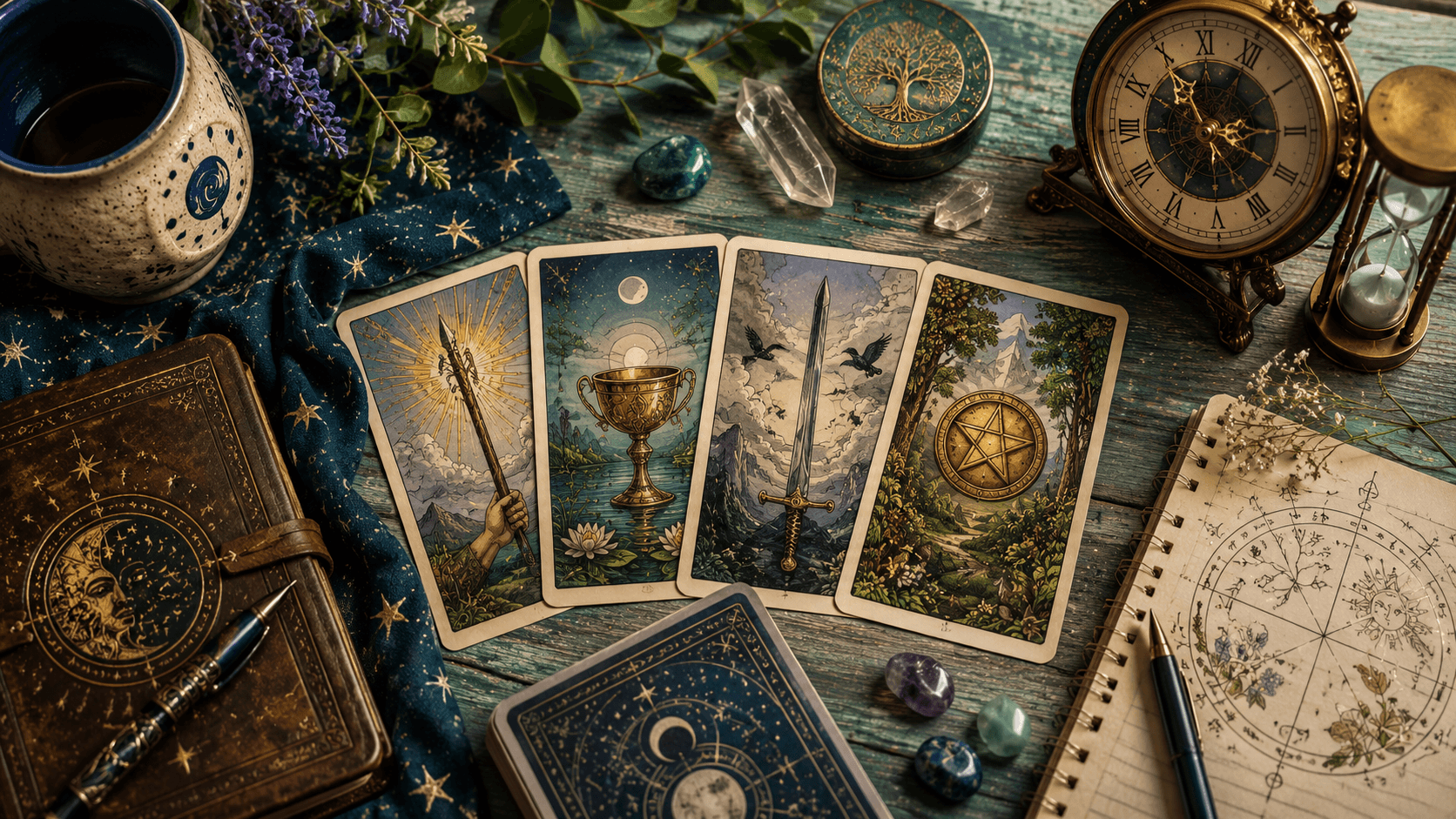
The four suits already provide a natural symbolic framework:
| Suit | Element | Seasonal Association | General Timing |
|---|---|---|---|
| Wands | Fire | Spring / High Summer | Days to weeks |
| Cups | Water | Late Spring / Summer | Weeks to months |
| Swords | Air | Autumn | Swift or changing |
| Pentacles | Earth | Late Autumn / Winter | Months / slow development |
These correspondences should not be treated as universal laws.
Different Tarot traditions assign seasons somewhat differently, and individual practitioners may discover through experience that their cards speak according to a slightly different rhythm.
What matters is consistency.
If Wands repeatedly indicate rapid developments in your readings, record that.
If Pentacles consistently indicate long-term material development, record that too.
Over time, your own practice becomes a laboratory in which traditional correspondence and personal experience meet.
Wands — Fire
Wands tend to move quickly.
Fire ignites.
It spreads.
It consumes fuel.
It transforms what it touches.
For timing questions, Wands can therefore indicate initiation, acceleration, enthusiasm, and events occurring relatively soon.
A Wand does not necessarily mean that the final result arrives immediately.
It may instead indicate that movement begins quickly.
That distinction matters.
The decision might happen this week even though the consequences take months to unfold.
Cups — Water
Cups move according to tides.
Water is receptive, emotional, relational, and cyclical.
Cup timing may therefore be slower and more fluid than the sudden ignition of Fire.
A Cups-heavy reading can indicate emotional development that takes weeks or months.
It may also suggest that timing depends upon emotional readiness.
Something may happen when feelings settle, when trust develops, or when two people become receptive to one another.
Swords — Air
Air moves quickly.
Thoughts can arise in an instant.
Words can travel rapidly.
Decisions can change the direction of a situation almost immediately.
Swords can therefore indicate swift developments, sudden communications, decisions, conflict, or changes in circumstances.
But their relationship to autumn also suggests a period of separation, clarification, harvest, or release.
Something may need to be understood before it can move forward.
Pentacles — Earth
Earth takes time.
A seed must germinate.
A tree must grow.
A house must be built.
A skill must be practiced.
Money must be accumulated.
The body must heal and strengthen through processes that cannot simply be rushed.
Pentacles are therefore excellent indicators of gradual manifestation.
When Pentacles dominate a timing reading, ask whether the situation requires practical preparation rather than immediate action.
The answer may not be “never.”
It may simply be:
Not yet. Build the foundation first.
Numbers as Timing Indicators
Numbers can provide another layer of information.
A simple approach is to regard lower numbers as representing earlier stages of a process and higher numbers as representing greater development or maturation.
An Ace may indicate the beginning of a current.
A Two may suggest the first stage of development or a choice between possibilities.
A Three can indicate expansion.
A Four may suggest stabilization.
Higher numbers can indicate processes that have had more time to develop.
But this should never become a rigid formula.
The Ten of Pentacles, for example, does not automatically mean “ten months.”
Its number may instead emphasize completion, fullness, inheritance, establishment, or the culmination of a long material process.
Likewise, the Eight of Wands might indicate rapid movement despite its relatively high number.
The card’s imagery, suit, surrounding cards, and position in the spread all matter.
Numbers are indicators.
They are not stopwatches.
Court Cards and the Pace of Development
Court Cards can also provide clues.
Pages often correspond to beginnings, messages, discoveries, or something newly entering awareness.
In a timing question, a Page can therefore indicate an early stage or news arriving.
Knights are more active.
They move.
A Knight may indicate that something is already in motion or that movement is about to begin.
Queens and Kings generally represent greater maturity and established conditions.
This does not necessarily mean they indicate a longer chronological period.
Instead, they may describe a more mature stage of the process.
This distinction is important.
A King of Pentacles appearing in a timing reading may not mean “this will happen after twelve months.”
It may say:
The matter requires mature material conditions before it can fully manifest.
Tarot often answers questions about readiness more reliably than questions about exact dates.
The Major Arcana and Greater Cycles
The Major Arcana can operate on a different scale altogether.
When a Major appears in a timing reading, the matter may involve a significant developmental threshold rather than an ordinary event.
The Major Arcana often describe initiatory processes.
They speak of turning points, lessons, transformations, revelations, and larger movements of the life.
Some also possess traditional astrological correspondences that can provide seasonal or planetary clues.
The Hermit, for example, is traditionally associated with Virgo.
Justice is associated with Libra in many Hermetic systems.
Death is associated with Scorpio.
The Star with Aquarius.
The Moon with Pisces.
The Sun with Leo.
These correspondences can provide additional timing symbolism when appropriate.
But again, do not assume that drawing The Star automatically means “Aquarius season.”
It may instead describe hope, spiritual renewal, vision, or clarity as the quality of the time surrounding the matter.
The correspondence is another lens.
It is not the entire reading.
A Practical Method for “When?” Questions
Rather than asking only:
“When will this happen?”
try approaching timing from several directions.
Method One: Seasonal Orientation
Ask:
“What season of development is this situation currently in?”
Draw one or three cards.
Look at the elemental emphasis.
Is the reading dominated by Fire?
Perhaps the situation is entering a period of initiation and movement.
Is Earth dominant?
Perhaps consolidation and patience are required.
Is Water dominant?
Perhaps emotional or relational development is still occurring.
Is Air dominant?
Perhaps communication, decisions, or rapid changes are approaching.
This approach tells you where you are in the cycle.
Method Two: The Three-Card Timing Spread
Try this simple spread:
Card One — The Current Stage
What phase is the situation in now?
Card Two — The Developing Current
What is beginning to move or change?
Card Three — The Conditions of Fruition
What must be present for the matter to reach manifestation?
This is often more useful than demanding a calendar date.
Imagine you receive:
Four of Pentacles — Eight of Wands — Ten of Pentacles
The Four of Pentacles suggests consolidation and holding resources.
The Eight of Wands indicates acceleration.
The Ten of Pentacles points toward established material results.
The story might therefore be:
First consolidate. Then movement accelerates. Then a stable result becomes possible.
The cards are describing a sequence.
The timing is contained within the sequence itself.
Method Three: Read for Acceleration or Delay
Sometimes you do not need to know an exact time.
You need to know whether the situation is speeding up or slowing down.
Ask:
“What is causing this situation to accelerate?”
Then:
“What is causing it to delay?”
These questions restore your agency.
Perhaps the cards reveal that hesitation is slowing the process.
Perhaps they reveal that more preparation is necessary.
Perhaps an external circumstance must change.
Perhaps the querent needs to communicate clearly.
This is far more actionable than being told to wait until an arbitrary date.
Method Four: Conditional Timing
One of the most powerful ways to approach timing is through conditions.
Instead of asking:
“When will I find a new job?”
Ask:
“What conditions will bring me closer to finding a new job?”
Or:
“What will hasten this opportunity?”
And:
“What is likely to delay it?”
This transforms timing from passive prediction into active participation.
The Tarot becomes less like a fortune-telling clock and more like a map of the current landscape.
You can then work with the information.
If the cards indicate preparation, prepare.
If they indicate communication, communicate.
If they indicate patience, consolidate.
If they indicate movement, move.
Lunar and Planetary Timing
For the Hermetic Pagan practitioner, timing does not exist only within the calendar.
The natural and celestial cycles provide another framework.
The Moon moves through phases.
The planets move through their courses.
The seasons turn.
Days possess traditional planetary rulers.
These cycles can become part of the interpretation.
A reading dominated by lunar symbolism might encourage attention to the Moon’s cycle.
A strongly Saturnian pattern might suggest patience, discipline, boundaries, consolidation, or delayed results.
A Jupiterian current might suggest expansion and opportunity.
A Mercurial current may emphasize communication, movement, negotiation, or information.
This can become especially powerful when Tarot is integrated into an existing magical practice.
Rather than asking only:
“When will this happen?”
you might ask:
“Which tide should I work with?”
That is a fundamentally different question.
The first demands an answer from fate.
The second seeks a point of cooperation with the forces already moving through the world.
A Worked Example: “When Will Love Arrive?”
Imagine someone asks:
“When will I enter a meaningful relationship?”
Instead of attempting to predict a specific date, draw three cards:
The Hermit — Page of Cups — Two of Cups
The Hermit suggests a period of withdrawal, reflection, and inner development.
The Page of Cups suggests the emergence of new emotional openness, perhaps accompanied by a message or new emotional experience.
The Two of Cups suggests mutual connection.
The sequence itself provides timing information.
The situation may not be in the Two of Cups stage yet.
It is moving through the Hermit toward the Page and eventually toward greater emotional reciprocity.
The important message is therefore not:
“Love will arrive in three months.”
It is:
The season of solitude is giving way to emotional openness, and that openness creates the conditions for mutual connection.
That is a much richer form of timing.
It tells the querent what is happening now and what must develop next.
A Worked Example: “When Will My Project Succeed?”
Suppose the cards are:
Seven of Pentacles — Three of Wands — King of Pentacles
Here Earth appears first, followed by Fire, followed by Earth.
The Seven of Pentacles is the patient assessment of work already undertaken.
The Three of Wands introduces expansion and outward movement.
The King of Pentacles represents mature material establishment.
The timing appears gradual.
The project is not necessarily failing.
It is maturing.
The Three of Wands suggests that expansion may eventually accelerate the process, but the final result still belongs to the slower realm of Earth.
The cards therefore counsel patience combined with intelligent expansion.
The message is not:
“Wait.”
It is:
“Continue cultivating what you have built while preparing for the next stage of expansion.”
That is active patience.
When Tarot Says “Not Yet”
One of the hardest answers for a Tarot reader to accept is:
Not yet.
But “not yet” is not the same as “no.”
The difference is essential.
A seed beneath the soil has not failed because it has not yet become a flower.
A pregnancy does not become a failure because the child has not arrived in the first month.
A craftsperson does not abandon the work because mastery has not appeared after one afternoon.
Some things require duration.
If Pentacles dominate a reading, if Saturnian symbolism appears strongly, or if the cards repeatedly emphasize preparation and consolidation, the answer may genuinely be that the process needs time.
The wise response is not anxiety.
It is participation.
Ask:
What can I cultivate while the situation develops?
The Danger of Asking Again and Again
Timing questions can become addictive.
A person asks:
“When?”
Then asks again tomorrow.
And again next week.
And again after receiving an answer they did not like.
Eventually the Tarot becomes less an oracle and more a source of reassurance.
This weakens the relationship with the cards.
Repeatedly asking the same question does not necessarily produce greater clarity.
Often it produces noise.
If you receive a timing indication, work with it.
Allow the situation to unfold.
If circumstances genuinely change, consult again.
But do not use divination to escape the uncertainty inherent in being alive.
Some uncertainty cannot be eliminated.
It must be inhabited.
Developing Skill with Tarot Timing
The best way to become good at timing is simple:
Keep records.
Whenever you perform a timing reading, write down:
- The question.
- The cards.
- The elemental pattern.
- Any seasonal or astrological correspondence you noticed.
- What timing you believed the cards indicated.
- What actually happened.
Then review the reading after one month.
Again after three months.
And, when appropriate, after six months.
Patterns will emerge.
Perhaps Wands consistently indicate events within days or weeks.
Perhaps Cups usually indicate several months.
Perhaps your Major Arcana timing works better as developmental stages than calendar dates.
Perhaps a particular number repeatedly appears before events within a certain period.
This is how personal gnosis develops.
Traditional correspondences give you the language.
Experience teaches you how that language speaks through your particular practice.
Your journal becomes a record of the conversation.
The Deeper Lesson of Tarot Timing
The deepest purpose of timing in Tarot is not to extract a date from the cards.
It is to understand the season you inhabit.
There is a season for beginning.
A season for acting.
A season for feeling.
A season for thinking.
A season for building.
A season for waiting.
And a season for letting something die so that another cycle can begin.
The impatient mind asks:
“When will I get what I want?”
The divinatory mind asks:
“What is happening now?”
The magical mind asks:
“How can I work with it?”
This is where Tarot timing becomes something more than prediction.
It becomes a practice of alignment.
You begin to recognize that waiting can be active.
Rest can be active.
Preparation can be active.
Reflection can be active.
And action itself can be wise only when the conditions are ripe.
The wise practitioner learns both how to move with the current and how to recognize when the current is asking for stillness.
Reading the Seasons of the Soul
Tarot is not a clock.
It is a symbolic language capable of revealing patterns, tendencies, conditions, and stages of development.
Sometimes it may offer surprisingly specific timing clues.
But its greatest gift is often subtler.
It tells us what kind of time we are living through.
A Wand may announce the spark.
A Cup may reveal the tide.
A Sword may bring the wind of decision.
A Pentacle may remind us that manifestation requires roots.
The Major Arcana may reveal that we are standing at a threshold far greater than an ordinary calendar date can express.
When we understand these qualities, we become better diviners and better participants in our own lives.
So the next time you find yourself asking the Tarot:
“When will it happen?”
Pause before reaching for the calendar.
Ask instead:
What season am I in?
What is ripening?
What is still developing?
What would hasten the process?
What requires patience?
What must become true before this can manifest?
These questions do not weaken the oracle.
They deepen it.
And they return the seeker to a fundamental principle of the Great Work:
We do not merely wait for the future to arrive. We participate in its becoming.
In your next timing reading, try asking about the season and conditions of the matter rather than demanding a precise date.
Then watch what happens.
You may discover that the Tarot was never trying to give you a number on a calendar.
It was trying to teach you how to recognize the moment when the door is actually open.