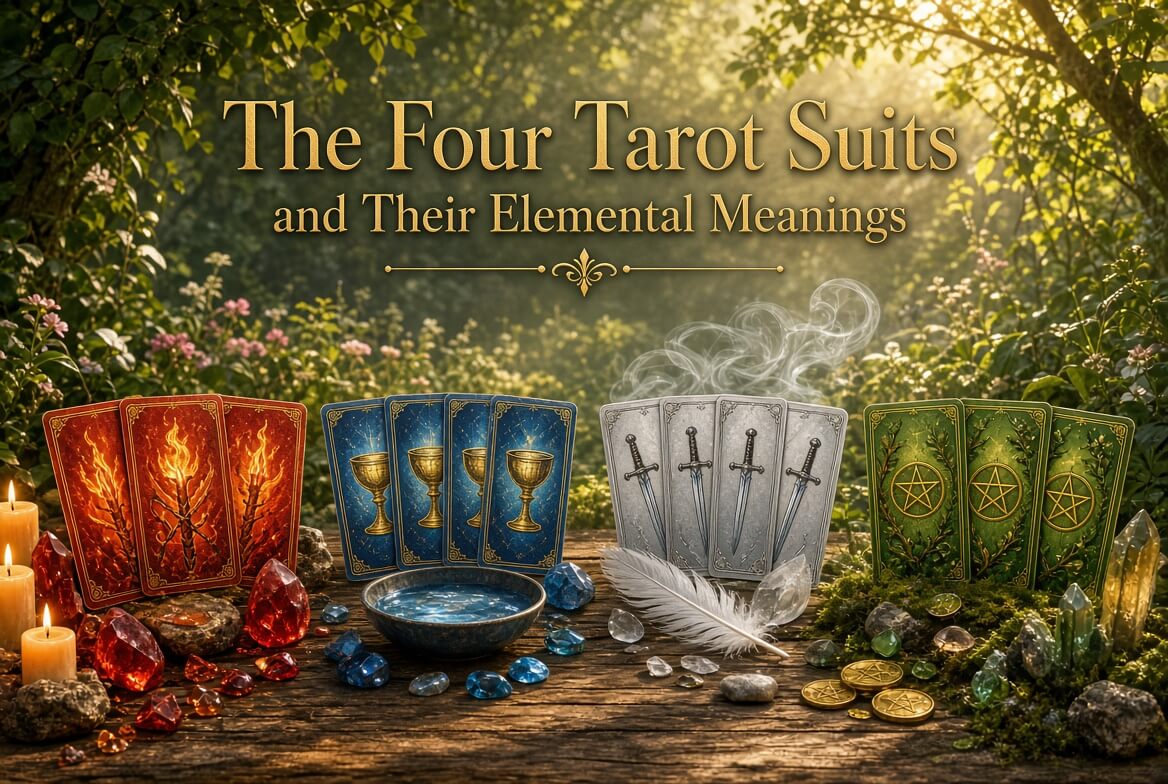
Once you understand that the Minor Arcana is divided into four suits—and that each suit is traditionally associated with a classical element—the tarot deck suddenly becomes much easier to read.
Instead of trying to memorize 56 separate tarot card meanings, you can begin recognizing patterns.
You see Wands and immediately think of Fire: passion, movement, creativity, and action.
You see Cups and think of Water: emotions, relationships, intuition, and the heart.
You see Swords and think of Air: thoughts, communication, decisions, and truth.
You see Pentacles and think of Earth: money, work, physical reality, and stability.
These elemental associations give the Minor Arcana its underlying structure.
A standard tarot deck contains 78 tarot cards, with 56 belonging to the Minor Arcana. Those 56 cards are divided between Wands, Cups, Swords, and Pentacles.
Each suit gives you a different lens through which to understand life.
Think of the four suits as four different languages tarot uses to talk about your experiences.
Once you learn those languages, individual tarot cards become much easier to interpret.
The Four Tarot Suits at a Glance
The Minor Arcana contains four suits:
- Wands → Fire
- Cups → Water
- Swords → Air
- Pentacles → Earth
Each suit contains 14 cards:
- Ace
- Two through Ten
- Page
- Knight
- Queen
- King
The elemental association gives each suit its basic personality.
The element doesn’t completely determine a card’s meaning, but it provides a powerful starting point.
For example, if you pull the Ace of Wands, you can begin with Fire: energy, inspiration, passion, and beginnings.
If you pull the Ace of Cups, you can begin with Water: emotions, love, receptivity, and emotional renewal.
The two cards are both Aces, but they express completely different kinds of beginnings.
That’s the beauty of understanding the suits.
Wands: The Element of Fire
Element: Fire
Wands are the suit of energy, passion, action, creativity, ambition, and inspiration.
If Cups ask, “How do I feel?”, Wands often ask:
“What do I want to do?”
Fire is active.
It moves.
It spreads.
It transforms.
This makes Wands particularly useful when you’re looking at motivation, projects, ambitions, creativity, sexuality, enthusiasm, or the desire to make something happen.
Wands Keywords
Think:
Passion • Action • Creativity • Ambition • Courage • Energy • Inspiration • Growth • Willpower
When Wands appear frequently in a tarot reading, something may be heating up.
You might be starting a new project, pursuing an opportunity, feeling intensely motivated, or experiencing a renewed sense of purpose.
The energy can be exciting—but it can also become difficult to control.
Fire can warm a home.
It can also burn one down.
The Light and Shadow of Wands
The positive side of Wands can represent:
- Inspiration
- Courage
- Creativity
- Sexual energy
- Leadership
- Enthusiasm
- Personal power
- Forward movement
But the shadow side can involve:
- Impulsiveness
- Restlessness
- Anger
- Burnout
- Ego
- Scattered energy
- Acting without thinking
A Wands-heavy reading might therefore ask you not simply to take action, but to consider where your energy is actually going.
Are you pursuing something meaningful?
Or are you simply running on adrenaline?
Three Wands Cards to Know
Ace of Wands
The Ace of Wands is the spark.
It can represent a new creative idea, exciting opportunity, passionate desire, or burst of inspiration.
Something wants to begin.
Three of Wands
The Three of Wands expands the initial spark.
It can represent:
- Expansion
- Foresight
- Exploration
- Looking toward the future
- Waiting for results from previous efforts
The energy is no longer simply “I have an idea.”
It’s becoming:
“Where can I take this?”
Ten of Wands
The Ten of Wands shows what can happen when Fire becomes too heavy.
You may be carrying too much responsibility or trying to do everything yourself.
The card can ask:
What are you carrying that you no longer need to carry?
Cups: The Element of Water
Element: Water
If Wands represent what you do, Cups represent much of what you feel.
Cups are the suit of:
- Emotions
- Love
- Relationships
- Intuition
- Dreams
- Compassion
- Connection
- The subconscious
Water flows, adapts, reflects, and takes the shape of its container.
This makes Cups a natural symbol for the emotional and intuitive dimensions of life.
When Cups dominate a tarot reading, ask:
What is happening beneath the surface?
Cups Keywords
Think:
Emotion • Love • Intuition • Connection • Empathy • Receptivity • Dreams • Compassion
Cups frequently appear in tarot readings about relationships, friendships, family, emotional healing, and personal fulfillment.
But they’re not limited to romance.
A Cup can describe your relationship with yourself, your creative life, your spiritual experience, or your emotional response to a situation.
The Light and Shadow of Cups
The positive side of Cups can represent:
- Love
- Emotional connection
- Compassion
- Intuition
- Creativity
- Empathy
- Healing
- Emotional fulfillment
But too much Water can become difficult to navigate.
The shadow side may involve:
- Moodiness
- Emotional overwhelm
- Escapism
- Idealization
- Attachment
- Emotional dependency
- Living too much in the past
Water teaches an important lesson:
Feelings are valuable information, but they aren’t always the whole story.
Three Cups Cards to Know
Ace of Cups
The Ace of Cups represents an emotional opening.
It can symbolize:
- New love
- Emotional renewal
- Compassion
- Spiritual love
- Creative inspiration
- Opening the heart
It’s the first drop of water filling an empty cup.
Two of Cups
The Two of Cups is one of tarot’s classic cards of partnership.
It can represent:
- Mutual attraction
- Connection
- Partnership
- Emotional reciprocity
- Harmony
In relationship readings, it can be especially significant.
Five of Cups
The Five of Cups explores disappointment and grief.
The emotional focus is on what has been lost.
But the card also contains another lesson: not everything has been lost.
Sometimes the emotional challenge is learning to acknowledge grief without becoming completely consumed by it.
Swords: The Element of Air
Element: Air
Swords belong to the realm of the mind.
They represent:
- Thoughts
- Communication
- Intellect
- Truth
- Decisions
- Conflict
- Logic
- Beliefs
- Mental challenges
Air is invisible, yet impossible to ignore.
You can’t see the wind itself, but you can see what it moves.
In much the same way, thoughts can be invisible while profoundly influencing your behavior.
When Swords appear, ask:
What am I thinking?
What truth needs to be acknowledged?
What conversation needs to happen?
Swords Keywords
Think:
Mind • Truth • Communication • Logic • Conflict • Decisions • Clarity • Strategy
Swords aren’t necessarily negative.
It’s true that some of the most difficult tarot cards belong to this suit.
But Swords can also represent intellectual breakthroughs, honest communication, clear decisions, and the courage to face reality.
The mind can create suffering.
It can also create clarity.
The Light and Shadow of Swords
The positive side of Swords can represent:
- Mental clarity
- Truth
- Honest communication
- Intellectual ability
- Strategy
- Insight
- Decisiveness
The shadow side can involve:
- Overthinking
- Anxiety
- Harsh communication
- Arguments
- Mental exhaustion
- Cruelty
- Obsessive thoughts
When Swords dominate a tarot reading, it may be useful to ask whether you’re dealing with an external conflict—or a conflict happening primarily inside your own mind.
Three Swords Cards to Know
Ace of Swords
The Ace of Swords is the blade of clarity.
It can represent a breakthrough idea, revelation, truth, decision, or new understanding.
Something becomes clear.
Three of Swords
The Three of Swords is traditionally associated with heartbreak, grief, sorrow, and painful truth.
It reminds us that sometimes clarity hurts.
Knowing the truth isn’t always comfortable—but it can ultimately allow healing to begin.
Eight of Swords
The Eight of Swords can represent feeling trapped by thoughts, beliefs, fear, or perceived limitations.
Its deeper lesson is often about examining whether the cage is entirely external—or whether some of its bars have been created by the mind.
Pentacles: The Element of Earth
Element: Earth
Pentacles bring tarot back down to the physical world.
They are associated with:
- Money
- Work
- Career
- Health
- Home
- Security
- Resources
- The body
- Practical results
- Long-term stability
If Wands ask, “What do I want to pursue?” and Cups ask, “How do I feel?”, Pentacles often ask:
“What can I actually build?”
Earth is slow.
It is tangible.
It requires patience.
You plant a seed, tend it, and wait.
That makes Pentacles especially relevant when you’re thinking about long-term results.
Pentacles Keywords
Think:
Money • Work • Stability • Resources • Health • Security • Value • Patience • Manifestation
When Pentacles dominate a tarot reading, pay attention to the practical side of the situation.
What resources do you have?
What are you building?
What requires patience?
What has real-world value?
The Light and Shadow of Pentacles
The positive side of Pentacles can represent:
- Abundance
- Financial stability
- Security
- Practical wisdom
- Skill
- Craftsmanship
- Patience
- Long-term growth
The shadow side can involve:
- Greed
- Materialism
- Possessiveness
- Stagnation
- Fear of financial loss
- Overwork
- Becoming overly attached to security
Earth can provide stability.
But too much attachment to stability can prevent growth.
Three Pentacles Cards to Know
Ace of Pentacles
The Ace of Pentacles can represent a new tangible opportunity.
This might involve:
- Money
- Work
- Career
- Business
- A practical opportunity
- A new foundation
The important word is potential.
The seed has been planted—but it still needs to be cultivated.
Four of Pentacles
The Four of Pentacles can describe holding tightly to what you have.
That could mean money, possessions, control, security, or even an emotional attachment to stability.
The card asks:
Am I protecting what I have—or am I afraid to let anything move?
Ten of Pentacles
The Ten of Pentacles represents long-term material stability and legacy.
It can involve:
- Wealth
- Family
- Security
- Generational resources
- Long-term achievement
- A lasting foundation
It’s Earth at its most established.
The Four Tarot Suits Side by Side
| Suit | Element | Core Focus | Keywords | Life Area |
|---|---|---|---|---|
| Wands | Fire | Action & inspiration | Passion, drive, creativity | Projects, ambition |
| Cups | Water | Emotions & relationships | Feelings, intuition, love | Heart & connections |
| Swords | Air | Thoughts & communication | Truth, conflict, clarity | Mind & decisions |
| Pentacles | Earth | Material world | Money, body, stability | Work, health, resources |
A simple way to remember them is:
Wands = What you do
Cups = What you feel
Swords = What you think
Pentacles = What you build
It’s not a complete interpretation of every card, but it’s an excellent starting point.
How the Elements Work Together in a Tarot Reading
Once you understand the four suits, start looking at the elemental balance of an entire tarot spread.
Suppose you perform a three-card tarot spread and pull:
Ace of Wands — Two of Cups — Eight of Pentacles
You have Fire, Water, and Earth.
The reading might involve:
- Fire: inspiration or action
- Water: emotional connection
- Earth: practical effort
The cards could suggest an exciting relationship or creative opportunity that requires emotional connection and consistent practical effort to develop.
Now imagine a reading containing five Swords.
Suddenly, the elemental emphasis is very different.
The reading may be heavily focused on:
Thoughts, decisions, communication, beliefs, or mental tension.
The dominant suit can give you a quick sense of where the energy of the reading is concentrated.
What Happens When Different Elements Meet?
You don’t need to become an expert in ceremonial magic or astrology to notice elemental relationships.
For beginners, simply observe what happens when different energies appear together.
Fire + Water
Fire and Water can create steam.
This can symbolize passion mixed with emotion.
It can be wonderfully creative and romantic—or emotionally volatile.
Air + Earth
Air deals with ideas while Earth deals with tangible reality.
Together, they can suggest turning plans into practical structures.
But they can also represent becoming overly concerned with planning while struggling to act.
Fire + Earth
Fire provides enthusiasm while Earth provides structure.
This can be a productive combination:
inspiration + practical effort.
Water + Air
Water feels while Air thinks.
This combination can highlight the tension between:
“What do I feel?”
and
“What do I think?”
Neither is automatically right or wrong.
Sometimes you need both.
The Goal Isn’t to Have Every Element in Every Reading
Don’t worry about creating a perfectly balanced elemental spread.
A reading dominated by one element isn’t necessarily a problem.
In fact, the imbalance itself can be informative.
Imagine a spread containing:
Seven of Cups — Two of Cups — Queen of Cups — Ace of Cups
That’s a lot of Water.
The obvious question becomes:
Why are emotions and relationships taking up so much space right now?
Likewise, a spread filled with Pentacles might be drawing your attention toward work, money, health, security, or practical responsibilities.
The dominant element can function almost like a spotlight.
It tells you:
“Look here.”
A Simple Beginner Exercise
The next time you perform a tarot reading, don’t immediately look up the card’s traditional meaning.
Start with the suit.
Ask:
Step 1: What suit is this?
Wands, Cups, Swords, or Pentacles?
Step 2: What element does it represent?
Fire, Water, Air, or Earth?
Step 3: What does that element suggest?
Is the situation primarily about:
Action? Emotion? Thought? Material reality?
Step 4: Now look at the individual card.
Once you understand the elemental foundation, the specific card meaning becomes easier to place in context.
For example, if you pull the Queen of Cups, you already know you’re dealing with the Water element.
So you might consider emotional intelligence, intuition, compassion, receptivity, and emotional maturity before even consulting a guidebook.
The card’s imagery and position in the tarot spread can then add another layer.
Don’t Forget the Court Cards
The elemental personality of a suit also carries through its Court Cards.
A Queen of Cups and a Queen of Swords are both Queens, but they express completely different energies.
The Queen of Cups may emphasize:
- Emotional intelligence
- Intuition
- Compassion
- Receptivity
The Queen of Swords may emphasize:
- Discernment
- Honesty
- Boundaries
- Clear thinking
The rank gives you one layer of meaning.
The suit gives you another.
This is one of the reasons understanding the structure of tarot cards is much more useful than simply memorizing isolated keywords.
No Suit Is “Good” or “Bad”
This is one of the most important things to remember as a beginner.
There is no universally “good” suit.
There is no universally “bad” suit.
Every element has both constructive and destructive expressions.
Fire can inspire—or burn.
Water can heal—or overwhelm.
Air can clarify—or torment the mind.
Earth can stabilize—or become stagnant.
Tarot isn’t simply dividing life into positive and negative categories.
It’s showing you different kinds of energy and experience.
The question is often not:
“Is this suit good?”
but:
“How is this energy being expressed?”
The Four Elements Create a Complete Picture
The four suits can be viewed as different dimensions of human experience.
Wands give you the energy to act.
Cups allow you to feel and connect.
Swords allow you to think and understand.
Pentacles allow you to create something tangible in the physical world.
A balanced life needs all four.
You can have a brilliant idea—but without Earth, you may never build it.
You can have enormous ambition—but without Water, you may lose touch with what you actually care about.
You can have deep emotions—but without Air, you may struggle to communicate them.
You can have financial security—but without Fire, your life may begin to feel stagnant.
The tarot suits remind us that life isn’t one-dimensional.
Final Thoughts: Learning the Four Tarot Suits
The four suits are one of the most useful shortcuts for learning tarot.
Instead of seeing 56 Minor Arcana cards as a mountain of information, you can organize them into four elemental families:
Wands → Fire → Passion, action, creativity
Cups → Water → Emotions, relationships, intuition
Swords → Air → Thoughts, communication, truth
Pentacles → Earth → Money, work, stability, physical reality
Once these associations become familiar, you can start recognizing patterns almost immediately during a tarot reading.
You don’t need to memorize every tarot card before you begin.
Start by asking what suit you’re looking at.
Then identify its element.
Then consider what that element might be saying about the situation.
Finally, bring in the specific card meaning, imagery, number, Court Card rank, and surrounding cards.
That simple process can transform the way you approach tarot cards.
And the more you practice, the more naturally the elemental language begins to speak.
Fire tells you to move.
Water tells you to feel.
Air tells you to think.
Earth tells you to build.
Together, they give the Minor Arcana its living structure—and give you a powerful framework for understanding your next tarot spread.
If you want to continue learning, the natural next step is to explore the Court Cards and discover how Pages, Knights, Queens, and Kings express the energy of each suit.
And if you’d like to put what you’ve learned into practice, try a simple three-card tarot spread and pay attention not only to the individual cards, but to which element appears most strongly.