Humanity has never been content with a single way of listening to the unseen.
Long before modern tarot readers shuffled cards on velvet cloth, people were casting lots, observing birds, studying the heavens, interpreting dreams, reading flames, tracing patterns in bones, consulting sacred texts, and watching the movements of natural things.
Across cultures and centuries, human beings have sought ways to enter into conversation with what lies beyond ordinary perception.
The systems differ enormously.
The symbols differ. The cosmologies differ. The techniques differ. The spiritual traditions surrounding them differ.
And yet, beneath these differences, there is something remarkably familiar.
They all attempt to make the invisible visible.
Tarot is one such language.
It is an extraordinarily rich language, particularly within the Western esoteric tradition. Its combination of archetype, number, element, image, planetary correspondence, and narrative makes it exceptionally versatile.
But tarot is not the only oracle.
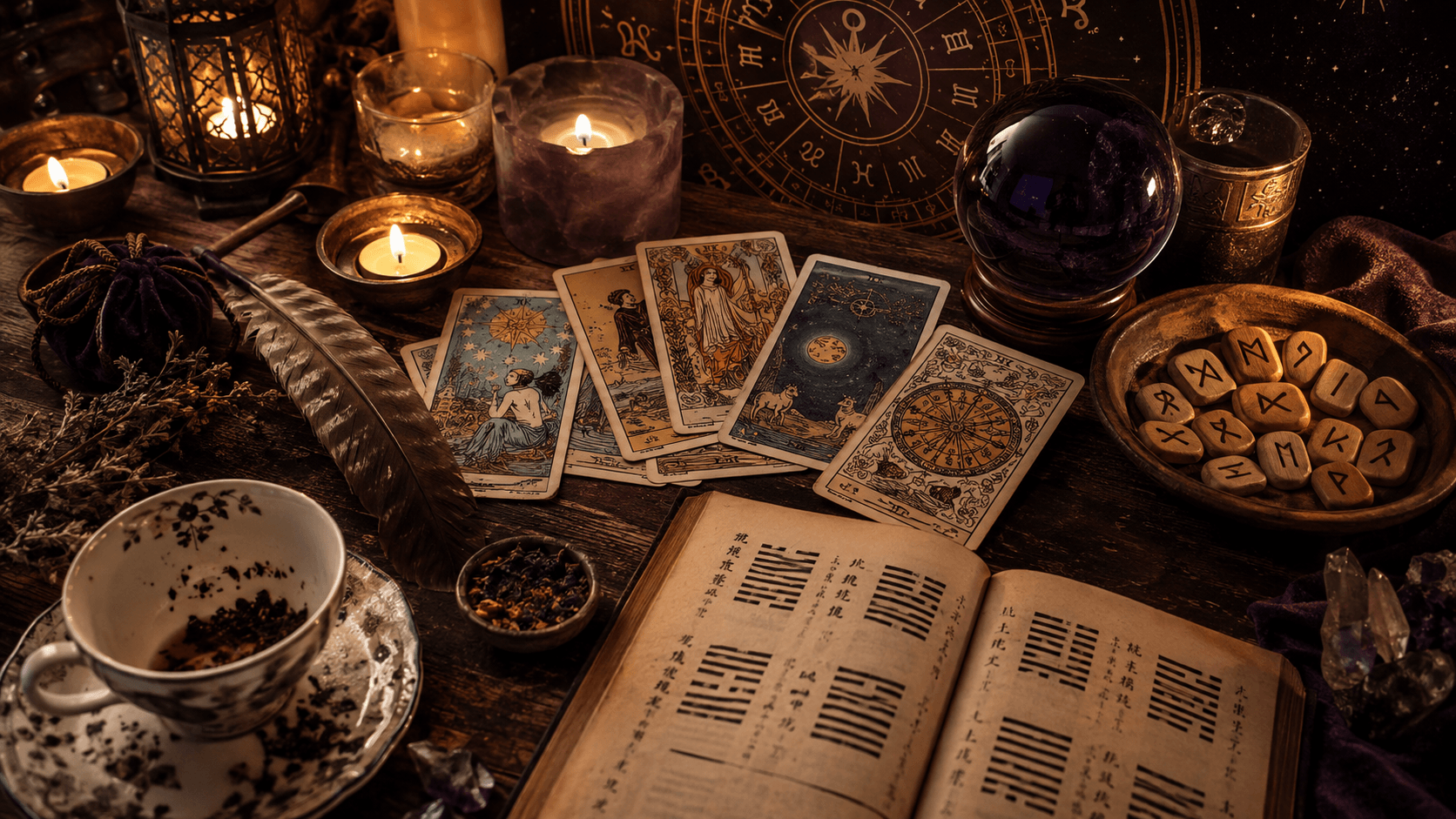
Runes, the I Ching, tasseography, astrology, scrying, pendulum work, and numerous other systems offer their own ways of approaching the unknown.
From a Hermetic Pagan perspective, there is little reason to declare one universally superior.
The better question is:
What kind of question are you asking, and which language is best suited to answer it?
The Shared Ground of Divination
Before comparing individual systems, it is worth asking what divination actually does.
At its deepest level, divination is not simply fortune-telling.
It is a method of revelation.
The oracle provides an external pattern through which something hidden can become perceptible.
That hidden thing might be an unconscious psychological current. It might be a pattern developing in circumstances around you. It might be ancestral or spiritual symbolism. It might be what a Hermetic practitioner understands as the intelligence of the cosmos communicating through correspondence.
Different traditions explain this differently.
But the practical experience can be remarkably similar.
You ask.
You create an opening.
A pattern appears.
You interpret.
The oracle becomes a mirror and a bridge at the same time.
The mirror reflects something that was already present but difficult to perceive.
The bridge establishes a relationship between ordinary consciousness and a deeper level of meaning.
This is why the quality of the practitioner matters so much.
A poorly trained reader can possess an extraordinary oracle and still produce shallow interpretations.
A disciplined practitioner can sometimes obtain remarkable insight from something as simple as a handful of objects or an accidental pattern.
The tool matters.
But the person using the tool matters too.
In a Hermetic Pagan framework, the gods, daimones, ancestors, spirits, archetypal forces, and deeper layers of the self are not necessarily restricted to communicating through one particular instrument.
The universe is full of symbols.
The oracle teaches us how to listen.
Tarot: The Great Symbolic Map
Tarot occupies a particularly interesting position among divination systems.
A standard tarot deck contains 78 cards, divided into the 22 Major Arcana and 56 Minor Arcana.
This gives the practitioner an enormous symbolic vocabulary.
The Major Arcana provide archetypal powers and stages of transformation.
The Minor Arcana provide more immediate expressions through the four suits, numbers, courts, and elemental principles.
This structure gives tarot an unusual ability to describe complex situations in layers.
Consider a question about a difficult relationship.
One card might describe the emotional atmosphere.
Another might reveal the underlying conflict.
Another might describe your own unconscious contribution.
Another might indicate what needs to change.
Another might show the likely direction of the process.
Tarot can therefore function almost like a symbolic language for mapping a situation.
Its visual nature is another major advantage.
The cards do not merely provide abstract symbols. They provide scenes.
People are fighting.
People are celebrating.
A tower collapses.
A figure walks toward the horizon.
A woman sits beside a lion.
A traveler stands at the edge of a cliff.
The reader can observe relationships between these images and construct a narrative.
This makes tarot particularly useful for:
- Psychological exploration
- Shadow work
- Spiritual reflection
- Complex questions
- Relationship dynamics
- Identifying patterns
- Understanding transitions
- Daily guidance
- Magical and ritual work
- Tracking a process over time
Tarot is also unusually flexible.
You can draw one card.
You can perform a three-card reading.
You can use a large ceremonial spread.
You can incorporate planetary, elemental, astrological, Qabalistic, or magical correspondences.
In the Western occult tradition, tarot eventually became deeply intertwined with Hermetic and ceremonial systems, particularly through later occult synthesis.
This makes it especially attractive to practitioners interested in correspondences.
Tarot is not merely a deck of pictures.
It can become a symbolic cosmology.
Runes: The Voice of the North
The runes present a very different experience.
The Elder Futhark consists of 24 runes, each traditionally associated with a sound and symbolic meaning.
Compared with tarot’s 78-card vocabulary, this is a much more concentrated system.
And that concentration is part of its strength.
Where tarot often feels expansive and descriptive, runic divination can feel terse.
A rune may seem to arrive with a single powerful concept:
strength.
necessity.
harvest.
journey.
disruption.
protection.
gift.
The effect can be more like receiving a concentrated symbolic force than reading a detailed narrative.
Runes can therefore be particularly compelling for practitioners drawn toward Northern European traditions, Germanic spirituality, ancestral work, land-based practice, or animist approaches.
They can also be used for purposes beyond divination, including symbolic magical work, inscriptions, talismanic practices, and meditation.
However, caution is important here.
The historical runic alphabets were writing systems before modern occultists transformed them into standardized divinatory systems. Modern rune divination should therefore not automatically be treated as an unchanged survival of ancient Germanic practice.
A historically conscious practitioner can honor the runes without confusing modern reconstruction with ancient certainty.
In practice, runes often work beautifully when questions require directness rather than elaborate narrative.
Tarot might show you the story.
A rune might give you the pressure point.
The I Ching: The Oracle of Change
Few divinatory traditions possess the philosophical depth of the I Ching, or Book of Changes.
Its traditional system consists of 64 hexagrams, each formed from six lines representing combinations of broken and unbroken patterns.
These are traditionally understood through the dynamics of yin and yang and the changing conditions of existence.
The I Ching is fundamentally concerned with change.
This makes it particularly interesting when compared with tarot.
Tarot can ask:
What is happening?
The I Ching often pushes further:
What pattern is unfolding, and how should you conduct yourself within it?
Its counsel can therefore feel strategic.
Rather than simply describing your emotional state, an I Ching consultation may emphasize timing, adaptation, restraint, action, or the consequences of moving against the prevailing circumstances.
This is one of its greatest strengths.
Suppose you are considering a major decision.
Tarot might illuminate your motivations, fears, opportunities, unconscious patterns, and probable developments.
The I Ching may instead give you a profound meditation on the character of the moment itself.
Is this a time to advance?
To wait?
To withdraw?
To remain steadfast?
To adapt?
To act without forcing?
This is not simply fortune-telling.
It is a philosophy of movement through changing circumstances.
The I Ching also demands respect for its own intellectual and cultural tradition.
It should not be reduced to a collection of 64 interchangeable fortune-cookie messages.
Its philosophical background, classical commentaries, and Chinese intellectual history are part of what gives the system its depth.
For the practitioner willing to study it seriously, the I Ching can become not merely an oracle but a lifelong school of thought.
Tea Leaves, Coffee Grounds, and Natural Oracles
Tasseography — the practice of interpreting patterns left by tea leaves or similar substances — represents another fascinating approach.
Here the oracle is not a fixed symbolic vocabulary like tarot.
There is no predetermined set of 78 images.
Instead, the practitioner observes a spontaneous pattern.
A shape emerges.
Perhaps it resembles a bird.
A road.
A tree.
A person.
A ring.
A mountain.
The interpretation develops from the relationship between the observed form, the question, and the intuitive perception of the reader.
Coffee-ground reading works similarly.
Other forms of natural divination and scrying operate according to related principles.
Clouds.
Smoke.
Flames.
Water.
Reflections.
The important characteristic is spontaneity.
The practitioner does not select from a predetermined symbolic system.
Instead, something unexpected appears.
This can make natural oracles excellent exercises in intuitive perception.
They require the reader to become comfortable with ambiguity.
A tarot card tells you what card has appeared.
A tea leaf pattern might barely resemble anything at all.
You must learn to look without forcing.
That makes tasseography particularly useful for cultivating the seer’s eye.
It is less codified than tarot or the I Ching, but this is not necessarily a weakness.
For some practitioners, the absence of a rigid system is precisely what allows intuition to breathe.
Other Divination Systems
There are many other forms of divination worth exploring.
Astrology
Astrology is fundamentally different from tarot because its symbolic language is celestial.
Planets, signs, houses, and aspects create a map of cosmic relationships.
Where tarot can provide an immediate snapshot of a situation, astrology can provide a much broader framework.
It is especially powerful for questions involving:
- Timing
- Cycles
- Long-term patterns
- Personality
- Life themes
- Transitions
Tarot and astrology complement one another exceptionally well.
Tarot can illuminate the immediate situation.
Astrology can show the larger sky in which that situation is unfolding.
Pendulum and Dowsing
Pendulum work is generally more constrained.
It can be useful when working with relatively simple questions or when seeking binary responses.
Yes.
No.
More likely.
Less likely.
Some practitioners also use dowsing for locating objects or exploring subtle environmental impressions.
Its simplicity is both its strength and its limitation.
A pendulum does not naturally provide the elaborate narrative vocabulary of tarot.
Scrying
Crystal balls, black mirrors, water, flames, and other reflective surfaces belong to the broad family of scrying practices.
Instead of interpreting a predetermined symbol, the practitioner enters a receptive state and observes what arises.
Scrying can therefore be deeply visionary.
It may be used for meditation, symbolic revelation, and — within certain traditions — attempts at spirit communication.
It generally requires more cultivation of receptive attention than a straightforward card reading.
Modern Oracle Decks
Modern oracle decks can be extremely diverse.
Some contain animal symbolism.
Others focus on deities, angels, ancestors, shadow work, affirmations, mythology, or particular spiritual traditions.
Their great advantage is specialization.
A tarot deck gives you a broad symbolic language.
An oracle deck may give you a particular dialect.
The trade-off is that many oracle decks have less standardized structure than tarot.
This can make them wonderfully intuitive, but it can also make systematic study more difficult.
Tarot vs Other Divination Systems
A simple comparison can help clarify their different strengths.
| System | Primary Strength | Often Best For |
|---|---|---|
| Tarot | Complex symbolic mapping | Psychology, relationships, spiritual development, layered questions |
| Runes | Concentrated symbolic force | Direct counsel, Northern traditions, protection, magical work |
| I Ching | Understanding change | Strategy, timing, adaptation, philosophical guidance |
| Tea/Coffee Reading | Spontaneous symbolism | Intuition, visual perception, open-ended readings |
| Astrology | Cosmic context | Timing, cycles, long-term patterns |
| Pendulum | Simple binary inquiry | Focused yes/no questions |
| Scrying | Visionary perception | Meditation, visions, symbolic or spiritual exploration |
| Oracle Decks | Thematic specialization | Deity work, focused messages, intuitive guidance |
This table should not be interpreted as a hierarchy.
It is a map of different strengths.
Choosing the Right Oracle
So which system should you use?
The answer begins with the question itself.
If you want to explore the psychological dynamics of a complicated relationship, tarot may be ideal.
If you are studying a particular Northern European spiritual tradition, runes may be more appropriate.
If you want to understand the strategic nature of a changing situation, the I Ching may offer extraordinary insight.
If you want to cultivate raw visual intuition, tasseography or scrying may be more useful.
If you need a broader understanding of cycles and timing, astrology may be the better instrument.
The spiritual framework matters too.
Divination is not culturally neutral.
The symbols of the I Ching belong to a profound Chinese intellectual and spiritual tradition.
The runes belong historically to Germanic cultures and languages.
Astrology developed through multiple civilizations and accumulated layers of Babylonian, Hellenistic, Persian, Islamic, European, and other traditions.
Tarot itself has a complicated history, beginning as a card game before becoming associated with occult and esoteric systems centuries later.
Respecting a system means learning something about where it came from.
It means resisting the temptation to flatten every tradition into the same modern vocabulary.
Different rivers can reach the ocean without pretending that they are the same river.
Combining Divination Systems
Once you have developed genuine competence in one system, combining systems can become extremely powerful.
The key is not to become scattered.
There is little value in owning twelve decks, a bag of runes, an I Ching book, a crystal ball, an astrology program, and a pendulum if you have never learned to use any of them properly.
Depth should come before accumulation.
Choose a primary language.
Learn its grammar.
Practice until you can recognize its subtleties.
Then begin exploring other systems.
At that point, combinations become interesting.
For example:
Tarot + Astrology
Use tarot to explore the immediate situation and astrology to examine timing and larger cycles.
Tarot + I Ching
Use tarot to explore the psychological and symbolic dimensions of a question, then consult the I Ching for strategic counsel concerning how to move through the changing situation.
Tarot + Runes
Use tarot for detailed interpretation and runes for a concentrated final symbol or magical emphasis.
Tarot + Scrying
Use the cards to establish the theme, then enter meditation or scrying to explore the imagery more deeply.
The purpose is not to ask every oracle the same question until they finally give you the answer you want.
That is not divination.
That is reassurance-seeking.
Instead, give each system its own office.
Let each oracle speak in its own language.
The Deeper Hermetic Perspective
The mature practitioner eventually discovers something paradoxical.
The more systems you study, the more clearly you begin to see what makes each one unique.
But you also begin to recognize the common principles beneath them.
Pattern.
Correspondence.
Symbol.
Change.
Relationship.
Attention.
Meaning.
The oracle does not necessarily function because the physical object possesses some crude magical mechanism.
Nor does the practitioner have to reduce every experience to psychological projection.
There is room for mystery.
A Hermetic Pagan approach can hold that consciousness, symbol, nature, and divine intelligence participate in a living web of correspondence.
The card is not necessarily the message.
The rune is not necessarily the message.
The hexagram is not necessarily the message.
They are vehicles through which meaning becomes perceptible.
This is why the trained practitioner gradually becomes less dependent on any single instrument.
The oracle trains perception.
Eventually, perception begins to operate without the oracle.
You start noticing patterns in circumstances.
You recognize recurring symbols in dreams.
You perceive the significance of timing.
You become sensitive to the atmosphere of places and encounters.
The world itself becomes increasingly transparent to meaning.
This is one of the deeper purposes of divination.
Not to make you helpless without your cards.
But to make you more awake with them — and eventually more awake without them.
No Single Oracle Rules Them All
There is no universally “best divination system.”
There is only the system that is appropriate to the question, the practitioner, the tradition, and the moment.
Tarot possesses extraordinary breadth.
Runes possess concentrated power and historical resonance.
The I Ching offers profound wisdom concerning change.
Tasseography cultivates spontaneous symbolic perception.
Astrology reveals the celestial pattern.
Scrying opens the door to visionary practice.
Pendulums provide simplicity.
Oracle decks offer specialization.
Each has something to teach.
And studying other systems can actually make you a better tarot reader.
When you encounter a more concentrated oracle such as a rune, you may begin to appreciate how much symbolic detail tarot contains.
When you study the I Ching, you may become more sensitive to cycles and changing conditions in a tarot reading.
When you practice scrying, you may become better at allowing an image to speak before immediately reaching for a textbook definition.
The traditions can illuminate one another without being collapsed into one another.
The wise practitioner remains a student.
Learn several languages if you are called to do so.
But master the language that has claimed you most deeply.
The purpose is not to collect oracles.
It is to refine perception.
And perhaps, in time, to discover that the entire living world is an oracle — and that every moment contains more meaning than the ordinary mind has learned to see.