When you first learn Tarot, it is natural to approach each card as an individual symbol.
The Three of Cups means celebration. The Eight of Swords means restriction. The Ace of Wands means inspiration. The Tower means upheaval.
You learn the meanings, lay out a spread, and then attempt to weave those meanings together into a coherent answer.
But there is another way to read.
In the Hermetic Pagan manner, the cards in a spread are not isolated statements placed beside one another by accident. They are powers entering into relationship.
A card can strengthen another card. It can restrain it. It can challenge it, clarify it, nourish it, or make its expression more difficult.
This is where elemental dignities in Tarot become extraordinarily useful.
The four elements — Fire, Water, Air, and Earth — are not merely categories attached to the Minor Arcana. They can be understood as living forces with different temperaments and modes of action. When those forces meet inside a Tarot spread, they interact much as elemental powers interact in nature and ritual.
Fire feeds upon Air.
Water nourishes Earth.
Fire and Water may struggle for dominance.
Air and Earth may obstruct one another.
None of this means that one element is inherently “good” and another inherently “bad.” The question is more subtle:
What happens when these powers meet?
Once you begin asking that question, a Tarot spread stops looking like a row of separate definitions.
It becomes a living conversation.
The Four Elements as Living Powers
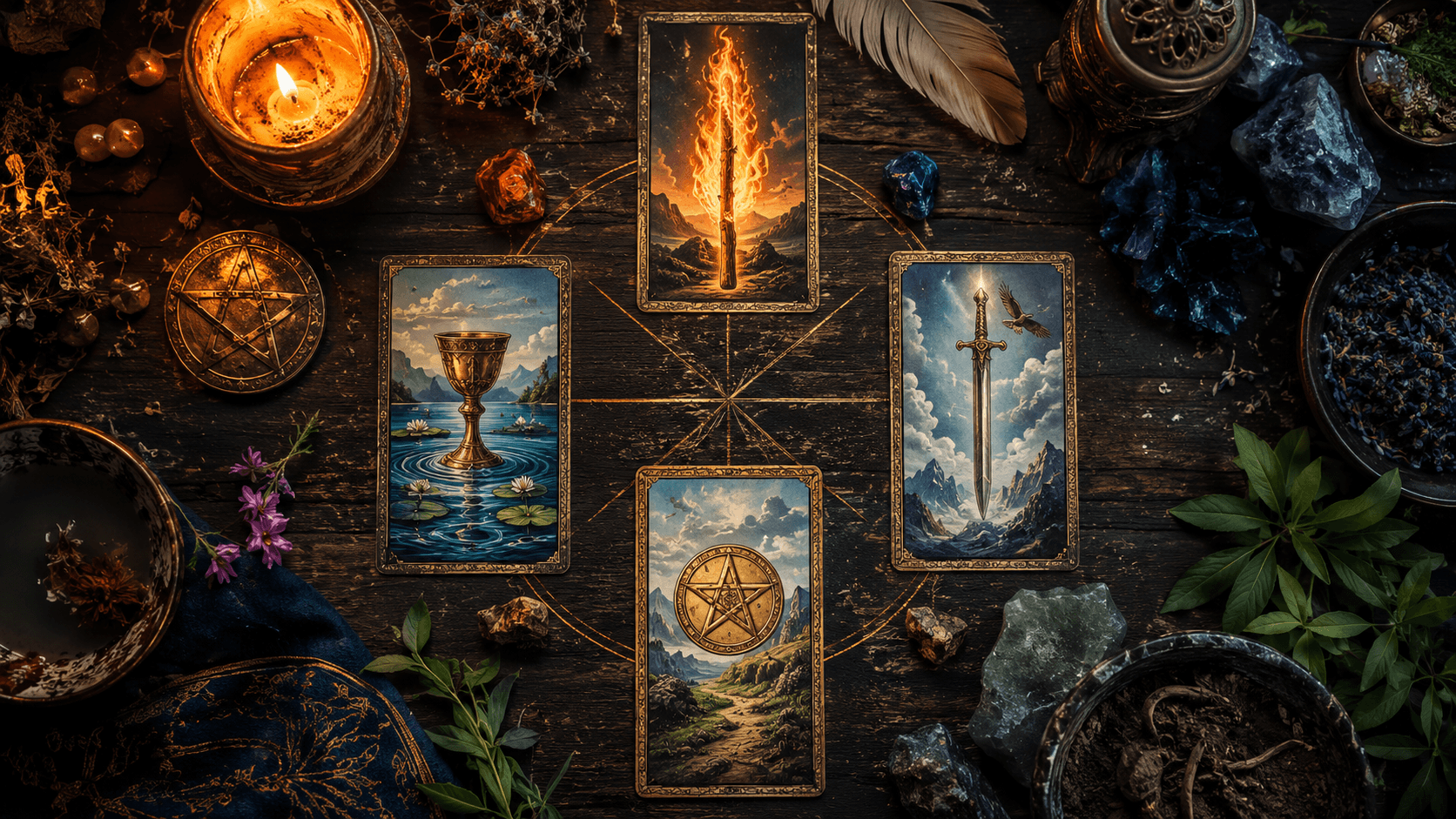
The simplest elemental correspondences in the Minor Arcana are:
| Tarot Suit | Element | Principle |
|---|---|---|
| Wands | Fire | Will, action, desire, vitality |
| Cups | Water | Emotion, intuition, relationship |
| Swords | Air | Thought, intellect, communication |
| Pentacles | Earth | Matter, body, work, manifestation |
These correspondences give us a foundation for understanding Tarot elemental relationships.
Fire moves.
Water flows.
Air circulates.
Earth stabilizes.
Fire reaches outward through enthusiasm and will. Water responds through feeling and receptivity. Air analyzes, separates, communicates, and conceptualizes. Earth gives things substance, structure, and permanence.
Consider what happens when these forces encounter one another outside of Tarot.
Fire and Air can cooperate beautifully. Air gives Fire oxygen; Fire gives Air warmth and movement.
Water and Earth likewise have an obvious affinity. Earth receives Water, while Water nourishes the living things rooted within Earth.
But Fire meeting Water produces steam, extinguishment, or violent transformation depending upon the circumstances.
Air meeting Earth can create dust, resistance, stillness, or erosion.
The same principle can be brought into a Tarot reading.
The cards do not simply possess meanings.
They possess relationships.
The Core Principles of Elemental Dignity
The classical elemental relationships can be simplified into three broad categories.
Friendly or Strengthening
Fire + Air
Water + Earth
These elements naturally cooperate.
Fire gives Air warmth and movement, while Air feeds Fire. Water nourishes Earth, while Earth gives Water a vessel and place to settle.
When cards belonging to these elements appear together, their meanings can often reinforce one another.
For example, the Ace of Wands beside the Ace of Swords may suggest that an idea and the will to act upon it are arriving together.
The Queen of Cups beside the Ten of Pentacles might suggest emotional nourishment finding expression through family, home, security, or material stability.
Neutral or Mixed
Fire + Earth
Water + Air
These combinations are not necessarily harmonious, but neither are they inherently hostile.
They can produce complicated or conditional relationships.
Fire wants movement; Earth wants stability.
Water moves through feeling; Air seeks understanding through thought.
Sometimes these combinations create useful balance.
At other times they indicate that two different modes of being are attempting to occupy the same situation.
A Fire card beside an Earth card might show ambition meeting practical limitations — but it could just as easily show ambition receiving the structure necessary to become real.
A Water card beside an Air card may describe emotional confusion, but it may also represent the ability to understand one’s feelings clearly.
Unfriendly or Challenging
Fire + Water
Air + Earth
These elements tend to create friction.
Fire can evaporate or overwhelm Water.
Water can extinguish Fire.
Air can scatter or disturb Earth.
Earth can restrict the movement of Air.
But remember: unfriendly does not mean evil, doomed, or negative.
It means that the powers do not naturally cooperate.
Something has to happen.
There may be tension, resistance, transformation, or conscious reconciliation.
And sometimes that friction is exactly what the reading needs.
How Elemental Dignities Modify Meaning
Imagine drawing the Three of Wands.
On its own, you might read it as expansion, foresight, confidence, or looking toward future possibilities.
Now place it beside another Fire card.
The Fire nature of the Three of Wands is reinforced.
Its qualities may become more pronounced: ambition, movement, enthusiasm, initiative, and desire for expansion.
Now place it beside a Water card.
The interpretation changes.
The same desire for expansion may now be tempered by emotion, relationship, intuition, or uncertainty.
The card has not suddenly acquired a completely different meaning.
Rather, its elemental expression has changed.
This distinction is important.
Elemental dignity should not replace the traditional meaning of a card. It modifies the way that meaning manifests within the particular spread.
A strengthened card may express its qualities freely.
A challenged card may express them with resistance.
A neutral combination may require conditions before its potential can manifest.
You might think of the cards as musicians.
The individual cards know their own notes.
The elemental dignities tell you something about the harmony being created between them.
Active and Receptive Elements
Another useful distinction is between active and receptive elemental forces.
Fire and Air are generally active or projective.
They move outward.
They initiate, express, communicate, pursue, and transform.
Water and Earth are generally receptive or containing.
They receive, absorb, nourish, preserve, stabilize, and embody.
This gives another layer to a Tarot reading.
Suppose a spread contains overwhelming amounts of Fire and Air.
There may be enormous activity.
Ideas are forming. Decisions are being made. Plans are being launched. The querent may be thinking, speaking, pursuing, or acting constantly.
But where is the Water?
Where is the emotional connection?
Where is the Earth?
Where is the grounding and embodiment?
Conversely, a spread dominated by Water and Earth may indicate a deeply receptive or inward period. Feelings, relationships, security, physical circumstances, and material concerns may dominate.
The absence of Fire or Air may suggest that action or clarity has not yet arrived.
This is one reason elemental balance can be so revealing.
Sometimes what is missing speaks as loudly as what is present.
How to Apply Elemental Dignities in a Tarot Spread
You do not need an elaborate ritual or complicated calculation.
Begin with five simple steps.
1. Identify the element of each card
Look at the suits first.
Wands are Fire.
Cups are Water.
Swords are Air.
Pentacles are Earth.
For Major Arcana cards, use their traditional elemental or astrological correspondence when you know it.
2. Observe which elements dominate
Do you have six Fire cards and one Water card?
Is the spread almost entirely Earth?
Are there no Swords at all?
Elemental imbalance can immediately reveal the atmosphere of a reading.
3. Look at neighboring cards
This is where elemental dignity becomes particularly useful.
Which cards are directly beside one another?
Which cards form clusters?
Which elements are repeatedly interacting?
A single Water card surrounded by Fire may be experiencing considerable elemental pressure.
A Fire card surrounded by Air may be receiving considerable support.
4. Adjust the strength and expression of the cards
Do not throw away the card’s ordinary meaning.
Instead, ask:
Is this energy flowing freely here, or is something interfering with it?
A dignified card may become more expressive.
A challenged card may become restrained, distorted, delayed, internalized, or difficult to manifest.
5. Read the spread as a conversation
This is the most important step.
Do not read:
Card One means X.
Card Two means Y.
Card Three means Z.
Ask instead:
What is Card One doing to Card Two?
And:
How does Card Three alter the relationship between them?
Now the spread begins to speak as a unified system.
Three Simple Examples
Example One: Three Fire Cards
Imagine a three-card spread containing:
Ace of Wands — Three of Wands — Knight of Wands
The elemental pattern is immediately obvious:
Fire + Fire + Fire
This is a highly active combination.
There is little resistance to the Fire principle. Desire, initiative, confidence, movement, ambition, and creative force reinforce one another.
Such a reading could indicate a period in which action comes easily.
But elemental harmony can have a shadow.
Too much Fire can become impatience.
Confidence can become recklessness.
Passion can become anger.
Movement can become inability to rest.
The dignity tells us that Fire is strong.
The individual cards tell us what that Fire is doing.
Example Two: A Cup Between Two Swords
Consider:
Five of Swords — Two of Cups — Queen of Swords
Here Water is surrounded by Air.
The Two of Cups represents connection, emotional reciprocity, attraction, union, or relationship.
But Air surrounds it from both sides.
The emotional experience may therefore be subjected to thought, analysis, communication, judgment, or conflict.
Perhaps the relationship requires an honest conversation.
Perhaps the querent is intellectualizing their emotions.
Perhaps clarity is being brought to a previously confusing emotional situation.
The Water has not disappeared.
It is simply meeting Air.
The resulting tension or cooperation becomes part of the interpretation.
Example Three: The Tower and the Ten of Cups
Consider:
The Tower — Ten of Cups
The Tower is traditionally associated with Fire, while the Ten of Cups belongs to Water.
Fire and Water are traditionally challenging elements.
The Ten of Cups represents emotional fulfillment, harmony, family, belonging, and happiness.
The Tower brings sudden disruption, revelation, destruction of unstable structures, and radical change.
Placed together, the elemental relationship immediately adds intensity.
Something concerning emotional security or happiness may be subjected to sudden upheaval.
But there is another possibility.
The Fire of the Tower may purify stagnant Water.
A structure that appears emotionally perfect may no longer be sustainable.
The Tower can therefore represent not merely the destruction of happiness, but the destruction of an illusion of happiness so that something more authentic can eventually emerge.
This is why “unfriendly” must never be translated simply as “bad.”
Friction can destroy.
Friction can also liberate.
Elemental Dignities and the Major Arcana
The Major Arcana require an additional layer of attention because many Major cards possess elemental, planetary, or zodiacal correspondences.
For example, in common Hermetic and Golden Dawn systems:
- The Fool is associated with Air.
- The Magician is associated with Mercury.
- Strength is associated with Leo and Fire.
- The Tower is associated with Mars and Fire.
- The Star is associated with Aquarius and Air.
- The Moon is associated with Pisces and Water.
- The World carries a complex elemental symbolism encompassing the fourfold structure.
Different Tarot traditions may assign correspondences differently, so it is wise to remain consistent with the system you are actually practicing.
The important principle is not memorizing dozens of correspondences immediately.
It is learning to ask:
What force does this Major represent, and what happens when that force enters this particular elemental environment?
Imagine The Star appearing between two Pentacles.
The Star’s Air quality may bring clarity, vision, hope, perspective, and spiritual orientation into practical or material circumstances.
The reading may concern bringing inspiration down into the physical world.
Now place The Star between two Wands.
Air and Fire cooperate.
The Star’s visionary quality may feed the Fire of ambition and inspiration.
The same Major Arcana card has not changed its essential nature.
Its context has changed.
And context is one of the great secrets of Tarot.
Developing Your Facility with Elemental Dignities
Do not try to master the entire system in one sitting.
For the next lunar cycle, try a simple experiment.
Whenever you perform a Tarot reading, write down the element beside every card.
Do this before interpreting the meanings.
At first, do not even judge whether the elements are harmonious or challenging.
Simply observe.
You might write:
Fire — Water — Earth
Or:
Air — Air — Fire
Or:
Earth — Earth — Water
After several weeks, patterns will begin to appear.
Then introduce the relationships.
Ask:
- Which elements strengthen one another?
- Which create friction?
- Which element dominates?
- Which element is missing?
- Is the energy active or receptive?
- Are certain cards being supported by their neighbors?
- Is another card struggling to express itself?
Three-card readings are particularly useful for this practice because the relationships are easy to see.
You can also keep a journal.
When a reading contains strong elemental friction, record what happened afterward.
Did the reading describe a real conflict between thought and feeling?
Did Fire and Water actually manifest as competing desires?
Did Earth provide the stability necessary for a Fire ambition to become real?
Over time, something interesting happens.
You stop calculating the dignities.
You begin to feel them.
A spread can start to look energetically balanced or strained before you have consciously explained why.
That is when the system begins to move from intellectual knowledge into practical occult perception.
Common Misunderstandings About Elemental Dignities
“Unfriendly means something bad will happen.”
Not necessarily.
An unfriendly relationship means friction.
Friction may manifest as difficulty, but it may also produce transformation, purification, discipline, or necessary change.
A challenging combination can sometimes be the most productive combination in the entire spread.
“Friendly cards always mean a positive outcome.”
Again, not necessarily.
Too much harmony can become excess.
Three Fire cards may reinforce one another beautifully — but they may also produce recklessness.
A dignified energy can become excessive just as easily as it can become beneficial.
“Elemental dignity is a mathematical formula.”
It can be approached systematically, but Tarot is not merely arithmetic.
The cards remain images.
They remain symbols.
They remain part of a story.
Elemental dignity should sharpen perception rather than replace it.
“I have to apply dignities to every single reading.”
No.
Use the system when it clarifies something.
If a simple one-card reading gives you exactly what you need, there is no reason to construct an elaborate elemental analysis around it.
Occult systems are tools.
They are not masters.
A Seven-Day Elemental Practice
If you want to develop this skill quickly, try the following exercise.
Each day, pull three cards.
Write down their suits and elemental correspondences before interpreting anything else.
Then answer five questions:
1. Which element dominates?
2. Which elements are cooperating?
3. Where is there friction?
4. What element is missing?
5. How does this elemental pattern describe the atmosphere of my day?
At the end of the day, return to your notes.
You may discover that the elemental pattern described your experience more accurately than the individual card meanings initially seemed to.
This is valuable training.
You are learning to recognize the weather of the spread.
The Spread as a Living Ecology
One of the great transformations in Tarot practice occurs when we stop thinking of a spread as a collection of definitions.
The cards are not merely sitting beside one another.
They are interacting.
Fire may ignite Air.
Water may nourish Earth.
Fire may challenge Water.
Earth may contain Fire.
Air may clarify Water.
Water may soften Earth.
Every combination creates a different field of possibility.
This is why elemental dignities are so valuable to the Hermetic Pagan reader.
They return us to a fundamental occult principle:
Nothing exists in isolation.
The elements exist in relationship.
The planets exist in relationship.
The gods and powers of nature exist in relationship.
And the cards in a Tarot spread exist in relationship.
When you begin to observe those relationships, your readings become more nuanced.
You no longer ask only:
“What does this card mean?”
You begin asking:
“What is this card doing here?”
And then:
“What is it doing to the cards around it?”
That question can transform the way you read Tarot.
The cards no longer speak one at a time.
They speak together.
And in that conversation — in the meeting of Fire, Water, Air, and Earth — the deeper pattern of the reading begins to reveal itself.