You’ve likely crossed paths with tarot at some point.
Maybe it was the mysterious reader at a local fair, a viral “pick-a-pile” TikTok reading that somehow felt uncomfortably accurate, or simply a beautifully illustrated deck catching your eye on a bookstore shelf.
For some people, tarot immediately brings to mind images of crystal balls, candlelit rooms, fortune tellers, and ominous predictions. For others, it is a fascinating symbolic system that seems to have an uncanny ability to put words to feelings they couldn’t quite articulate themselves.
And then there are the skeptics.
Is tarot really a way to glimpse the future? Is it simply psychological projection? Is it spiritual? Is it dangerous? Or is it nothing more than a deck of beautifully illustrated cards?
The answer depends partly on how you choose to approach it.
Tarot has been used as a card game, an occult system, a divination method, a meditation tool, a psychological prompt, and a system of symbolic storytelling. It can be approached religiously, spiritually, philosophically, psychologically, or simply as a fascinating way of examining your own thoughts.
What matters is understanding what the cards actually are—and what they aren’t.
By the end of this guide, you’ll understand the basic structure of a tarot deck, where tarot came from, how tarot readings work, what the cards can realistically tell you, why certain cards have particular meanings, and how you can begin reading tarot for yourself.
1. What Tarot Cards Actually Are
At its simplest, tarot is a structured deck of 78 illustrated cards.
Those 78 cards are divided into two major sections:
- 22 Major Arcana cards
- 56 Minor Arcana cards
Together, they form a symbolic vocabulary capable of describing an enormous range of human experiences.
The cards aren’t random illustrations. Each card belongs to a larger system, and its imagery, number, suit, elemental associations, and position within a reading can contribute to its interpretation.
Think of tarot less like a collection of 78 isolated definitions and more like a symbolic language.
A single word can mean something different depending on the sentence in which it appears.
Tarot works similarly.
The meaning of a card can change depending on the question, surrounding cards, position in the spread, and circumstances of the person receiving the reading.
The Major Arcana
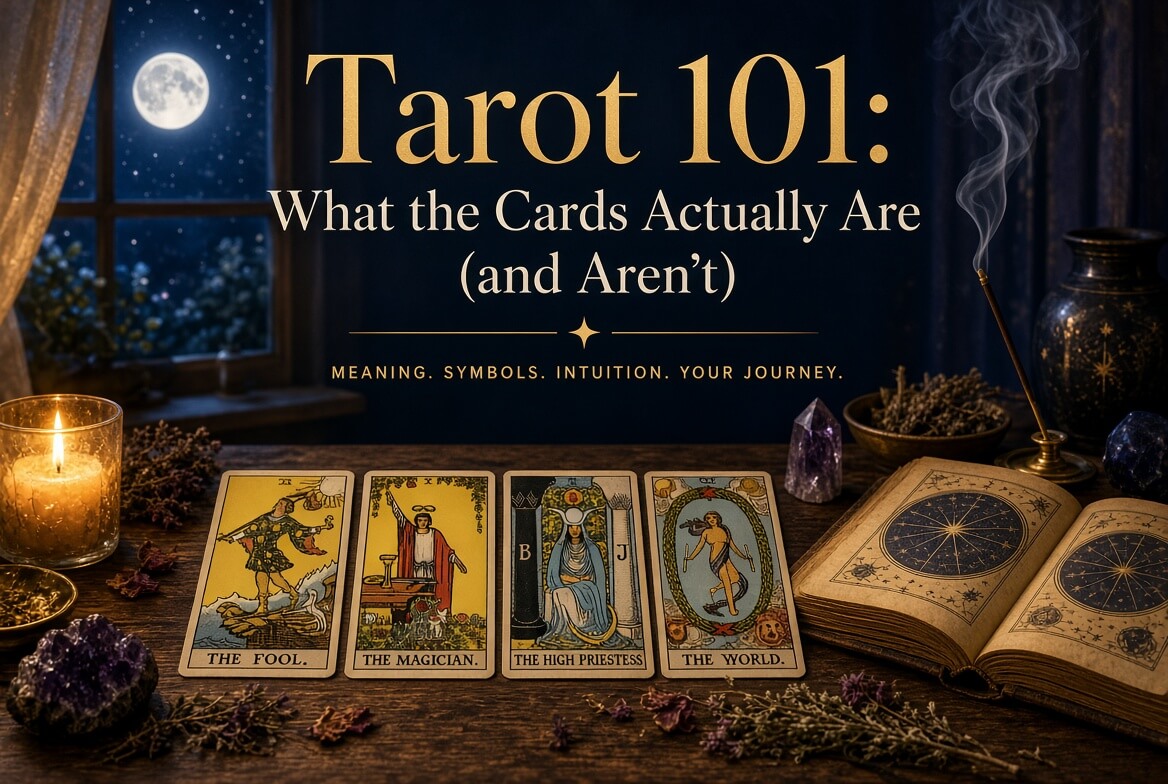
The Major Arcana contains 22 cards, beginning with The Fool and traditionally ending with The World.
These cards tend to represent larger archetypal experiences and significant themes.
The sequence is often described as The Fool’s Journey.
The Fool begins as an innocent traveler standing at the edge of a new adventure. Along the way, he encounters teachers, challenges, temptations, crises, transformations, and eventually integration.
The journey can be interpreted as a metaphor for human development.
For example:
- The Fool can represent beginnings, innocence, possibility, and taking a leap into the unknown.
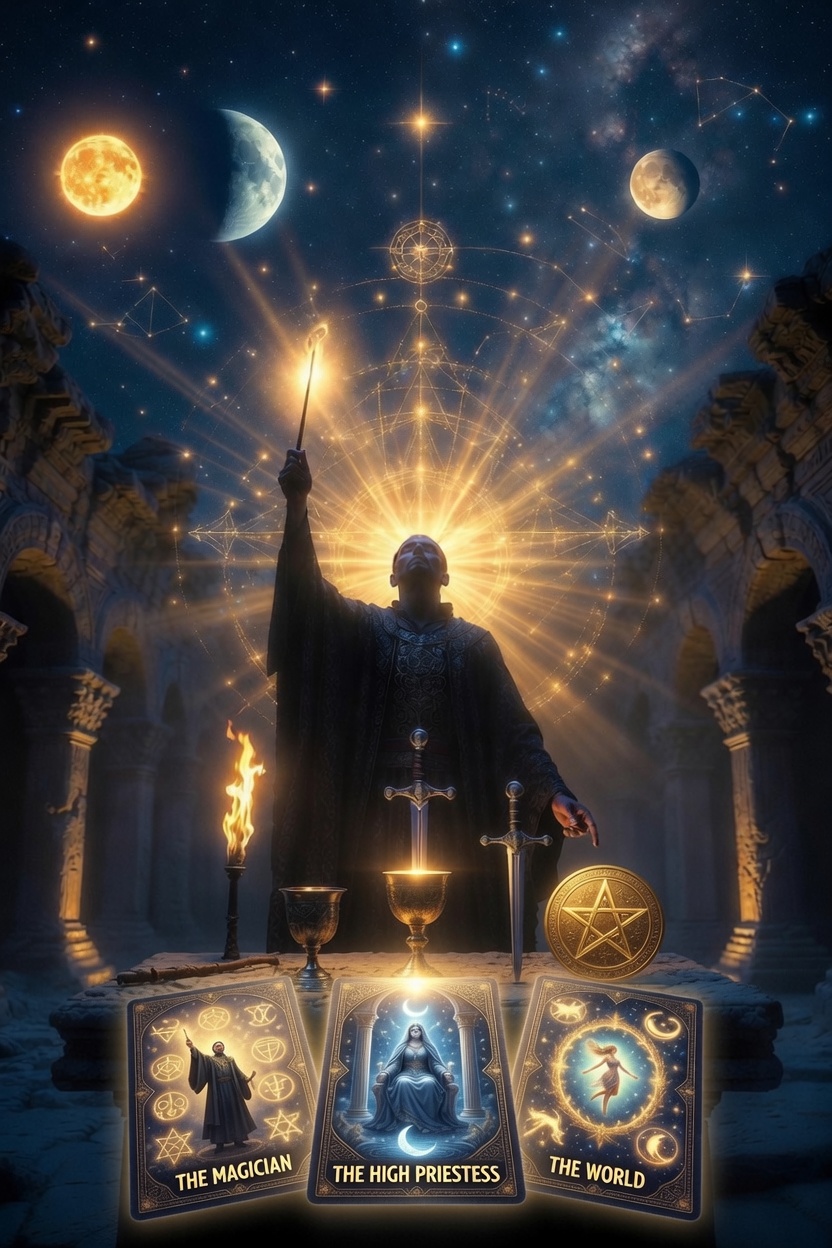
- The Magician represents will, skill, communication, and the ability to turn potential into action.
- The High Priestess points toward intuition, mystery, hidden knowledge, and the unconscious.
- The Empress embodies fertility, creativity, abundance, sensuality, and the generative forces of nature.
- The Emperor represents structure, authority, boundaries, and order.
- The Lovers can concern relationships, but also values, choices, alignment, and meaningful commitment.
- Death represents transformation, endings, release, and the transition from one state into another.
- The Tower can symbolize disruption, revelation, collapse, and the destruction of structures that can no longer stand.
- The Star brings themes of hope, healing, renewal, inspiration, and faith.
- The World represents completion, integration, accomplishment, and the closing of a major cycle.
This is why drawing a Major Arcana card can sometimes feel more significant than drawing a Minor Arcana card.
The Major Arcana tends to speak to the larger story.
The Minor Arcana
The 56 Minor Arcana cards are more closely associated with everyday experiences.
They are divided into four suits:
Wands — passion, creativity, ambition, inspiration, action, and personal drive.
Cups — emotions, relationships, intuition, love, connection, and the inner world.
Swords — thoughts, communication, decisions, conflict, beliefs, and mental patterns.
Pentacles — money, work, health, physical resources, practical matters, and material reality.
Each suit contains cards numbered from Ace through Ten, followed by four Court cards:
- Page
- Knight
- Queen
- King
This gives each suit its own miniature progression.
An Ace can represent the beginning or seed of an energy.
The numbered cards describe that energy developing through different circumstances.
The Court cards can represent people, personality traits, approaches, roles, or stages of development.
Once you understand the basic structure, learning tarot becomes much less intimidating.
You aren’t memorizing 78 completely unrelated meanings.
You’re learning a system.
2. Where Did Tarot Come From?
While forms of divination using cards originated in ancient egypt and Atlantis before that.
The earliest known tarot cards in their modern form appeared in 15th-century Europe, particularly in northern Italy.
Originally, tarot-like decks were associated with card games rather than fortune telling.
These early decks were sometimes elaborately illustrated and commissioned by wealthy families.
The cards eventually developed a second life.
During the 18th and 19th centuries, European occultists began interpreting tarot as a repository of esoteric symbolism.
Writers and occult thinkers connected the cards with systems such as:
- astrology
- Kabbalah
- alchemy
- numerology
- Hermetic philosophy
- elemental symbolism
- ceremonial magic
This transformed tarot from a card game into something much closer to the occult system familiar today.
Later decks, particularly influential modern decks such as the Rider-Waite-Smith tarot, made the symbolic language of tarot much more accessible.
The Rider-Waite-Smith deck was published in 1909 and featured illustrated scenes throughout the Minor Arcana rather than relying primarily on simple suit symbols.
That detail changed how many people learned tarot.
Instead of seeing a card with five cups and having to memorize an abstract definition, a beginner could look at a scene and begin interpreting the story visually.
Modern tarot owes much of its popularity to this evolution.
3. What Tarot Is Not
Before learning how tarot works, it’s useful to separate the cards themselves from some of the mythology surrounding them.
Tarot Isn’t Evil
One of the oldest misconceptions about tarot is that the cards are inherently evil or connected to the Devil.
A tarot deck is a tool.
It consists of printed cards containing images, symbols, numbers, and archetypal scenes.
The moral or spiritual character of a reading depends on the beliefs and intentions of the person using the cards—not on the cardboard itself.
Even traditionally “dark” cards such as The Devil, Death, or The Tower don’t mean that something demonic is automatically happening.
In tarot, symbolism is rarely that literal.
The Devil can describe attachment, temptation, obsession, dependency, or feeling trapped.
Death can describe an ending and transformation.
The Tower can represent sudden upheaval or a revelation that destroys a false assumption.
Understanding this distinction is essential for beginners.
A frightening-looking card isn’t necessarily predicting something frightening.
4. Tarot Doesn’t Guarantee a Fixed Future
Another common misconception is that tarot tells you exactly what will happen.
A more useful way to think about a tarot reading is that it describes patterns, possibilities, influences, and trajectories.
Imagine checking a weather forecast.
If the forecast says rain is likely, you still have choices.
You can stay inside.
You can take an umbrella.
You can change your plans.
The forecast didn’t force the rain—or your response to it.
Tarot can be approached in a similar way.
A reading may highlight a particular pattern developing in your life, but awareness gives you the opportunity to respond differently.
This is especially important when reading about relationships, career decisions, money, or major life changes.
Instead of asking:
“Exactly what is going to happen?”
Try asking:
“What energy is influencing this situation?”
“What am I not seeing clearly?”
“What happens if I continue on my current path?”
“What can I do to improve this situation?”
Those questions tend to produce much more useful readings.
5. Tarot Isn’t Only for Psychics
You don’t need supernatural powers to learn tarot.
You don’t need to come from a family of witches.
You don’t need to own crystals.
You don’t need to be clairvoyant.
And you don’t need to have a mystical experience every time you shuffle the cards.
Learning tarot is much like learning another symbolic language.
At first, you learn the vocabulary.
Then you learn how the words interact.
Eventually, you start understanding the larger story without consciously translating every individual symbol.
This is why experienced readers can sometimes look at a spread and immediately notice a pattern.
They’re not necessarily memorizing definitions.
They’re reading relationships between symbols.
6. How Tarot Actually Works
Tarots works on multiple levels
The Psychological dimension
From a psychological perspective, tarot can function as a projection tool.
The images give your mind something concrete to respond to.
A card showing someone standing alone might make you think about loneliness.
A card showing a crossroads might immediately remind you of a decision you’ve been avoiding.
The card didn’t necessarily implant the thought.
It gave your mind an image through which to explore it.
This makes tarot particularly useful for self-reflection.
The Intuitive dimension
Tarot helps you access intuition.
Your conscious mind processes an enormous amount of information every day.
Sometimes you know something before you can explain why you know it.
A tarot reading can create enough distance from a problem to allow those subtle impressions to become conscious.
The card becomes a prompt.
Your intuition supplies the connection.
The Symbolic Storytelling dimension
Tarot can also be understood as a storytelling system.
Every card contains characters, objects, landscapes, actions, colors, numbers, and relationships.
Together, those elements create a visual narrative.
A reading becomes a story constructed from symbols.
This can be incredibly useful when you’re stuck because stories naturally encourage us to look at situations from multiple perspectives.
The Spiritual dimension
But tarot’s greatest power is that it can serve as a form of divination.
Cards can be used as a way of communicating with spiritual forces, ancestors, guides, deities, or higher consciousness.
Tarot can also be viewed through Hermetic principles of correspondence, seeing symbolic patterns in the cards as reflections of larger patterns operating within consciousness and the universe.
The important thing is to understand which framework you’re personally using.
7. Why Tarot Images Matter So Much
One of the biggest mistakes beginners make is immediately opening a guidebook and memorizing definitions.
Don’t do that first.
Look at the card.
Really look at it.
Ask yourself:
- What is happening in this image?
- Who has power here?
- Who appears vulnerable?
- Where is the character looking?
- What objects stand out?
- What emotions does the scene evoke?
- Is the image moving or still?
- Does the environment feel abundant, threatening, peaceful, chaotic, or empty?
- What does the card remind you of?
These observations aren’t distractions from the “real” tarot meaning.
They are part of reading the card.
For example, imagine drawing The Eight of Cups.
A traditional interpretation might involve leaving something behind, emotional dissatisfaction, searching for deeper meaning, or walking away.
But before reading any definition, look at the image.
A person is walking away.
The cups remain behind.
The scene suggests movement away from something that once mattered.
Even without memorizing a single keyword, you can begin to understand the emotional story.
That’s one of tarot’s greatest strengths.
The images communicate before the textbook does.
8. What Are Tarot Spreads?
A tarot spread is simply a structured arrangement of cards.
Each position in the spread has a particular purpose.
For example, a simple three-card spread might use:
Card 1 — Past
What influence brought me here?
Card 2 — Present
What energy is active now?
Card 3 — Future
Where might this situation be heading?
Or you could use:
Card 1 — Situation
What is happening?
Card 2 — Challenge
What is making this difficult?
Card 3 — Advice
What should I consider?
The same card can mean something different depending on its position.
Imagine drawing The Hermit.
In a “What is blocking me?” position, it might suggest isolation or withdrawing too much.
In a “What do I need?” position, it might suggest solitude, reflection, or stepping away from distractions.
In a “What should I do next?” position, it could encourage you to slow down and seek your own answers.
The spread gives the card a question to answer.
9. Do Reversed Tarot Cards Have a Different Meaning?
Eventually, you’ll encounter the question of reversals.
A reversed card is simply a card that appears upside down when drawn.
Some readers use reversed meanings.
Others don’t.
There is no universal rule saying you must read reversals.
A reversed card can sometimes suggest:
- blocked energy
- internalized energy
- delay
- excess
- deficiency
- resistance
- an issue that is not yet fully expressed
For example, The Chariot upright might emphasize determination, direction, discipline, and forward movement.
Reversed, it might suggest scattered energy, lack of direction, or trying to force movement without control.
But beginners shouldn’t feel pressured to use reversals.
You can become an excellent reader without ever turning a card upside down.
10. What You Can Realistically Expect From a Tarot Reading
So what does a tarot reading actually give you?
Ideally, it gives you a different way of looking at something you already care about.
A good reading can provide:
Clarity
Sometimes the problem isn’t that you don’t know what to do.
It’s that you’re emotionally too close to the situation to see it clearly.
A reading can create distance.
Perspective
Tarot can reveal an alternative interpretation of a situation.
Something that looked like rejection might actually be an invitation to redirect your energy.
Something that looked like failure might reveal itself as the end of an unhealthy cycle.
Emotional Awareness
Cards can help you identify feelings you’ve been avoiding.
You might pull the Five of Cups and realize you’ve been focusing so intensely on what went wrong that you haven’t noticed what remains.
Decision-Making Support
Tarot shouldn’t make important decisions for you.
But it can help you explore them.
Instead of asking:
“Should I quit my job?”
You might ask:
“What am I not considering about leaving?”
Then:
“What might I experience if I stay?”
And:
“What should I prioritize before making this decision?”
Those questions turn tarot into a structured reflection tool.
Self-Awareness
Repeated readings can reveal recurring patterns.
Perhaps the same suit keeps appearing.
Maybe you repeatedly draw Swords whenever you’re asking about relationships.
Maybe The Devil appears whenever you’re questioning a particular attachment.
Patterns like these can become invitations to investigate your behavior.
11. What Tarot Can’t Reliably Tell You
A responsible tarot practice also requires knowing its limits.
Tarot shouldn’t replace qualified professional advice.
Don’t use a tarot card to diagnose a medical condition.
Don’t use it instead of seeing a doctor.
Don’t use it as a replacement for a lawyer when facing a legal problem.
Don’t use it as a substitute for professional mental-health care.
And be particularly cautious about questions involving other people’s private thoughts.
Instead of:
“Exactly what is my ex thinking right now?”
Try:
“What do I need to understand about my relationship with my ex?”
The second question puts the focus back where you have genuine agency: your own life.
Tarot is most useful when it helps you make better choices—not when it encourages you to surrender responsibility for those choices.
12. How to Start Reading Tarot for Yourself
You don’t need to memorize all 78 cards before you begin.
In fact, waiting until you’ve memorized everything is one of the easiest ways to never start.
Begin with one card.
The One-Card Tarot Reading
Shuffle your deck while focusing on a simple question.
For example:
“What energy should I be aware of today?”
Draw one card.
Don’t immediately reach for the guidebook.
Look at the image.
Spend a minute or two observing it.
Then write down:
- The name of the card.
- What you notice first.
- What emotion the image creates.
- What you think the card might be saying.
- The traditional meaning.
- How the meaning relates to your question.
At the end of the day, return to your journal.
Ask:
“Where did I see this card’s energy today?”
This is one of the fastest ways to develop your relationship with tarot.
You’re not simply memorizing definitions.
You’re learning how the symbolism manifests in real life.
13. Keep a Tarot Journal
If you genuinely want to learn tarot, start keeping records of your readings.
Write down:
Date:
Question:
Card or spread:
Initial interpretation:
Traditional meaning:
What happened afterward:
What I learned:
Over time, you’ll build your own personal tarot dictionary.
You’ll also begin discovering something fascinating.
Certain cards may mean something slightly different to you than they do to someone else.
Perhaps the Queen of Pentacles always reminds you of stability.
Maybe The Moon repeatedly appears when you’re ignoring your intuition.
Maybe The Tower has eventually come to represent liberation rather than disaster.
Those personal associations can become an important part of your reading practice.
14. The Difference Between Tarot Knowledge and Tarot Reading
Knowing the definition of every card doesn’t automatically make someone a good tarot reader.
You can memorize:
The Tower = sudden change.
But that’s only the beginning.
What happens when The Tower appears next to The Star?
What if it appears in a position asking about someone’s greatest obstacle?
What if it appears reversed?
What if the surrounding cards are almost entirely Pentacles?
What if the person asking the question has just left a long-term relationship?
Suddenly, the card isn’t a definition anymore.
It’s part of a sentence.
This is where tarot becomes genuinely interesting.
The goal isn’t simply:
“What does this card mean?”
The better question is:
“What is this card saying here?”
15. Tarot as a Mirror
Perhaps the simplest way to understand tarot is to think of it as a mirror.
A physical mirror reflects your appearance.
Tarot can reflect your attention.
It can show you what you’re focusing on, what you’re avoiding, what you’re afraid of, what you desire, and what patterns may be influencing your decisions.
Sometimes the card tells you something you already knew but didn’t want to admit.
Sometimes it introduces a perspective you hadn’t considered.
And occasionally, the most valuable thing a reading does is force you to ask a better question.
That’s an underrated function of tarot.
You may begin with:
“Will they come back?”
And finish with:
“Why am I waiting for someone else to determine my worth?”
That is a very different kind of answer.
16. The Deeper Structure Behind Tarot
Once you’ve learned the basics, you’ll discover that tarot contains several overlapping symbolic systems.
Numbers matter.
Elements matter.
Suits matter.
Astrological associations matter.
The progression of the Major Arcana matters.
Even the relationships between cards can matter.
For example, the four suits can be understood through the classical elements:
- Wands — Fire
- Cups — Water
- Swords — Air
- Pentacles — Earth
This creates another layer of interpretation.
A reading dominated by Cups may emphasize emotional or relational concerns.
A spread filled with Swords may point toward thought, communication, decisions, or mental conflict.
A spread dominated by Pentacles may bring attention to money, work, health, or practical circumstances.
A large number of Wands can emphasize motivation, creativity, desire, ambition, or action.
The more you learn, the more connections become visible.
And that is why tarot can remain fascinating even after years of study.
There is always another layer.
17. Is Tarot Fortune Telling or Self-Reflection?
It can be approached as either.
Some practitioners genuinely use tarot for divination and believe the cards can reveal information about future possibilities.
Others use tarot entirely as a psychological or reflective tool.
Neither approach needs to prevent you from learning the system.
What matters most is maintaining a healthy relationship with the practice.
If tarot encourages you to reflect, become more aware, and make thoughtful choices, it can be incredibly valuable.
If you’re repeatedly pulling cards because you’re terrified of making a decision without them, however, it may be time to put the deck down and make the decision yourself.
The cards should support your agency.
They shouldn’t replace it.
18. The Most Important Tarot Lesson for Beginners
If you remember only one thing from this guide, remember this:
You are not supposed to surrender your power to the cards.
Tarot doesn’t become more powerful because you become more frightened of it.
A frightening card doesn’t automatically mean something terrible is going to happen.
A beautiful card doesn’t guarantee that everything will work out perfectly.
And no tarot reader—not even an experienced one—should convince you that you are powerless over your own life.
The most useful tarot reading is one that leaves you feeling more aware, not more helpless.
The cards can give you a perspective.
They can challenge your assumptions.
They can reveal patterns.
They can help you ask better questions.
But ultimately, you decide what you do with the information.
Conclusion: Tarot Is a Tool, Not a Master
Tarot is simultaneously much simpler and much deeper than its reputation suggests.
At the most basic level, it’s a deck of 78 illustrated cards.
But those cards form a sophisticated symbolic system that has been interpreted through centuries of art, philosophy, occultism, psychology, spirituality, and personal practice.
You don’t have to believe that tarot predicts the future to appreciate it.
You don’t have to be psychic.
You don’t need an elaborate altar.
You don’t need an expensive deck.
And you certainly don’t need to be afraid of the cards.
All you really need is curiosity.
Start with one card.
Look at the image.
Ask a meaningful question.
Write down what you see.
Then watch how the symbolism interacts with your actual life.
Over time, you’ll discover that learning tarot isn’t simply about memorizing what The Fool, The Lovers, The Tower, or The Empress supposedly mean.
It’s about learning how to recognize patterns.
How to sit with uncertainty.
How to examine your own assumptions.
How to notice what you’re avoiding.
And sometimes, how to see something you’ve been looking at all along from an entirely different angle.
The cards don’t have to dictate your future to be useful.
Sometimes, they simply need to help you see the present more clearly.
And that’s where the real journey begins.