If you’ve ever opened a tarot deck and thought, “How am I supposed to learn all 78 of these cards?”, you’re not alone.
At first glance, tarot can seem overwhelming. There are mysterious figures, strange symbols, numbers, suits, court cards, and cards with names like Death and The Tower that can make the whole system feel more complicated than it actually is.
But there’s a simple secret that makes learning tarot much easier:
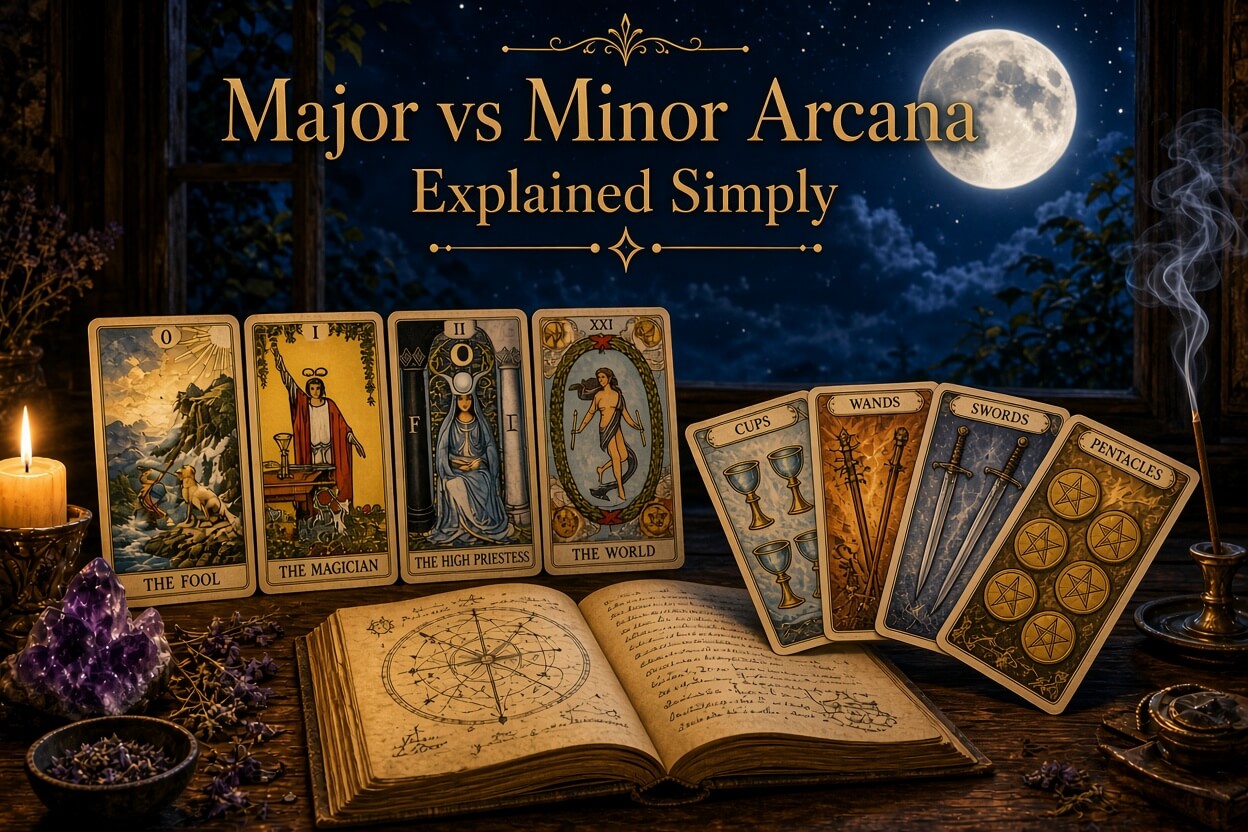
A standard tarot deck is divided into two main sections: the Major Arcana and the Minor Arcana.
Once you understand what each section represents, the entire deck starts to make much more sense.
Think of the Major Arcana as the big chapters of your life story, while the Minor Arcana describes the everyday scenes, conversations, emotions, challenges, and decisions that happen within those chapters.
In this guide, we’ll break down the difference between Major and Minor Arcana, explain how they work together in a tarot reading, and show you how to start interpreting them without trying to memorize all 78 tarot cards at once.
The Tarot Deck at a Glance
A traditional tarot deck contains 78 cards.
Those 78 cards are divided into two groups:
- 22 Major Arcana cards
- 56 Minor Arcana cards
The word Arcana comes from a Latin term associated with secrets or mysteries. In tarot, the two groups serve different but complementary purposes.
The Major Arcana deals with larger themes: transformation, identity, purpose, major choices, spiritual lessons, beginnings, endings, and significant turning points.
The Minor Arcana is much closer to ordinary life. It deals with emotions, relationships, work, money, communication, ambition, conflict, creativity, and the countless smaller events that make up our days.
A useful way to picture the difference is to imagine a movie.
The Major Arcana contains the major scenes that change the direction of the story.
The Minor Arcana contains the conversations, arguments, decisions, routines, relationships, and small events that show us how that story actually unfolds.
You need both to understand the whole picture.
The Major Arcana: The Big Life Lessons
The Major Arcana consists of 22 cards, traditionally numbered from 0 to 21.
It begins with The Fool, numbered 0, and ends with The World, numbered 21.
These cards include some of the most recognizable images in tarot:
The Magician, The High Priestess, The Empress, The Lovers, The Chariot, Strength, The Hermit, Wheel of Fortune, Death, The Devil, The Tower, The Star, The Moon, The Sun, and others.
When you’re first learning tarot, the Major Arcana is often the best place to begin because each card tends to represent a large, memorable archetype.
What Does the Major Arcana Represent?
The Major Arcana often points toward experiences that feel particularly important.
A Major Arcana card may appear when you’re dealing with:
- A major life transition
- A profound personal decision
- A change in identity
- Spiritual or psychological growth
- The beginning or ending of an important chapter
- A major relationship development
- A crisis that forces transformation
- Questions about purpose and direction
This doesn’t mean Major Arcana cards are automatically more “powerful” than Minor Arcana cards.
Rather, they tend to operate on a larger symbolic level.
For example, the Three of Swords might describe heartbreak, grief, or painful words within a particular situation.
Death, by contrast, can point toward the ending of an entire phase and the transformation that follows.
The distinction is less about one card being “better” than another and more about the scale of the theme being described.
The Fool’s Journey
One of the most useful ways to understand the Major Arcana is through the idea of The Fool’s Journey.
The Fool begins the journey at card 0, stepping into the unknown.
Along the way, The Fool encounters different archetypes and experiences that represent lessons of life.
The Fool encounters teachers, authority figures, relationships, challenges, temptation, destruction, hope, illumination, and eventually completion.
The journey ends with The World, symbolizing wholeness, completion, and the integration of what has been learned.
You don’t have to believe that tarot literally predicts a predetermined destiny to find this framework useful.
The Fool’s Journey can simply be understood as a symbolic map of human development.
Some Major Arcana Cards Explained Simply
The Fool — New Beginnings
The Fool represents stepping into something new.
It can suggest:
- Fresh starts
- Adventure
- Trust
- Taking a leap of faith
- Openness to possibility
The Fool doesn’t necessarily know exactly where the journey will lead.
That’s part of the point.
The Lovers — Choice and Alignment
Although often associated with romance, The Lovers is much broader than simply “love.”
It can represent:
- Relationships
- Important choices
- Union
- Values
- Alignment between desire and principle
In a reading, The Lovers may ask: What choice is truly aligned with who you are?
Death — Transformation
Death is one of the most misunderstood tarot cards.
In most tarot traditions, it does not literally predict physical death.
Instead, it represents endings, transformation, release, and the beginning of something new.
Something may need to end because it has completed its purpose.
The Tower — Sudden Change
The Tower represents disruption.
It can point toward:
- Unexpected revelations
- Sudden change
- The collapse of unstable structures
- Shattering illusions
- A breakthrough that changes your perspective
The Tower can be uncomfortable, but it can also clear away something that was never stable to begin with.
The World — Completion
The World is the final Major Arcana card.
It represents completion, integration, achievement, and the closing of a major cycle.
Where The Fool begins the journey, The World represents arriving at the other side of it.
The Minor Arcana: Everyday Life
If the Major Arcana represents the big chapters, the Minor Arcana describes what happens inside those chapters.
There are 56 Minor Arcana cards, divided into four suits:
- Wands
- Cups
- Swords
- Pentacles
If you’ve ever played a traditional card game, the structure may feel familiar.
Each suit contains:
- Ace through 10
- Page
- Knight
- Queen
- King
That gives us 14 cards per suit, multiplied across four suits for a total of 56.
The Four Minor Arcana Suits
The easiest way to begin learning the Minor Arcana is to understand the basic personality of each suit.
Wands — Fire
Wands are associated with fire.
They often relate to:
- Passion
- Creativity
- Ambition
- Energy
- Action
- Inspiration
- Personal drive
When Wands dominate a tarot reading, there may be a lot happening.
You may be starting something, pursuing a goal, taking action, competing, creating, or trying to turn an idea into reality.
Cups — Water
Cups are associated with water.
They deal primarily with:
- Emotions
- Relationships
- Love
- Intuition
- Connection
- Feelings
- Inner experience
If you’re asking about relationships or emotional circumstances, Cups may become especially important.
The Ace of Cups, for example, can suggest emotional renewal or the opening of the heart, while the Five of Cups can point toward disappointment, grief, or focusing on what has been lost.
Swords — Air
Swords are associated with air.
Their territory includes:
- Thoughts
- Communication
- Ideas
- Conflict
- Decisions
- Truth
- Mental patterns
Swords can sometimes feel intense because the mind itself can be a difficult battlefield.
A Sword card isn’t necessarily negative, however.
It may simply be asking you to confront reality, communicate clearly, examine your assumptions, or make a difficult decision.
Pentacles — Earth
Pentacles are associated with earth.
They tend to concern the material and practical side of life:
- Money
- Work
- Career
- Resources
- Health
- Home
- Stability
- Physical reality
If you’re asking a question about finances, career, or building something tangible, Pentacles can provide particularly useful context.
Understanding the Numbers
You don’t have to memorize every Minor Arcana card individually.
One of the easiest ways to learn them is to notice the number of the card.
The numbered cards show an unfolding progression within each suit.
For example, the Ace represents the beginning or seed of an energy.
The numbered cards then show that energy developing through different stages and circumstances.
The Ten often represents culmination, completion, or the point where the energy of the suit has reached a significant conclusion.
This means that once you understand what Cups represent and have a basic understanding of what the numbers represent, you can begin making educated interpretations even if you haven’t memorized every single tarot meaning.
What About the Court Cards?
Each suit also contains four Court Cards:
- Page
- Knight
- Queen
- King
These cards can represent actual people, but they don’t have to.
They can also represent:
- Personality traits
- Ways of approaching a situation
- Different stages of development
- Behaviors
- Roles you or someone else may be playing
For example, a Queen might represent mature, receptive mastery of a particular suit’s energy, while a Knight can represent movement, pursuit, or action.
The exact interpretation depends on the card, the question, and the surrounding tarot cards.
Major vs Minor Arcana: What’s the Difference?
Here’s the simplest comparison:
| Aspect | Major Arcana | Minor Arcana |
|---|---|---|
| Number of cards | 22 | 56 |
| Main focus | Big life themes | Everyday experiences |
| Structure | 0–21 | 4 suits, Ace–10 + Court Cards |
| Typical themes | Transformation, purpose, major choices | Emotions, work, relationships, decisions, practical matters |
| Role in a reading | Highlights larger themes | Adds details and circumstances |
| Example | The Tower | Five of Cups |
A useful shortcut is:
Major Arcana = What is the bigger story?
Minor Arcana = How is that story playing out?
How Major and Minor Arcana Work Together
This is where tarot becomes especially interesting.
The two groups aren’t competing with each other.
They work together.
A Major Arcana card can establish the larger theme, while the Minor Arcana cards show how that theme manifests in everyday life.
Imagine pulling:
The Empress + Three of Cups + Six of Pentacles
The Empress could establish a larger theme of creativity, abundance, nurturing, beauty, or growth.
The Three of Cups might bring friendship, celebration, or community into the picture.
The Six of Pentacles could introduce generosity, support, resources, or an exchange between people.
Together, these cards create a much richer story than any one card could provide by itself.
The Major Arcana gives you the headline.
The Minor Arcana gives you the details underneath it.
What If Your Reading Has Mostly Major Arcana?
Pay attention.
A reading containing several Major Arcana cards may suggest that the question touches on something deeper or more significant than a temporary everyday problem.
For example, imagine asking:
“Why does this period of my life feel so different?”
And you pull:
The Hermit, Death, The Star, and The World.
That’s a very different atmosphere from pulling four Minor Arcana cards about routine tasks or temporary frustrations.
The Major Arcana combination suggests themes of withdrawal, transformation, healing, and completion.
It feels like you’re moving through a larger chapter of development.
That doesn’t necessarily mean something is “fated.”
It means the symbolic language of the cards is emphasizing a larger pattern.
What If Your Reading Is Mostly Minor Arcana?
Don’t assume a Minor Arcana-heavy reading is less important.
It may simply indicate that the situation is more practical, immediate, or changeable.
For example, a reading containing several Pentacles might suggest that the answer is connected to work, money, resources, or practical planning.
A reading dominated by Cups may place greater emphasis on relationships and emotions.
A reading filled with Swords might point toward communication, decisions, beliefs, or mental conflict.
And a reading dominated by Wands may emphasize action, creativity, ambition, or momentum.
The Minor Arcana can actually be extremely helpful because it tells you what you can work with right now.
A Simple Way to Read Major and Minor Arcana Together
If you’re a beginner, try asking three questions whenever you pull cards.
1. Is there a Major Arcana card?
If there is, ask:
What bigger theme might this card be highlighting?
2. What suit appears?
Look at the Minor Arcana suits.
Is the reading emphasizing:
- Wands: action and ambition?
- Cups: emotions and relationships?
- Swords: thoughts and communication?
- Pentacles: work and material concerns?
3. How do the cards interact?
Don’t read every card as an isolated definition.
Instead, look for a conversation between them.
A Major Arcana card might tell you what the deeper lesson is, while the Minor Arcana tells you how that lesson is appearing in your current circumstances.
Don’t Try to Memorize All 78 Tarot Cards
One of the biggest mistakes beginners make is thinking they need to memorize a dictionary of 78 meanings before they can perform a tarot reading.
You don’t.
Start with the 22 Major Arcana cards.
Learn their basic themes and become familiar with their imagery.
Then learn the four suits of the Minor Arcana.
Once you understand the basic language of:
Major Arcana + Suit + Number + Context
you already have a surprisingly powerful foundation for interpreting tarot cards.
And remember: tarot meanings aren’t completely isolated from one another.
The same card can communicate something different depending on the question and the cards surrounding it.
The Five of Cups in a reading about a breakup will naturally feel different from the Five of Cups appearing in a reading about career disappointment.
Context matters.
A Simple Practice Exercise
Here’s an easy exercise you can try if you’re learning tarot.
Shuffle your deck and pull two cards.
Try to make sure one is a Major Arcana card and one is a Minor Arcana card.
Then ask:
“What is the bigger theme, and how is it showing up in my everyday life?”
For example:
The Chariot + Eight of Pentacles
The Chariot could represent determination, direction, discipline, and forward movement.
The Eight of Pentacles could represent practice, craftsmanship, work, and developing a skill.
Together, the cards might suggest that the larger theme is moving deliberately toward a goal, while the practical expression of that energy is consistent work and skill development.
You’re no longer memorizing two separate definitions.
You’re learning to make the cards speak to each other.
That’s the beginning of actual tarot reading.
Final Thoughts: Major vs Minor Arcana Made Simple
The distinction between the Major and Minor Arcana doesn’t have to be complicated.
There are 22 Major Arcana cards representing larger archetypal themes, major transitions, important choices, and profound lessons.
There are 56 Minor Arcana cards divided into Wands, Cups, Swords, and Pentacles, showing the emotions, actions, thoughts, relationships, work, and practical circumstances of everyday life.
The simplest way to remember the difference is:
The Major Arcana shows the bigger story. The Minor Arcana shows how that story unfolds in everyday life.
Once you understand that, those intimidating 78-card tarot decks suddenly become much easier to approach.
You don’t have to know everything at once.
Start with the Major Arcana. Learn the four suits. Pay attention to numbers and imagery. Then practice combining the cards instead of treating each tarot card as an isolated definition.
The more you practice, the more naturally the structure of the deck begins to reveal itself.
And that’s when tarot starts becoming less about memorizing meanings—and more about learning to read the story the cards are telling.
.